Quick answer
How do you pass the California DMV permit test first try?
Study the official California Driver Handbook, practice road signs and right-of-way rules, take several timed practice tests, review every missed answer, and confirm your DMV documents before test day.
- Use the handbook for final California rules and wording.
- Practice signs, speed rules, lane use, turns, parking, and alcohol/drug laws.
- Aim to score above 80% in practice before booking or retesting.
Quick disclaimer: US Permit Prep is not affiliated with the California Department of Motor Vehicles or any government agency. California rules, fees, appointment options, and testing steps can change, so use this as a study guide and verify final details on the official California DMV website before you apply or test.
If you want to pass the California DMV permit test on your first try, the main job is not cramming random questions the night before. The job is learning how California asks about safe driving. Who yields? When is the posted speed limit still too fast? What is a sign telling you to do, not just what is it called? Those are the questions that separate a lucky practice score from real test readiness.
This guide is written for three common situations: a teen getting a first provisional instruction permit, a parent trying to keep the DMV visit organized, and an adult learner who wants a simple plan. You will get the California basics, a practical 7-day study plan, a short quiz, extra practice questions, and a test-day checklist.
California permit test basics at a glance
| Topic | What California learners should know |
|---|---|
| Minimum age under 18 | The California DMV says under-18 applicants for an instruction permit must be at least 15 1/2 but under 18. |
| Driver education | Under-18 applicants need proof that they completed or are enrolled in driver education, according to the DMV learner permit requirements. |
| Passing score | The official DMV learner permit page states that the knowledge test passing score is 80%. |
| Test source | California DMV says knowledge test questions are based on the California Driver’s Handbook. |
| Application fee | The DMV licensing fees page lists the Class C original application fee as $46 at the time this guide was checked. |
| Where to verify | Use the official DMV learner permit, testing preparation, handbook, and fee pages linked in this article. |
The 80% passing score is the number to remember, but do not aim for the edge. A practice score right at 80% can fall apart on test day because of nerves, rushed reading, or one topic you have not reviewed well. Try to score comfortably above 80% on more than one practice round before you treat yourself as ready.
What to verify for 2026 before you test
Some California DMV details stay steady for long stretches, but you should still check the official pages before your appointment. Fees can change. Office procedures can change. Appointment options can change. If you are under 18, the parent or guardian and driver education pieces matter just as much as the knowledge test itself.
You may see websites mention a California first-attempt pass rate. We are not using a specific percentage here unless it can be traced to a current official DMV source. The safer, more useful goal is simple: know the handbook topics well enough that an 80% passing score is not a close call.
What the California DMV is really testing
The knowledge test is not designed to reward trivia. It checks whether you can choose the safest legal action from a short driving situation. That is why a learner can memorize a sign name and still miss the question when the same sign appears in a rain, curve, work-zone, or pedestrian scenario.
Most California permit study should fit into five buckets:
- Signs and signals: warning signs, regulatory signs, school signs, work zones, lane-use signs, railroad signs, and signal meanings.
- Right-of-way: four-way stops, left turns, pedestrians, emergency vehicles, roundabouts, and merging.
- Speed and space: following distance, stopping distance, speed for conditions, and sharing the road with trucks, motorcycles, bicycles, and pedestrians.
- California safety rules: seat belts, cell phones, alcohol and drugs, collision responsibilities, and provisional license restrictions.
- Judgment: choosing the answer that gives you more time, space, and control.
That last bucket matters more than learners expect. If two answers sound possible, the DMV usually wants the one that is more defensive and more consistent with the handbook, not the one that sounds like what drivers sometimes do in traffic.
Try a California practice quiz before you keep reading
Take a short practice round now. Do not worry about being perfect. The useful part is seeing which topics slow you down.
Practice test
Build your practice test
Select a state, test type, and question count. Questions are loaded from the bundled starter banks.
After the quiz, write down every missed topic. A short list like “right-of-way, signs, following distance” is more helpful than staring at a score alone.
A 7-day California permit test plan
You can stretch this over two weeks if school, work, or driver education is busy. The order matters more than the exact calendar. Read first, practice second, then fix weak topics.
Day 1: Check the DMV requirements before studying questions
Start with the official California DMV learner permit requirements. Confirm whether you are applying as a teen or an adult. Teens should pay attention to driver education, parent or guardian signature, identity and residency documents, vision screening, photo, and payment.
Parents can help by making a small document folder before the visit. A learner can know the rules and still lose a day if a required document is missing.
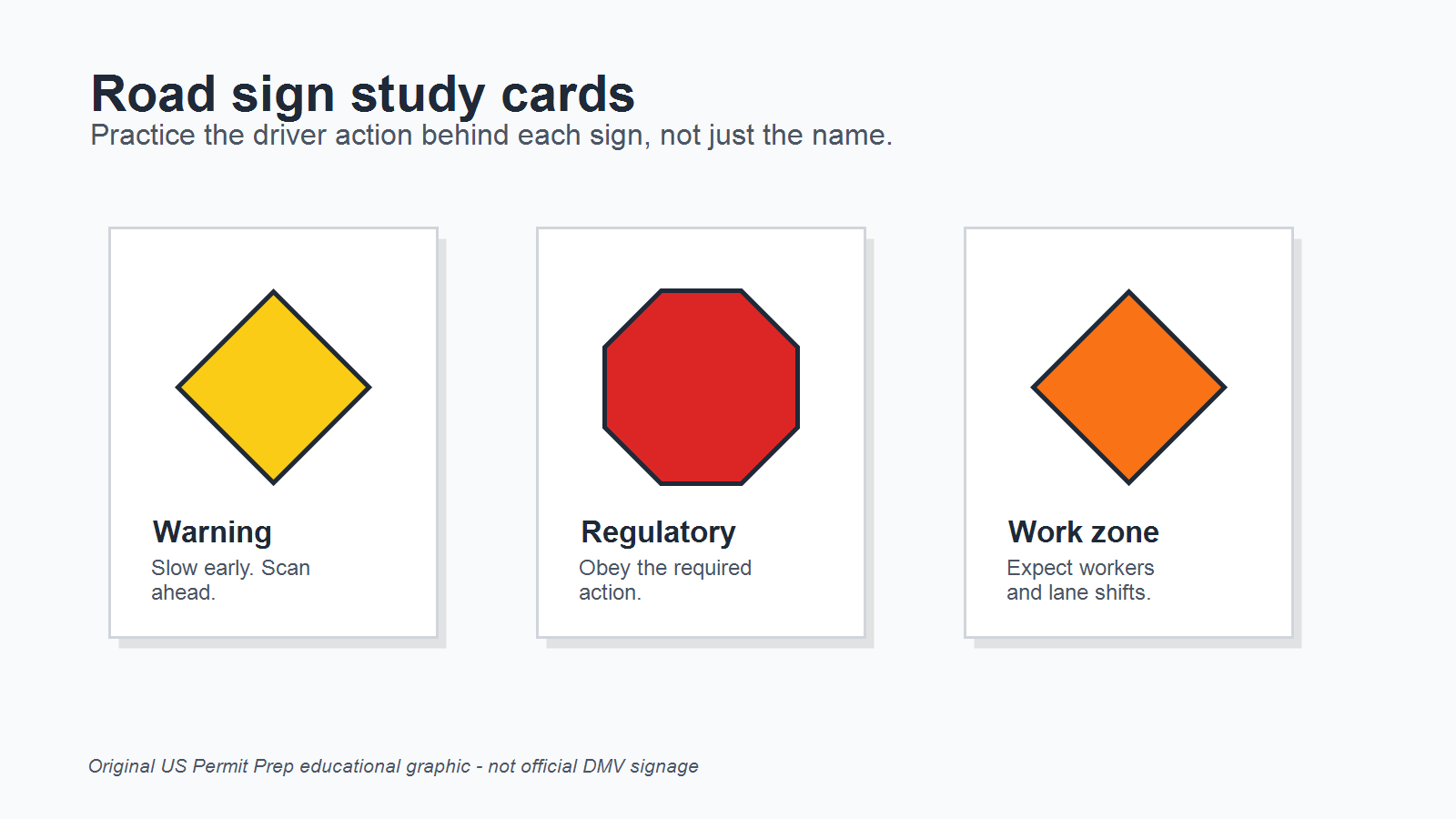
Day 2: Study road signs as driver actions
Do not stop at “this is a warning sign.” Ask what the sign tells a safe driver to do. Red usually means stop, yield, or prohibition. Yellow warns you to prepare. Orange points to work zones. White rectangular signs regulate. Green signs guide.
Use the Road Signs Test and Road Signs Meaning Guide. When you miss a sign, write one sentence that starts with: “When I see this sign, I should…” That turns memorization into judgment.
Day 3: Give right-of-way its own study session
Intersections are where many learners get tripped up. Look for the whole scene: stop signs, pedestrians, left turns, emergency vehicles, and who arrived first. If two vehicles arrive at the same time, the driver on the right often matters. If a pedestrian is involved, slow down and protect the person outside the vehicle.
After this section, take the California DMV Practice Test. Circle any right-of-way misses. They deserve a separate review pass.
Day 4: Practice speed, space, and bad-weather choices
California test questions often reward the safest answer, not the fastest legal answer. A posted speed limit is not a promise that the speed is safe. Rain, fog, traffic, bicyclists, construction, school zones, and poor visibility can all require slower driving.
Try making your own mini-scenarios. What changes if the road is wet? What changes if a truck is behind you? What changes if a pedestrian is near the crosswalk but has not stepped off the curb? That style of practice makes DMV wording less intimidating.
Day 5: Take a longer practice round and review explanations
If you score below 80%, treat it as useful information, not failure. Sort misses into signs, right-of-way, speed and space, parking, alcohol or drugs, provisional rules, and documents. The topic pattern matters more than the raw number.
Do not retake the same quiz over and over hoping the score improves. Stop and fix the topic that keeps costing points.
Day 6: Practice test-day reading
Slow down on words like always, never, first, unless, safe, and must. If two answers seem close, choose the one that gives the driver more time and space and protects pedestrians, passengers, and other road users.
The DMV says the test is handbook-based. That means casual street habits are not a study strategy.
Day 7: Confirm paperwork and do a light review
The day before testing is not the time for panic-studying. Confirm documents, application status, payment method, appointment details, and parent or guardian signature if you are under 18. Take one light road signs review, then stop while your brain still feels fresh.
Use the DMV Document Checklist, then verify the latest California details on the official DMV site. Check the DMV licensing fees page before your visit.
California DMV handbook vs practice sites
The California Driver Handbook is the source of truth. Practice sites are helpful when they make the handbook easier to remember, not when they replace it.
- Use the handbook for rules: official wording, legal requirements, signs, right-of-way, alcohol rules, and provisional limits.
- Use practice tests for diagnosis: finding weak topics and getting used to question wording.
- Use score tracking for readiness: look for repeated scores above 80%, not one lucky pass.
A good routine is handbook first, quiz second, explanation third. If you skip the explanations, you may never notice that you guessed correctly for the wrong reason.
Common reasons California learners fail the permit test
Most learners do not fail because the rules are impossible. They fail because their study method leaves holes. Watch for these patterns:
- Memorizing answer letters. That breaks as soon as the wording changes.
- Skipping explanations after correct guesses. A correct click does not always mean you knew the rule.
- Studying sign names without driver actions. The test cares about what you should do next.
- Answering from adult driving habits. The test rewards legal, defensive driving, not shortcuts you may see in traffic.
- Leaving documents until the last minute. A bad DMV visit can happen before the test even starts.
- Rushing through long questions. Many misses come from overlooking one condition in the question.
California-style sample questions with explanations
These are original practice examples, not official DMV questions. Use them to train the kind of reasoning the California knowledge test expects.
Question 1: Wet road speed
You are driving at the posted speed limit, but rain starts and traffic becomes heavy. What should you do?
- A. Keep the posted speed because it is legal.
- B. Slow down and increase following distance.
- C. Drive closer to the car ahead so others cannot merge.
Best answer: B. Speed must be safe for conditions. Rain and traffic reduce stopping space, so slowing down and leaving more room is the safer choice.
Question 2: Yellow warning sign
A yellow diamond sign shows a curve ahead. What should you do first?
- A. Prepare to adjust speed before the curve.
- B. Speed up before entering the curve.
- C. Stop immediately in your lane.
Best answer: A. A warning sign gives you time to prepare. Check traffic, control speed early, and stay in your lane.
Question 3: Pedestrian at a crosswalk
You are approaching a marked crosswalk and a pedestrian is preparing to cross. What is the safest response?
- A. Speed up if you think you can pass first.
- B. Slow down and be prepared to stop.
- C. Honk so the pedestrian waits.
Best answer: B. Permit test questions often focus on protecting pedestrians and avoiding sudden choices near crosswalks.
Question 4: Emergency vehicle
An emergency vehicle approaches with lights and siren. What should you do?
Best answer: Yield safely and make room as soon as practical. Do not panic or make a sudden move that creates a new hazard.
Question 5: Work-zone signs
You see orange signs and cones ahead. What should change?
Best answer: Slow down, watch for workers and equipment, and follow temporary lane directions.
Question 6: Four-way stop
You and another driver arrive at a four-way stop at the same time, and that driver is on your right. What should you expect?
Best answer: Yield to the driver on your right unless signs, signals, or an officer direct traffic differently.
Question 7: Fog
Fog makes it hard to see far ahead. What is the safest adjustment?
Best answer: Reduce speed and increase following distance. Your speed should match visibility, not just the posted limit.
Question 8: Phone distraction
Your phone rings while you are driving. What should matter most?
Best answer: Keep attention on driving. California safety questions reward distraction-free decisions.
Question 9: Lane ending
A lane is ending and traffic is merging. What is the safest approach?
Best answer: Adjust speed and space early. Blocking, racing, or crowding another driver increases risk.
Question 10: School bus
A school bus ahead has flashing red lights. What should you expect?
Best answer: Stop as required and watch carefully for children. The safest answer protects people outside vehicles.
Test-day checklist for California learners
- Confirm your DMV appointment or testing option.
- Complete the California Driver’s License or ID Card Application if required.
- Bring proof of identity and California residency.
- If under 18, bring driver education proof and make sure the parent or guardian signature requirement is handled.
- Be ready for a vision exam and photo.
- Bring payment for the application fee and verify the latest fee on the official DMV site.
- Arrive with enough time. The DMV notes that office knowledge tests are not available after 4:30 p.m.
FAQ: California DMV permit test first try
How old do you have to be to get a California instruction permit?
The California DMV says applicants under 18 must be at least 15 1/2 but under 18 to apply for an instruction permit. Adults can apply at 18 or older. Always confirm on the official DMV learner permit page before applying.
What score do you need to pass the California permit test?
The California DMV learner permit page states that the knowledge test passing score is 80%. Aim above that in practice so one or two tricky questions do not put you on the edge.
Are California DMV permit test questions from the handbook?
Yes. The DMV test preparation page says knowledge test questions are taken from the California Driver Handbook. Practice tests should support handbook study, not replace it.
Can I take the California permit test in another language?
Testing options can vary by location and test type. Check the official DMV appointment and testing pages before relying on a language option. If English is not your strongest language, study signs and safety concepts visually as well as verbally.
Do I need an appointment for the California permit test?
Appointment availability and online options can change. Check the official California DMV site before you go, and leave time for documents, payment, photo, vision screening, and parent or guardian requirements if you are under 18.
What should I do if I fail the California permit test?
Use the score as a topic map. Sort missed questions into signs, right-of-way, speed and space, safety rules, and documents. Review the weakest category before retesting.
How many practice scores should be above 80% before testing?
A good target is several different practice rounds above 80%, not one lucky result. If your score drops when questions are mixed differently, review the rules behind the answers.
Where should I verify California permit rules?
Verify requirements on the official California DMV website, especially the learner permit page, the California Driver Handbook, the testing preparation page, and the licensing fees page. US Permit Prep is a study aid, not an official DMV source.
Editorial check
Sources and review note
This independent guide is written for learners and parents, then checked against California DMV learner permit and fee pages. DMV rules, fees, and appointment steps can change, so use the official links before your visit.