Quick answer
Can you study for the permit test in one day?
You can make useful progress in one focused day, especially when you already know basic road rules, but one day cannot guarantee a pass. Start with a baseline, study weak rules from your current state handbook, use mixed practice with an error log, and reschedule when fresh scores remain below the passing requirement.
- Use the official handbook as the final source for state rules, limits, exceptions, and penalties.
- Alternate focused study blocks with practice and mistake review instead of taking quizzes nonstop.
- Stop heavy studying early enough to sleep and arrive able to read every question carefully.
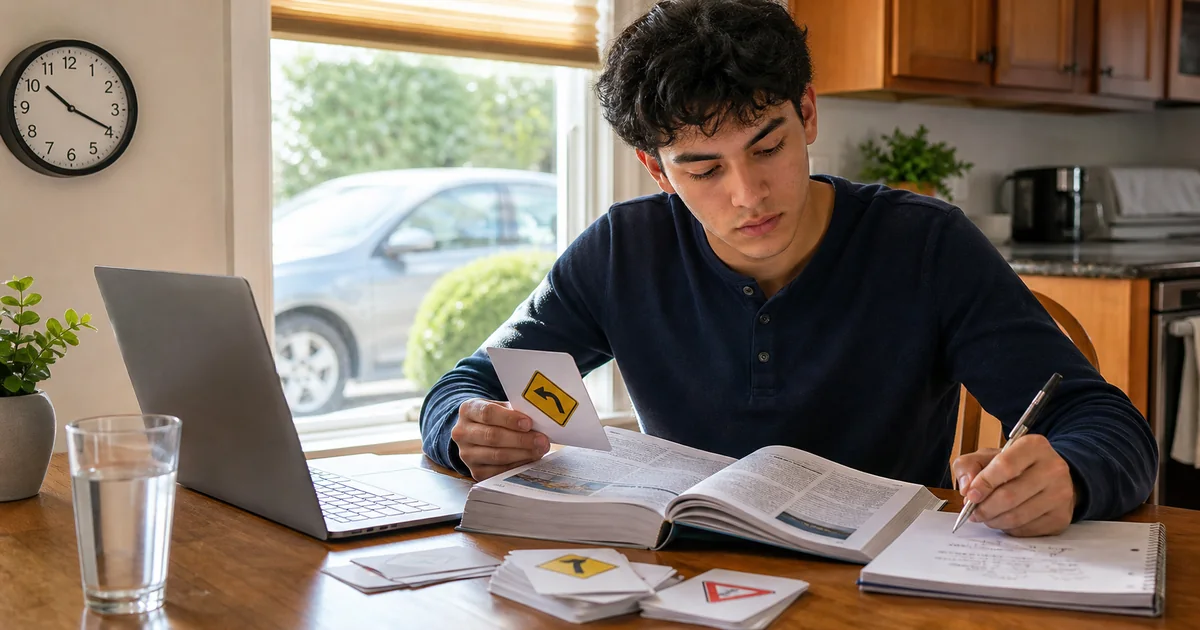
Can you study for the permit test in one day? You can make meaningful progress in one focused day, especially if you already know basic traffic rules, but no schedule can guarantee a pass. Use the day to identify weak topics, learn rules from your current state handbook, practice applying them, and decide honestly whether to keep the appointment.
California DMV recommends giving yourself a few days to work through its handbook. That is the better plan whenever you have time. This guide is for the learner whose test is tomorrow or whose earlier studying was scattered, not a reason to leave preparation until the last minute.
Start with the right material
Your state handbook is the final study source
Practice questions show whether you can apply a rule, but your DMV, DPS, MVD, MVC, RMV, or licensing agency controls the real test. Open the current handbook before starting, identify the tested chapters, and use third-party explanations only to support that official material.
What to prepare before the study day begins
Do this setup the night before if possible. It keeps your best study hours from disappearing into searches, account setup, and appointment confusion.
- Download or bookmark the current official driver handbook for your state.
- Confirm the license class and applicant path: teen, adult, first-time, transfer, motorcycle, or commercial.
- Check the test format, question count, passing requirement, available language, and testing method.
- Open a short practice test, the road signs practice test, and a blank error log.
- Silence nonessential notifications and study away from television or conversation.
- Set out water, a simple meal, and accepted DMV documents so breaks stay short.
Do not use an old handbook saved months ago without checking the official page. Test topics are stable, but laws, penalties, license procedures, and handbook editions can change.
First: take a 10-question baseline test
Do not read for three hours before checking what you know. Start with a short mixed quiz under honest conditions: no notes, no searching, and no help. Then use the result to choose the right version of the plan.
| Baseline result | What it suggests | How to use the day |
|---|---|---|
| 80% or higher | You may know the foundation, but one short score can include lucky guesses. | Repair every missed or guessed rule, then complete longer shuffled tests and a separate sign review. |
| 60%–79% | You have usable knowledge with clear gaps. | Follow the full schedule, spend extra time on the two weakest topics, and require repeated passing scores before testing. |
| Below 60% | Too many core rules may still be unfamiliar. | Study the foundation today, but reschedule when possible rather than treating one rushed day as proof of readiness. |
Record whether each wrong answer was caused by a missing rule, a misread question, confusion between two choices, or a guessed state-specific number. Those require different fixes.
A practical one-day permit test study schedule
The times below assume a full study day. Move the start time if needed, but keep the sequence: baseline, targeted learning, mixed retrieval, repair, then rest. Short breaks are part of the plan.
| Time | Study block | What to produce |
|---|---|---|
| 8:00–8:25 | Baseline and setup | One honest 10-question score, a list of weak topics, and the current official handbook. |
| 8:25–9:45 | Road signs, signals, and markings | Shape/color recognition plus the required driver action for each missed sign or signal. |
| 9:45–10:00 | Break | Leave the screen, move around, and return without opening social media. |
| 10:00–11:30 | Right-of-way and intersections | Rules for stop order, pedestrians, turns, uncontrolled intersections, emergency vehicles, and roundabouts. |
| 11:30–12:15 | Speed, space, and lane use | Safe following, stopping distance concepts, passing, merging, lane changes, and weather adjustments. |
| 12:15–1:00 | Meal and real break | No practice test. Let the first study blocks settle. |
| 1:00–2:15 | Sharing the road and special situations | School buses, railroad crossings, work zones, bicycles, motorcycles, trucks, parking, and hill rules. |
| 2:15–3:00 | Driver responsibility | Seat belts, distraction, alcohol/drugs, implied consent, crashes, insurance, and penalties from your state handbook. |
| 3:00–3:15 | Break | Water, movement, and no new information. |
| 3:15–4:00 | First longer mixed test | A topic-by-topic score and a marked list of every missed or guessed item. |
| 4:00–5:15 | Error repair | One handbook-backed correction for every miss, followed by a changed practice scenario. |
| 5:15–5:45 | DMV-day preparation | Documents, payment, appointment, glasses/contacts, parent forms, and test-delivery confirmation. |
| 6:30–7:15 | Final mixed test | A fresh shuffled score completed without notes or interruptions. |
| 7:15–7:45 | Light final review | Error-log rules, sign shapes, and a few state-specific numbers—not another full handbook reading. |
| After 7:45 | Stop studying | Pack the appointment items, set alarms, and get normal sleep. |
If you have only three or four hours, keep the baseline, road signs, right-of-way, one mixed test, and error repair. Drop extra question volume before dropping review of mistakes.
High-value permit test topics to study first
There is no nationwide percentage for how many questions every state assigns to each topic. New York DMV, for example, tells applicants that its manual chapters 4 through 11 contain material needed for the Class D, DJ, or E permit test and provides chapter quizzes. Use your state’s own chapter list when it is available.
Signs and signals
Sign shape, color, symbol, traffic signals, flashing lights, pavement markings, railroad crossings, school zones, and work zones.
Right-of-way
Four-way stops, uncontrolled intersections, turns, pedestrians, bicycles, roundabouts, emergency vehicles, and funeral processions where covered.
Speed and space
Posted and default limits, following distance, stopping distance, weather, night driving, hills, curves, and visibility.
Lane use
Passing, merging, lane changes, center turn lanes, solid and broken lines, freeway entry/exit, and sharing the road.
Parking and special hazards
Hill parking, curb colors where applicable, hydrants, crosswalks, railroad tracks, school buses, and work-zone behavior.
Driver responsibility
Seat belts, phones, alcohol and drugs, implied consent, insurance, crashes, license points, suspension, and permit restrictions.
Use a small error log, not a pile of screenshots
An error log should be short enough to review twice. For every missed or guessed question, write four lines:
- Topic: for example, flashing red signal.
- Correct rule: state the action in your own words.
- Why the wrong answer was tempting: identify the confusion.
- Source: record the handbook section or official page.
Then answer a changed version of the rule. If the first question asks about a flashing red signal, test the difference between flashing red, flashing yellow, steady red, and a dark signal. This checks understanding instead of answer-letter memory.
Our most-missed permit test question guide uses original scenarios to show how similar-looking rules separate.
The 45-minute road-sign sprint
Learn signs in layers rather than memorizing one hundred isolated pictures.
- Shape first: octagon means stop; downward triangle means yield; diamond signals a warning; pentagon commonly marks a school warning; a round sign warns of a railroad crossing.
- Color second: red often signals prohibition or stopping; yellow warns; orange marks temporary traffic control; green guides; blue identifies services; brown identifies recreation or cultural interest.
- Action third: say what the driver should do—stop, yield, reduce speed, merge, keep right, prepare for a crossing, or follow a detour.
- Mixed recognition last: use an image-based quiz without category labels.
The Federal Highway Administration’s MUTCD standardizes sign shapes and colors so drivers can recognize sign classes quickly. State tests can include additional or locally emphasized signs, so finish with your state handbook.
Do not skip state-specific rules
Core traffic-safety principles overlap, but the real knowledge test is not a national exam. Your state can set its own numeric limits, exceptions, penalties, license procedures, permit restrictions, question count, passing score, retake process, and testing options.
Reserve at least 30 minutes for details such as:
- default speed limits and special zones;
- school-bus stopping rules and divided-highway exceptions;
- parking distances and curb rules;
- alcohol limits, zero-tolerance rules, and implied consent;
- phone use and passenger or nighttime permit restrictions;
- point, suspension, crash-reporting, and insurance rules; and
- test attempts, waiting periods, and fees.
Use the passing score finder and state permit requirements, then open the official agency source linked from your state page.
What not to do the day before the permit test
- Do not take tests nonstop. Repeated guessing can rehearse mistakes when you never return to the handbook.
- Do not memorize answer letters. Wording and choice order change.
- Do not use another state’s numbers as your final rule. Verify state-specific limits and exceptions.
- Do not trust an old social post or anonymous answer over the current handbook.
- Do not attempt to use notes, a phone, or the handbook during the real test. California DMV explicitly prohibits testing aids during knowledge tests.
- Do not study through the night. Stop early enough to sleep and arrive able to read carefully.
- Do not ignore the appointment paperwork. A passing score cannot fix missing identity, residency, consent, or payment requirements.
Should you take the test tomorrow?
Use evidence, not optimism. You are in a stronger position when you can:
- score above your state’s passing requirement on at least two fresh, shuffled mixed tests;
- explain every missed and guessed rule without reading the answer choices;
- recognize common sign shapes, colors, meanings, and required actions;
- answer right-of-way scenarios by describing who goes first and why;
- separate state-specific limits from general safe-driving advice; and
- confirm the appointment, documents, payment, and test method.
Honest stop rule
Reschedule when the foundation is still missing
If fresh mixed scores remain below the passing requirement, common signs are still guesses, or you cannot explain right-of-way decisions, more time is likely more useful than another rushed test. Check the cancellation policy, fee, and available dates before changing an appointment.
The final 15-minute test-day checklist
- Read the error log once; do not start a new topic.
- Review sign shapes, flashing signals, and the two weakest state-specific rules.
- Bring accepted identity, residency, Social Security or status, course, and parent/guardian documents required for your path.
- Bring glasses or contacts used for the vision screening.
- Confirm payment method, appointment time, location, and arrival instructions.
- During the test, read the entire question and look for words such as first, best, must, except, and unless.
Use the DMV document checklist and permit appointment walkthrough before leaving home.
Questions about studying for the permit test in one day
Is one day enough to study for the permit test?
It can be enough to review and repair gaps when you already know basic road rules, but it may not be enough to learn the full handbook from the beginning. Use fresh practice scores and explanations—not time spent—to judge readiness.
What should I study first for the permit test?
Start with a short baseline. Then prioritize signs and signals, right-of-way and intersections, speed and following distance, lane use, parking, school buses, railroad crossings, sharing the road, and state-specific driver responsibilities.
How many practice tests should I take in one day?
Quality matters more than a fixed number. One short baseline and two or three fresh mixed tests can be enough when every missed or guessed rule is reviewed from the handbook between attempts.
Should I read the entire driver handbook in one day?
Use your state’s tested-topic guidance when available. Skim the structure, study high-value chapters closely, and return to the exact handbook section for every missed practice rule rather than racing through every page without recall.
Can I memorize practice-test answers and pass?
Memorizing letters or familiar wording is unreliable because real questions and choice order can differ. Learn the rule, explain why the wrong choices fail, and answer a changed scenario.
What score should I get before taking the real permit test?
Score consistently above your state’s passing requirement on fresh shuffled tests and explain all misses and guesses. One score at the exact passing line provides little margin for unfamiliar wording.
Should I stay up late studying for the permit test?
No. End heavy study early enough to sleep normally. The test requires careful reading and decisions, so another exhausted practice round is usually less useful than rest and a short morning review.
What happens if I am not ready after the one-day plan?
Check whether you can reschedule without losing the fee or appointment. Continue with the official handbook, targeted practice, and error review until your fresh mixed scores and rule explanations show reliable readiness.
Editorial check
Official sources and review note
This last-minute study plan is organized around official state handbook and practice-test guidance plus federal road-sign standards. Test format, topics, passing score, attempts, documents, and testing options vary, so use your current state licensing source as the final authority.
After the permit test
After you pass, here's what comes next
Passing the written permit test starts the supervised-driving stage. Use the After Permit guide to plan restrictions, driving hours, road-test practice, insurance questions, and the next steps toward a full license.
After you pass, here's what comes next →