Quick answer
When do you have to stop for a school bus?
In most situations, drivers must stop when a school bus is stopped with red flashing lights and an extended stop arm while children are loading or unloading. Traffic approaching from either direction often must stop, but divided-highway exceptions and stopping distances vary by state.
- Yellow school-bus lights mean the bus is preparing to stop, so slow down and prepare to stop.
- Red flashing lights and an extended stop arm mean stop and wait until the bus moves, the lights stop, the arm retracts, or an authorized signal allows traffic to proceed.
- Do not assume the opposite direction is exempt unless your state rule and road design clearly allow it.
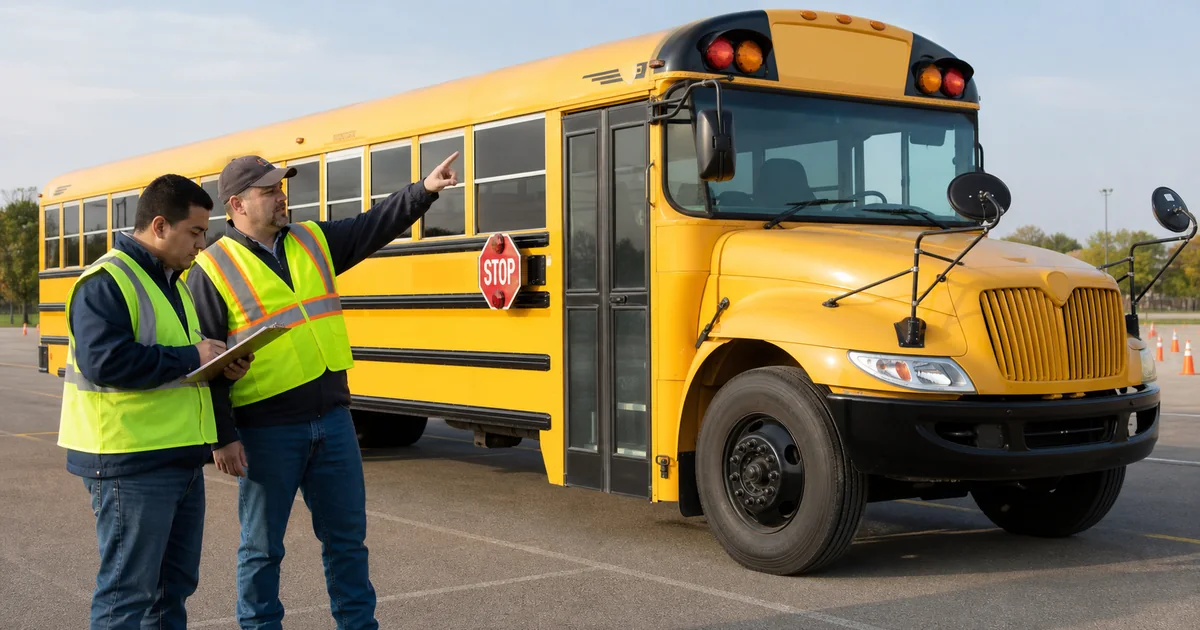
School-bus stopping rules appear in many DMV handbooks because the mistake is high risk: a child may cross from either side of the bus while drivers are focused on traffic. The safe pattern is simple, but the test questions often add details about yellow lights, red lights, opposite-direction traffic, divided highways, penalties, and how far away to stop.
What yellow school-bus lights mean
Yellow flashing lights mean the school bus is preparing to stop. Treat yellow lights as a warning stage, not as permission to speed around the bus. Slow down, create extra space, and prepare for red lights, an extended stop arm, and children entering the roadway.
New York DMV explains this clearly: yellow lights mean the bus is getting ready to stop and drivers should slow down and prepare to stop. That is the same practical behavior you should use for permit-test scenarios even when your state words the rule differently.
What red lights and an extended stop arm mean
Red flashing lights and an extended stop arm mean the bus has stopped for children. In most situations, you must stop before reaching the bus and wait. Do not pass on the left. Do not pass on the right shoulder. Do not creep forward because you think the last child already crossed.
NHTSA summarizes the national safety principle: when a school bus stops and displays red flashing lights and its stop arm, motorists must stop too in most situations. State laws control the exact penalty and exception, but the core test answer is usually: stop and wait until it is legally clear.
Do cars going the opposite direction have to stop?
Often yes on undivided roads. This is the question many learners miss. A bus stopped on the opposite side of a two-lane road can still mean children are crossing the full roadway, so oncoming traffic may need to stop before reaching the bus.
The important exception is the road design. Some states do not require opposite-direction traffic to stop on a divided highway or on certain multi-lane divided roads. Do not guess from a national rule. Read the wording in your state handbook and look for the words divided highway, physical median, separate roadway, or multiple lanes in each direction.
School bus stopping laws by state: quick comparison
This table is a study reference, not legal advice. It uses official state resources where possible and normalizes the wording so you can compare the same three things: stopping distance/action, opposite-direction rule, and penalty note.
| State | Stop distance or action | Opposite direction / divided road note | Penalty note |
|---|---|---|---|
| California | Stop immediately before passing a stopped school bus with flashing red lights and stop signal arm. The reviewed DMV handbook section does not give one feet number. | California DMV notes a divided or multi-lane exception for traffic on the other side. | California DMV warns the fine can be up to $1,000 and driving privilege can be suspended up to one year. |
| New York | Stop at least 20 feet away when red lights flash. | New York requires stopping when approaching from the front or rear, including near schools and parking lots. | Penalties vary by violation history and enforcement path; verify the current DMV/traffic court result. |
| Texas | Stop before reaching a school bus with flashing red lights or an extended stop sign. | Texas allows an opposite-side divided-highway exception. | Texas penalties can include fines and license consequences; verify current DPS/TxDOT enforcement guidance. |
| Pennsylvania | Stop at least 10 feet away from a bus with red lights flashing and stop arm activated. | Stop when behind, meeting, or approaching an intersection where the bus is stopped, unless a specific divided-road rule applies. | Pennsylvania lists a $250 fine, five points, and 60-day license suspension for certain law-enforcement citations. |
| Florida | Stop for a school bus displaying a stop signal while picking up or dropping off children. | FLHSMV says all drivers moving either direction on a two-way street must stop; divided-highway details should be checked in the state handbook/statute. | Florida penalties can include fines and license consequences; verify current FLHSMV/statute wording. |
| Illinois | Illinois State Police safety guidance says vehicles should stop at least 20 feet before reaching the school bus. | On two-lane roads, vehicles in all lanes must stop when the bus is stopped to pick up or drop off pupils. | Illinois lists school bus violations as serious; verify current Secretary of State penalty wording. |
| Ohio | Ohio’s driver digest says amber lights warn the bus is preparing to stop and drivers must stop when the bus is dropping off or picking up students. | Ohio’s exact lane rule depends on roadway design; verify the current Ohio Digest and ORC 4511.75 wording. | Penalties are state-law based; verify current BMV/ORC penalty language. |
| Georgia | Georgia DDS explains when all traffic must stop by roadway type instead of giving a single feet distance in the reviewed sharing-the-road page. | All directions stop on two-lane roads, two-lane roads with a center turn lane, four-lane roads without a median, and four-lane roads with a center turn lane. On divided highways of four or more lanes with a median, only traffic following the bus stops. | Georgia penalties are strict; verify current DDS/state-law language before relying on a number. |
| North Carolina | NCDOT/N.C. school bus safety materials focus on roadway type and stopping for passenger loading rather than a single feet number in the reviewed public summary. | North Carolina materials show all directions stop on two-lane roads, four-lane roads without median separation, and two-lane roads with a center turn lane. | Penalties can be serious; verify current NCDMV/statute wording. |
| Michigan | Michigan law covers stopping for a bus displaying flashing red lights; many Michigan safety summaries use a 20-foot practical stopping distance, but verify the current official manual/statute. | Michigan statute addresses the divided-highway exception for meeting a stopped bus. | Michigan violations are civil infractions with statutory fines; verify current MCL 257.682 language. |
What happens if you do not stop for a school bus?
Consequences vary by state, but school-bus stop-arm violations are not treated like minor paperwork mistakes. They can involve fines, points, license suspension, civil camera penalties, court costs, or more serious charges if a child is endangered or injured.
Two official examples show the range. California DMV warns that failing to stop can lead to a fine up to $1,000 and driving privilege suspension up to one year. Pennsylvania’s school-bus stopping law materials list a $250 fine, five points, and a 60-day license suspension for certain citations issued by law enforcement.
For permit-test study, remember the reason behind the penalty: children may be hidden by the bus, may cross unexpectedly, and may not judge vehicle speed correctly. The safest answer is to stop early and wait until the bus signal is fully clear.
Common DMV test traps about school buses
| Trap answer | Why it is wrong | Better rule |
|---|---|---|
| Only the cars behind the bus must stop. | On many undivided roads, oncoming traffic must stop too. | Check the road design and state rule before assuming opposite traffic is exempt. |
| Yellow lights mean pass quickly before the red lights. | Yellow lights warn that the bus is preparing to stop. | Slow down and prepare to stop. |
| You can move once the child reaches the curb. | Other children may still be crossing or hidden near the bus. | Wait until the bus signal equipment stops or an authorized signal allows movement. |
| A divided road always means you can keep going. | State definitions differ, and not every wide road is legally divided. | Look for a physical divider or the exact state exception. |
What to do when you see a school bus stopping
- See yellow lights: slow down and prepare to stop.
- See red lights or stop arm: stop before reaching the bus.
- Check your road: if you are approaching from the opposite direction, stop unless your state rule and road design clearly create an exception.
- Leave space: use your state stopping-distance rule and keep the loading area clear.
- Watch for children: scan both sides of the road, the shoulder, and the front of the bus.
- Move only when clear: wait until the lights stop flashing, the stop arm retracts, the bus moves, or an authorized signal allows traffic to proceed.
How this appears on the permit test
Permit-test questions usually describe a road scene rather than asking for a definition. You may see a school bus ahead, flashing yellow lights, flashing red lights, a two-lane road, a divided highway, or an oncoming lane. Read the whole scenario before choosing an answer.
If the question includes red lights and no clear divided-highway exception, the safest test answer is usually to stop and wait. If the question includes yellow lights, the answer is usually to slow and prepare to stop. If it includes a divided highway, use the state-specific exception exactly as your handbook explains it.
School bus stopping law FAQ
How many feet do you have to stop from a school bus?
It depends on the state. New York says at least 20 feet, Pennsylvania says at least 10 feet, and Illinois safety guidance says at least 20 feet. Some official handbook sections, including California’s reviewed DMV page, say to stop immediately before passing instead of giving one universal feet number.
Do you have to stop for a school bus on a divided highway?
Traffic behind the bus usually must stop. Opposite-direction traffic may be exempt when the bus is on the other side of a divided highway or physical median, but the exact rule varies by state. Do not apply the exception unless the road design clearly matches your state rule.
What happens if you do not stop for a school bus?
Penalties can include fines, points, license suspension, civil camera tickets, and more serious consequences if a child is endangered or injured. California warns of fines up to $1,000 and possible suspension. Pennsylvania lists a $250 fine, five points, and a 60-day suspension for certain citations.
Do yellow school-bus lights mean stop?
Yellow lights mean slow down and prepare to stop. They warn that the bus is about to stop for children. If the bus then displays red lights or a stop arm, stop and wait.
When can you start driving again after stopping for a school bus?
Wait until the red lights stop flashing, the stop arm retracts, the bus starts moving, or the bus driver or officer signals traffic to proceed. Continue scanning for children before accelerating.
Practice school-bus and road-sign questions
After reading the rule, test it with mixed DMV practice questions. School-bus questions often appear beside railroad crossings, flashing signals, school zones, and warning signs.
Related study pages
- Flashing red vs. flashing yellow traffic lights
- Warning signs explained
- Regulatory signs explained
- Four-way stop right-of-way rules
- State permit requirements
Editorial check
Official school-bus safety sources
This guide summarizes common school-bus stopping rules reviewed against NHTSA safety guidance and official state driver resources. School-bus laws are enforced by state law and local officers, so verify the exact rule in the state where you drive.
After the permit test
After you pass, here's what comes next
Passing the written permit test starts the supervised-driving stage. Use the After Permit guide to plan restrictions, driving hours, road-test practice, insurance questions, and the next steps toward a full license.
After you pass, here's what comes next →