Quick answer
What is the difference between flashing red and flashing yellow?
A flashing red signal requires a complete stop, just like a stop sign. After stopping, yield to pedestrians and traffic with the right-of-way, then proceed only when safe. A flashing yellow signal does not automatically require a stop; slow down, scan carefully, yield when necessary, and continue with caution.
- Do not assume every approach sees the same color; a major street may flash yellow while a side street flashes red.
- A flashing yellow arrow permits the indicated turn only after yielding to oncoming traffic, pedestrians, and bicyclists.
- A completely dark traffic signal is not the same as flashing yellow; stop and follow the state rule for an inoperative signal.
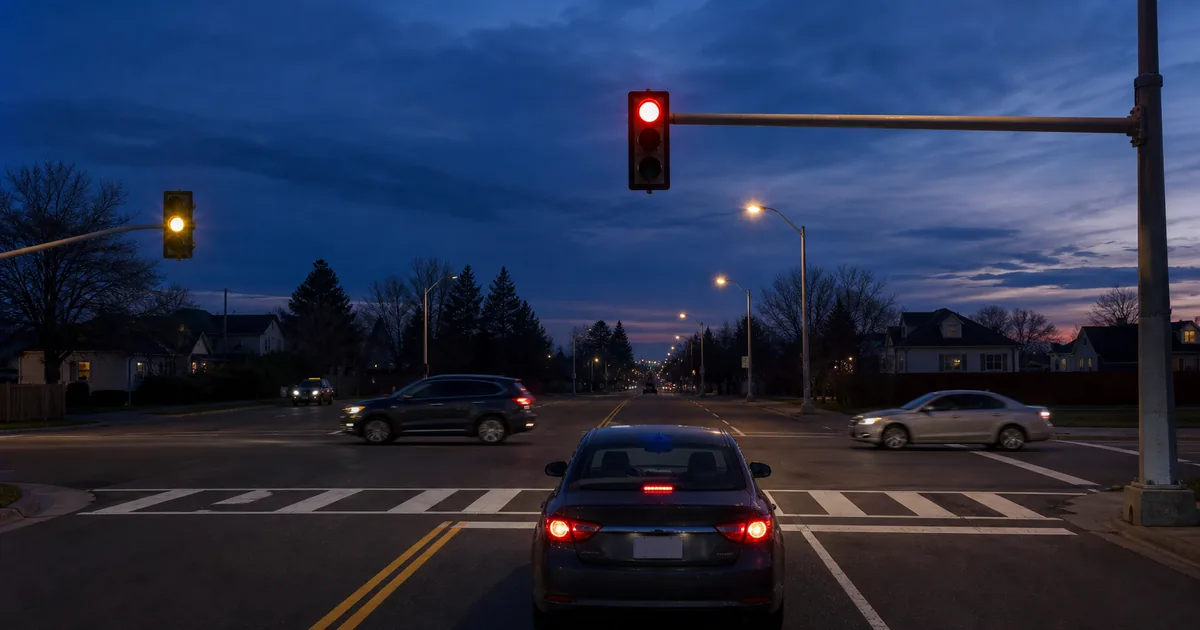
What is the difference between a flashing red and flashing yellow traffic light? A flashing red signal requires a complete stop, just like a stop sign. After stopping, yield to pedestrians and traffic with the right-of-way, then proceed only when safe. A flashing yellow signal does not automatically require a stop; slow down, look carefully, yield when necessary, and continue with caution.
Do not assume every approach sees the same color. At some intersections, the major street flashes yellow while the side street flashes red. A driver facing flashing red must stop and may need to wait for cross traffic that is legally moving through under flashing yellow.
Fast memory rule
Red requires a stop; yellow requires caution
At a flashing red intersection signal, stop fully at the correct boundary, yield, and proceed only when safe. At flashing yellow, reduce speed enough to inspect the intersection and respond to a hazard. You may continue without stopping when the path is clearly safe.
Flashing red versus flashing yellow at a glance
| Signal | Required first action | When you may proceed | Closest familiar control |
|---|---|---|---|
| Flashing red circle | Come to a complete stop. | After yielding, when the intersection and your path are safe. | Stop sign. |
| Flashing yellow circle | Slow down and increase attention. | Continue cautiously when the path is safe; stop if a hazard requires it. | Caution warning, not a stop sign. |
| Flashing yellow arrow | Prepare for an unprotected turn and scan conflicts. | Turn in the arrow’s direction after yielding to oncoming traffic, pedestrians, and bicyclists. | Permissive turn. |
| Dark signal | Follow the state’s failed-signal rule; many manuals require a full stop. | After applying the required stop and right-of-way sequence. | Often an all-way stop, but verify state law. |
What should you do at a flashing red traffic light?
Treat a flashing circular red signal like a stop sign. Use this sequence:
Stop at the correct boundary
Stop before the marked stop line. If there is no line, stop before the crosswalk. If neither exists, stop before entering the intersection at the nearest point where approaching traffic can be seen.
Check every conflict
Look for pedestrians, bicyclists, motorcycles, cross traffic, turning traffic, and emergency vehicles. A green-looking gap is not enough if another road user is already in the intersection.
Identify the control on other approaches
Other drivers may face flashing yellow rather than red. Do not assume they will stop just because you must.
Yield and proceed when safe
Apply the intersection’s right-of-way order, then move smoothly only when the complete path is open.
If all approaches show flashing red, drivers generally use an all-way-stop sequence: first complete stop normally goes first, simultaneous arrivals are resolved by the applicable right-of-way rule, and left-turning drivers yield when paths conflict. Review the full four-way-stop lesson for those scenarios.
What should you do at a flashing yellow traffic light?
A flashing circular yellow signal warns you to proceed with caution. It does not give permission to maintain full speed without checking, and it does not require a stop when the path is clearly safe.
- Ease off the accelerator early. Slow enough to judge the intersection and stop if a new hazard appears.
- Scan left, right, ahead, and the crosswalks. Look for drivers facing flashing red who may start after stopping.
- Yield where the movement requires it. Pedestrians in the crosswalk, vehicles already in the intersection, and oncoming traffic during a left turn can still have priority.
- Continue only at a controllable speed. Cover the brake when visibility is limited or another driver’s intention is uncertain.
“Proceed with caution” is an active decision, not a promise that the road is clear. The safest permit-test answer usually combines lower speed, observation, yielding when necessary, and readiness to stop.
What if your signal flashes red but cross traffic flashes yellow?
This arrangement often gives the major street a flashing yellow indication and a side street a flashing red indication. The two drivers have different duties:
| Approach | Driver duty | Critical mistake to avoid |
|---|---|---|
| Flashing red side | Stop completely and yield before entering. | Assuming cross traffic will also stop. |
| Flashing yellow side | Slow, scan, and proceed cautiously while yielding to hazards already in the path. | Driving through at normal speed without checking the side street or crosswalk. |
| Left turn from either side | Yield to pedestrians and conflicting oncoming traffic as required. | Treating the flashing signal as a protected turn. |
Texas’s current driver handbook makes this risk explicit: vehicles on the intersecting road may not have to stop when you face flashing red. Wait for a gap large enough to enter and clear the full intersection without forcing yellow-side traffic to brake.
Is a flashing yellow arrow the same as a flashing yellow light?
Both require caution, but a flashing yellow arrow applies only to the movement shown by the arrow. It commonly permits an unprotected left turn. You may turn after yielding to:
- oncoming vehicles close enough to create a hazard;
- pedestrians in the associated crosswalk;
- bicyclists or motorcycles crossing the turn path; and
- vehicles already lawfully within the intersection.
Oncoming traffic commonly has a steady green indication during a flashing yellow left arrow. Your turn is permitted but not protected. A solid green arrow is different because it indicates a protected movement, subject to checking that the intersection is clear.
Permit-test clue
Flashing yellow arrow means yield before turning
Do not choose an answer that says the arrow gives an automatic right-of-way. The correct answer should allow the turn only after yielding to oncoming traffic and people crossing.
Steady yellow versus flashing yellow
A steady yellow light warns that the signal is changing to red. Stop before the intersection if you can do so safely; if you cannot stop safely or are already committed, clear the intersection cautiously. A flashing yellow light is a continuing caution indication rather than a change interval.
- Steady yellow: the current signal phase is ending.
- Flashing yellow: the intersection or movement remains caution-controlled.
- Flashing yellow arrow: the arrow movement is permitted after yielding.
Never accelerate to “beat” a steady yellow. Never treat a flashing yellow as a green light that removes your responsibility to scan and yield.
What should you do when the traffic signal is dark?
A completely dark signal is not the same visual indication as flashing red, but many state manuals require drivers to stop and treat the intersection like an all-way stop. California, Oregon, and Pennsylvania publish that instruction in their current driver guidance.
Because the legal wording can vary, use your state’s failed-signal rule. In every case:
- slow well before the intersection;
- watch for a police officer, temporary stop signs, or other traffic control;
- do not assume other drivers noticed the outage;
- stop where required and establish the right-of-way order; and
- proceed only when the path is safe.
A police officer or authorized flagger directing traffic overrides the normal signal sequence. Follow that person’s directions even when they conflict with the dark or flashing signal.
Do all flashing red or yellow lights mean the same thing?
No. The location and device matter.
School-zone flashing yellow beacons
A flashing yellow beacon attached to a school-zone speed sign can mean that the posted school speed restriction is active. Obey the sign’s stated speed and times or flashing-light condition. Do not apply the generic “continue cautiously” rule while ignoring the regulatory speed sign.
Warning-sign beacons
A flashing yellow beacon attached to a curve, intersection, pedestrian, or other warning sign calls extra attention to that sign. Slow and respond to the hazard described by the sign.
Railroad crossing flashing red lights
Railroad red flashers are not ordinary stop-and-go intersection signals. Stop as required and remain stopped while the warning is active. Never drive around a lowered gate, and do not proceed until the signals end and the tracks are clearly safe under state law.
School-bus flashing red lights
School-bus red lights and an extended stop arm trigger special state stopping laws. Divided-roadway exceptions vary. Use the school-bus rules in your state instead of treating the bus like a roadside stop sign.
Emergency-vehicle warning lights
Flashing lights on a police car, fire truck, ambulance, or roadside response vehicle involve emergency-yield and move-over rules. They are not interpreted as intersection flashing signals.
Common flashing-signal permit-test traps
Stopping at flashing yellow every time
Slow and proceed cautiously. Stop only when traffic, a pedestrian, visibility, or another hazard makes it necessary.
Rolling through flashing red
Flashing red requires a complete stop before yielding and proceeding.
Assuming all approaches flash red
The cross street may flash yellow and may not be required to stop.
Confusing steady and flashing yellow
Steady yellow means the phase is ending; flashing yellow is an ongoing caution control.
Calling a yellow arrow protected
A flashing yellow arrow permits the turn only after yielding. A green arrow is the protected indication.
Using intersection rules at railroad tracks
Railroad flashers and gates have special rules. Remain stopped while the warning is active.
Flashing-signal mini self-test
Choose the safest legal action before opening each answer.
1. Your signal flashes red and the intersection looks empty. What must you do first?
Answer: Come to a complete stop at the proper boundary. Then yield and proceed only when the full path is safe.
2. Your signal flashes yellow and no hazard is visible. Must you stop?
Answer: Not automatically. Slow down, scan carefully, and continue with caution while remaining ready to stop.
3. You face flashing red while cross traffic faces flashing yellow. Who normally stops?
Answer: You must stop. Cross traffic slows and proceeds cautiously, so you must wait for a safe gap rather than expecting it to stop.
4. A flashing yellow left arrow appears. Is your turn protected?
Answer: No. The turn is permitted but unprotected. Yield to oncoming traffic, pedestrians, bicyclists, and vehicles already in the intersection.
5. A steady yellow light appears as you approach. What does it mean?
Answer: The signal is about to turn red. Stop if you can do so safely; otherwise clear the intersection cautiously.
6. The traffic signal is completely dark. What is the safest response?
Answer: Slow and follow your state’s failed-signal rule. Many states require a full stop and all-way-stop sequence. Watch for temporary controls or an officer.
7. A school-zone sign has flashing yellow beacons. Can you ignore the posted school speed?
Answer: No. The beacon draws attention to the sign and can indicate that its school-zone restriction is active.
8. Railroad crossing red lights are flashing but no train is visible. May you cross?
Answer: No. Stop as required and remain stopped while the warning is active. Never go around a lowered gate.
Official sources checked
This guide explains common US traffic-signal meanings. State statutes, turn-on-red rules, failed-signal procedures, school zones, buses, and railroad crossings can differ. Use the current driver handbook and posted controls for the state where you drive.
- FHWA MUTCD 11th Edition, Part 4
- California DMV: Traffic Signals
- Oregon DMV: Signs and Traffic Signals
- Pennsylvania Driver’s Manual: Signals
- Texas Driver Handbook
- Florida Driver’s Handbook
Flashing traffic light questions
Does a flashing red light mean the same as a stop sign?
Yes. Come to a complete stop at the proper boundary, yield to traffic and pedestrians with the right-of-way, and proceed only when safe.
Do you have to stop at a flashing yellow light?
No automatic stop is required. Slow down, scan the intersection, yield when necessary, and proceed cautiously. Stop when a hazard or traffic condition requires it.
What if one road has flashing red and the other has flashing yellow?
Drivers facing red stop and yield. Drivers facing yellow slow and proceed cautiously. The red-side driver must not assume yellow-side traffic will stop.
What does a flashing yellow left arrow mean?
You may turn in the arrow’s direction after yielding to oncoming traffic, pedestrians, bicyclists, and vehicles already in the intersection. The turn is not protected.
What is the difference between steady yellow and flashing yellow?
Steady yellow warns that the phase is ending and red is coming. Flashing yellow is a continuing caution indication that allows careful movement.
How do I treat a traffic light that is not working?
Follow your state’s failed-signal law. Many states require treating a dark signal as an all-way stop. Slow early, look for temporary controls, and proceed only when safe.
Are flashing railroad lights the same as a flashing red intersection signal?
No. Railroad flashers indicate a train warning and have special stopping rules. Remain stopped while the warning is active and never drive around a lowered gate.
Can a flashing yellow light appear with a warning sign?
Yes. A flashing yellow beacon can draw attention to a school-zone, curve, pedestrian, intersection, or other warning sign. Obey the message or restriction on that sign.
Editorial check
Official traffic-signal sources and state variation
This guide summarizes standard flashing-signal meanings reviewed against the FHWA MUTCD and current state driver handbooks. State wording and special devices can differ, so obey every posted sign, flagger, police officer, railroad warning, and school-bus signal and verify the current handbook where you drive.
After the permit test
After you pass, here's what comes next
Passing the written permit test starts the supervised-driving stage. Use the After Permit guide to plan restrictions, driving hours, road-test practice, insurance questions, and the next steps toward a full license.
After you pass, here's what comes next →