Quick answer
Who has the right-of-way at a four-way stop?
The road user who reaches the intersection and completes a legal stop first normally proceeds first. If two road users stop at the same time, the driver on the left yields to the road user on the right. A left-turning driver must also yield when the turn crosses an oncoming path, and every driver must yield to pedestrians and avoid a collision.
- Stop completely before the limit line, crosswalk, or intersection boundary before deciding the order.
- Use the right-hand rule to resolve a simultaneous arrival, not to override a vehicle that stopped first.
- Never enter only because you believe another driver should wait; scan the full path and yield when safety requires it.
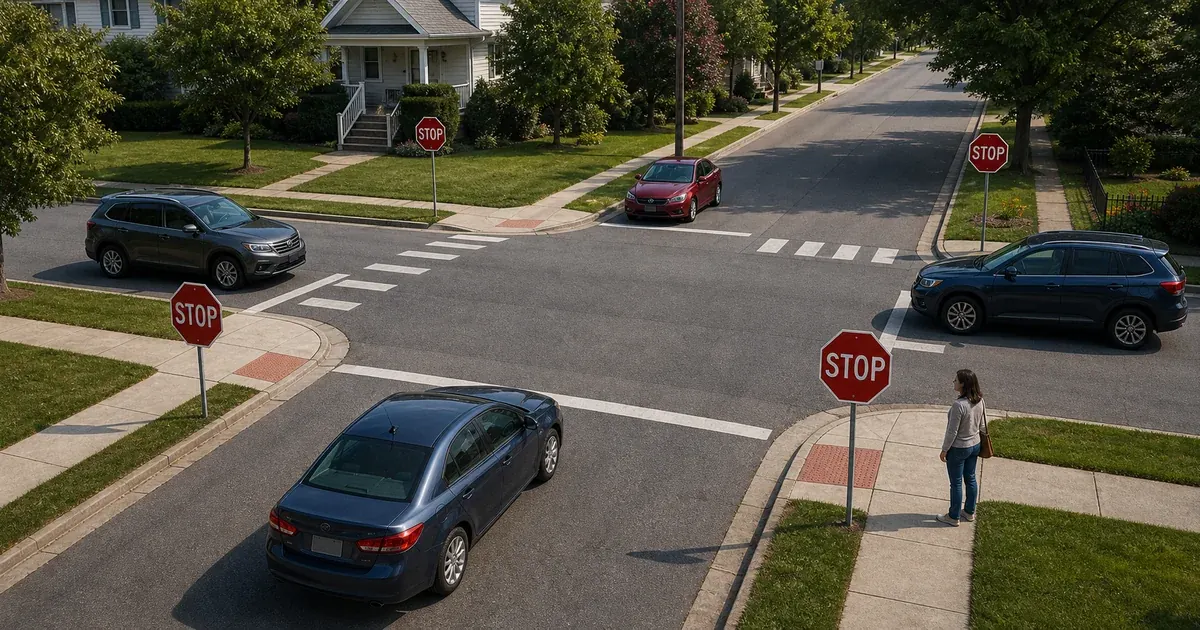
Who goes first at a four-way stop? The road user who reaches the intersection and makes a complete stop first normally goes first. If two road users stop at the same time, the driver on the left yields to the road user on the right. A driver turning left must also yield to oncoming traffic, pedestrians, and bicyclists when their paths conflict.
Those rules establish an order, but they do not make a collision safe or legal. Never enter because you believe another driver should wait. Scan left, right, and ahead; confirm the crosswalk is clear; and give up priority when another road user moves unexpectedly.
The safe answer
Right-of-way is given, not taken
Official handbooks consistently warn drivers not to assume another person will yield. Even when the sequence says you may proceed, wait if a pedestrian is crossing, a bicyclist is still in the intersection, an emergency vehicle is approaching, or another driver starts moving into your path.
Use this five-step method at every four-way stop
Recognize the all-way stop
Look for a stop sign controlling each approach. An ALL WAY or 4-WAY plaque may appear below the sign, but sign placement and the other approaches confirm the intersection type.
Make a complete stop in the correct place
Stop before the marked limit line. If there is no line, stop before the crosswalk. If neither exists, stop before entering the intersection where you can check cross traffic safely.
Remember the arrival order
Identify which vehicle, motorcycle, or bicyclist stopped first. A rolling vehicle has not completed its required stop and should not be treated as safely established in the sequence.
Resolve ties and turning conflicts
For a simultaneous arrival, yield to the road user on your right. If you are turning left, yield to oncoming movement that would cross your path.
Scan again before moving
Check pedestrians, bicycles, motorcycles, emergency vehicles, and drivers who may not follow the order. Proceed smoothly only when your full path is open.
This sequence works better than memorizing a phrase such as “the person on the right always goes.” The right-hand rule resolves a tie; it does not erase the first-arrival rule.
Where should you stop at a stop sign?
A correct right-of-way decision begins with a legal stop. Stop while the front of the vehicle is behind the first applicable boundary:
- Marked stop or limit line: stop before the line.
- Crosswalk but no stop line: stop before the crosswalk, including an unmarked crosswalk where recognized by state law.
- No line or crosswalk: stop before entering the intersection at a point where approaching traffic can be seen.
If a building, parked vehicle, hedge, or other obstruction blocks the view, make the required first stop, then inch forward carefully for a second look without blocking a pedestrian path or entering cross traffic. Stopping past the line because visibility is limited is not the same as completing the required stop first.
Knowledge-test clue
A slow roll is not a complete stop
The safest exam answer is the one requiring the vehicle to stop fully at the correct boundary, check the intersection, yield as required, and proceed only when clear. “Slow down and continue if no one is visible” is not a valid stop-sign procedure.
Who goes first? Eight common four-way-stop scenarios
| Scenario | Who normally proceeds first | Why |
|---|---|---|
| One vehicle clearly stops first | The first vehicle to complete its stop. | Arrival order controls when no higher-priority conflict remains. |
| Two vehicles stop at the same time on crossing roads | The road user on the right. | The driver on the left yields to the right to resolve the tie. |
| Opposite vehicles arrive together and both go straight | They may proceed together when both paths are clear and do not conflict. | Opposite straight paths can usually move at the same time, but each driver must still scan for turns and vulnerable road users. |
| Opposite vehicles arrive together; one turns left | The driver going straight normally proceeds before the left-turning driver. | The left turn crosses the oncoming vehicle’s path. |
| A vehicle arrived first, but a pedestrian is crossing | The pedestrian completes the crossing first. | Arrival order among vehicles does not cancel the duty to yield at the crosswalk. |
| A bicyclist stops before a car | The bicyclist normally proceeds first. | A bicyclist using the road is part of the right-of-way sequence and must not be ignored because the vehicle is smaller. |
| Three or four vehicles appear to arrive together | Apply the right-hand rule one safe movement at a time. | When the order remains unclear, yield rather than compete and proceed only after another path is visibly stopped. |
| An emergency vehicle approaches with lights or siren | The emergency vehicle. | Follow state emergency-vehicle rules and avoid stopping inside the intersection. |
What if two vehicles arrive at the same time?
First decide whether the arrivals were truly simultaneous. If one vehicle clearly stopped first, that road user normally proceeds first even if the other vehicle is on the right. Use the right-hand rule only when the stopping order cannot separate them.
Imagine you are driving north and another vehicle approaches from the west. The westbound driver is on your left, while you are on that driver’s right. If both complete their stops at the same time, the westbound driver yields to you. Before moving, check that the other driver is actually stopped and that no pedestrian or bicyclist is crossing.
Do not accelerate hard to “claim” a tie. Smooth movement gives other road users time to understand the sequence and reduces the chance that two people enter together.
How left turns change the order
Left turns create crossing conflicts. When two vehicles face each other and stop at the same time, the driver turning left generally yields to the oncoming driver going straight. The same caution applies when the oncoming driver is turning right and the planned paths would conflict.
If the left-turning driver clearly stopped before the opposing driver, the earlier arrival can normally proceed first after yielding to pedestrians and confirming the other vehicle remains stopped. State wording can vary, so the safest knowledge-test approach is to apply arrival order, then resolve any same-time or left-turn conflict, then check the complete path.
Signal before the turn, stay in the proper lane, and avoid cutting the corner. A right-of-way answer is incomplete if the turn itself enters the wrong lane or crosses an occupied crosswalk.
Pedestrians, bicycles, and motorcycles at a four-way stop
Permit questions often show only cars, but real intersections include people whose smaller profile is easy to miss. Before moving:
- Pedestrians: check both ends of every marked or unmarked crosswalk. Do not pass a vehicle stopped for a person crossing.
- Bicyclists in the road: include them in the arrival order. A bicycle is not permission to squeeze through the intersection at the same time.
- Bicyclists in a crosswalk: follow the state’s crossing rules and yield when required. Do not assume every cyclist will behave predictably.
- Motorcycles: look twice. A motorcycle may be hidden by a windshield pillar, parked vehicle, or a larger vehicle across the intersection.
- People using white canes, guide dogs, or mobility devices: provide the right-of-way and enough time to clear the roadway.
The California Driver’s Handbook tells drivers to look left, right, and ahead before entering an intersection and to be prepared to stop. That scan matters after the vehicle ahead moves too; a second pedestrian may still be in the crosswalk.
What should you do when no one knows whose turn it is?
Confusion is common when drivers roll, stop far behind the line, arrive in a cluster, or use hand gestures that cannot be seen through glare. Use a defensive reset:
- Remain fully stopped.
- Check every approach and the crosswalk.
- Allow an already-moving road user to clear.
- When another driver clearly yields and your path is open, proceed smoothly.
- If two drivers start together, stop rather than racing through.
A hand wave is not a legal transfer of responsibility. The person waving may not see a bicyclist, motorcycle, or vehicle approaching from another direction. Make the safety check yourself.
Do not confuse a four-way stop with a two-way stop
At a four-way stop, every approach has a stop sign and stopped road users use arrival order and tie rules. At a two-way stop, only the minor road is controlled. Drivers on the through road usually do not stop and have priority over drivers waiting at the stop signs.
| Feature | Four-way stop | Two-way stop |
|---|---|---|
| Controlled approaches | All approaches stop. | Only the signed approaches stop. |
| Main decision | Arrival order, same-time tie, turning conflict, then safety scan. | Wait for through traffic and pedestrians; opposing stopped vehicles also resolve turning conflicts. |
| Common mistake | Assuming the vehicle on the right always goes before an earlier arrival. | Pulling out because the waiting vehicle opposite stopped first while cross traffic is still moving. |
Look for the back of stop signs on the cross street, an ALL WAY plaque, and the movement of through traffic. If the intersection type is uncertain, stay stopped until the path is clearly safe.
Common four-way-stop permit-test traps
- “The larger vehicle goes first.” Vehicle size does not create priority.
- “The driver on the right always goes first.” The right-hand rule normally resolves simultaneous arrival, not every sequence.
- “A driver turning left goes before a vehicle going straight.” Not when they arrive together and the paths conflict.
- “Slow to 2 mph if the intersection looks empty.” A stop sign requires a complete stop.
- “Follow the vehicle ahead through.” Each driver must stop and make an independent safety decision.
- “A wave means it is safe.” A courtesy signal cannot reveal every hidden road user.
- “Go because you have priority.” Yield when proceeding would create a collision.
- “Enter and wait in the middle.” Do not block an intersection when there is no space beyond it.
Four-way-stop mini self-test
1. You stop two seconds before a car on your right. Who normally goes first?
You do, after checking the full intersection. The right-hand rule is for a simultaneous arrival; it does not override a clear first stop.
2. You and a driver on your right stop at the same time. Who normally goes first?
The driver on your right. Remain stopped until that vehicle clears and verify no pedestrian or other road user changes the situation.
3. You face an oncoming vehicle. Both stop together; you are turning left and the other driver goes straight. Who proceeds first?
The oncoming driver going straight normally proceeds first because your left turn crosses that vehicle’s path.
4. You arrived first, but a pedestrian has entered the crosswalk. May you go?
No. Yield and wait until the crossing is clear. Vehicle arrival order does not cancel pedestrian right-of-way.
5. Three vehicles appear to stop together. What is the safest response?
Apply the right-hand rule one movement at a time, remain ready to yield, and proceed only when your path is visibly clear. Do not race to establish priority.
6. The car ahead stopped, then entered the intersection. Can you follow without stopping again?
No. Stop your own vehicle at the required boundary and make an independent right-of-way and safety check.
7. A driver waves you through, but a bicyclist is approaching the crosswalk. What should you do?
Stay stopped and assess the bicyclist. A hand signal from another driver does not replace your duty to yield or avoid a conflict.
8. Cross traffic does not have stop signs. Is this a four-way stop?
No. Treat it as a two-way stop. Yield to through traffic and enter only when there is a safe gap.
Ready for mixed questions? Take the 10-question permit drill, then review stop, yield, one-way, and turn-control signs.
Official sources checked
- California DMV: right-of-way rules and intersections
- Oregon Driver Manual: intersections and all-way stops
- Nevada Official Driver Handbook: right-of-way
- Texas Driver Handbook: right-of-way
Editorial note: This guide explains common US all-way-stop principles reviewed against the official sources above in July 2026. Traffic statutes and handbook phrasing vary by state. Obey posted signs, signals, police or flagger directions, and the law of the place where you drive.
Four-way stop questions
Who goes first at a four-way stop?
The road user who reaches the intersection and completes a legal stop first normally proceeds first, after yielding to pedestrians and confirming the path is clear.
Who goes first when two cars arrive at the same time?
The driver on the left normally yields to the road user on the right. If their paths do not conflict, opposite vehicles may sometimes proceed together when it is clearly safe.
Does the car going straight always have the right-of-way?
No. Arrival order still matters. Going straight becomes especially important when opposite vehicles arrive together and the other driver wants to turn left across the straight vehicle’s path.
Can two cars go at the same time at a four-way stop?
Opposite vehicles may proceed together when their planned paths do not conflict and the crosswalk and intersection are clear. When unsure, one driver should yield.
What if another driver goes out of turn?
Yield and avoid the collision. Having priority does not make it safe to enter the same space. Let the unexpected driver clear, scan again, and proceed when safe.
Do bicyclists follow four-way stop right-of-way rules?
Bicyclists using the road are part of the intersection sequence, subject to the applicable state rules. Drivers must not ignore a bicycle because it is smaller or slower.
What is the difference between a four-way stop and an uncontrolled intersection?
A four-way stop requires every approach to stop. An uncontrolled intersection has no stop or yield control, so drivers reduce speed and apply the state’s uncontrolled-intersection right-of-way rules.
What if all four cars arrive at exactly the same time?
Remain stopped, use the right-hand rule to establish one safe movement, and do not compete. If the order remains unclear, yielding briefly is safer than entering with another vehicle.
Editorial check
Official handbook sources and state variation
This lesson explains common US all-way-stop principles reviewed against current official state driver handbooks. Traffic statutes and handbook wording vary, so obey posted controls, police or flagger directions, and the law of the state where you drive.
After the permit test
After you pass, here's what comes next
Passing the written permit test starts the supervised-driving stage. Use the After Permit guide to plan restrictions, driving hours, road-test practice, insurance questions, and the next steps toward a full license.
After you pass, here's what comes next →