Motorcycle license steps
How to Get a Motorcycle License – Step-by-Step
Getting a motorcycle license involves a few more steps than a regular driver license. The exact process varies by state, but most riders follow the same basic path: check eligibility, study the motorcycle manual, pass the written test, practice with a permit, complete a safety course or skills test, and then receive a motorcycle license or endorsement.
Quick answer
The basic path is written test, permit, practice, then skills test or course waiver
Most states require a motorcycle-specific written knowledge test before you can practice legally. After that, you ride only within permit restrictions until you finish the required safety course, skills test, or endorsement process. State rules decide the minimum age, permit holding period, fees, and whether a rider course can waive the DMV skills test.
State-specific checks
Start with your state because the path is not identical everywhere
A Texas rider, New York rider, and California rider may all study similar safety topics, but their licensing steps, safety-course rules, permit restrictions, and fee details are different. Use these official links for the highest-population starter states, then open your US Permit Prep state page for internal guidance as we build each page out.
Step 1
Make sure you meet the basic requirements
Before you apply, check your state age, residency, identification, and driver license eligibility rules. Many states start motorcycle permit eligibility around age 15 to 16, but younger riders often face stricter training, parent consent, helmet, or permit holding rules.
- Be old enough under your state motorcycle rules.
- Have, or be eligible for, a regular driver license in states that require it.
- Be a resident of the state where you apply.
- Bring identity, residency, application, and fee documents required by your DMV.
If you are not sure what a permit is, start with what the motorcycle permit is.
Step 2
Study the motorcycle manual, then test your weak spots
Every state publishes motorcycle study material, usually as a motorcycle handbook, manual section, or rider guide. Do not just read it once from front to back. Use practice questions to find weak areas, then return to the manual sections that explain those topics.
High-yield topics
Focus on intersection safety, lane position, visibility, alcohol and impairment, helmet/protective gear, curves, braking, and bad-weather traction.
Practice method
Take a short practice set, write down missed topics, reread only those manual sections, then test again. This is faster than rereading the full manual every time.
Use this site
Use our motorcycle practice test page as the question hub as the bank is built out.
Step 3
Pass the motorcycle written knowledge test
The motorcycle written test is usually taken at your state DMV or licensing agency. Many states use about 25 to 30 multiple-choice questions and expect around an 80% passing score, but the official number and passing mark can vary.
Common topics
Motorcycle controls, safe riding, lane positioning, signals, riding in groups, intersections, curves, and bad weather.
After you pass
Passing often leads to a motorcycle learner permit, instruction permit, or the next licensing step required by your state.
Before test day
Check whether your state requires an appointment, application fee, ID documents, vision screening, or parent consent for younger riders.
Step 4
Hold your permit and practice riding
Most states require or strongly expect a practice period before full motorcycle privileges. Permit holding periods can range from short appointment-driven timelines to several months, especially for younger riders.
Practice starts, stops, smooth clutch/throttle control, turning, lane changes, scanning, emergency braking, swerving, and riding in low-speed situations. Always follow permit restrictions on passengers, night riding, highways, helmets, and supervision.
Step 5
Complete a motorcycle safety course if required
Many states use an approved rider course such as the Motorcycle Safety Foundation Basic RiderCourse or a state-approved equivalent. In some states, completing an approved course can waive the DMV motorcycle skills test, but this is not automatic everywhere.
Course rules can depend on your age, whether you already have a driver license, how quickly you submit the completion card, and whether the course provider is state-approved. Check your state’s specific rules before assuming a course will replace the skills test.
Step 6
Pass the motorcycle skills test
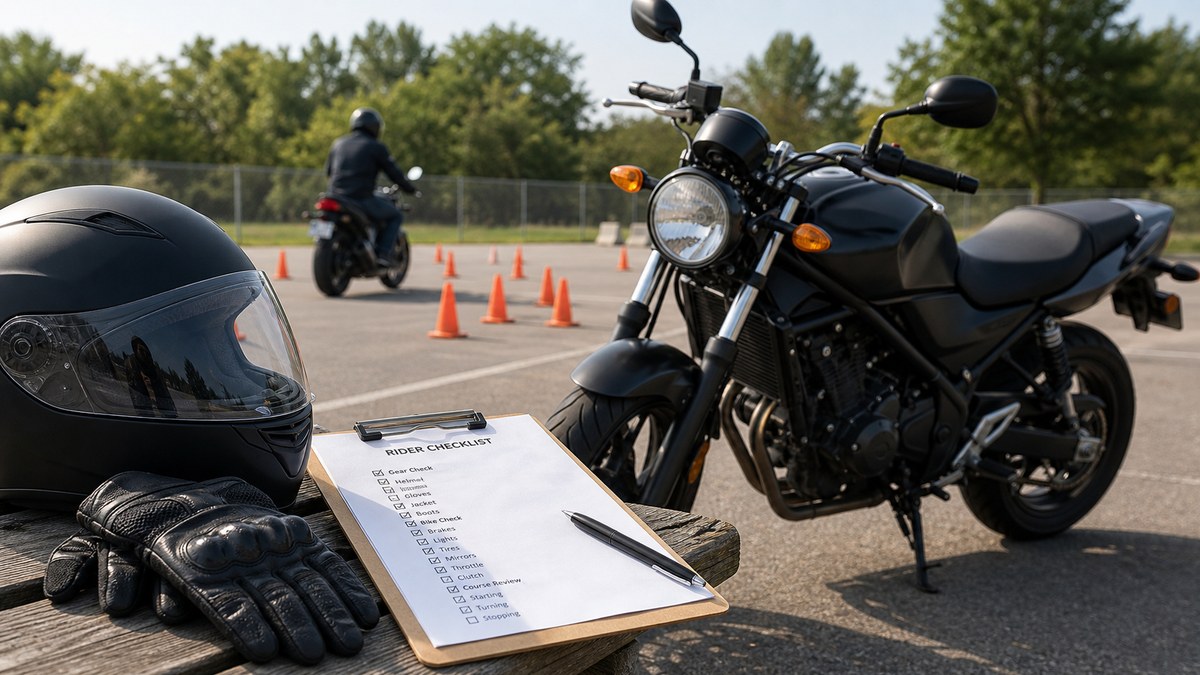
If your state does not waive the skills test through an approved course, you will need to pass the motorcycle riding test. Many motorcycle skills tests are held in a closed lot or controlled testing area rather than normal traffic.
Slow-speed control
Keep the motorcycle balanced through tight turns, starts, stops, and low-speed maneuvers.
Turning and swerving
Show that you can turn, change direction, and avoid a hazard without losing control.
Emergency stop
Brake quickly and smoothly while keeping the motorcycle stable and under control.
Examiners usually score with a points-deduction system. Too many points, unsafe actions, or dropping the motorcycle can cause a failed attempt.
Step 7
Get your license or endorsement issued
After you pass the skills test or complete an approved course waiver, take the required certificate or test result to the DMV. You may need to pay a motorcycle endorsement or license fee, update your license card, or wait for a mailed card depending on the state.
If you already have a driver license, many states add a motorcycle endorsement. If you do not, your state may issue a motorcycle-only license or a motorcycle class. Read license vs endorsement if you are comparing those paths.
Cost planning
Typical motorcycle license costs to budget for
Exact fees are state-specific and can change, but these planning ranges help you avoid being surprised before you schedule a course or DMV visit.
| Cost item | Typical planning range | What changes the price |
|---|---|---|
| Written test | $5-$25 | State testing fee and retest rules |
| Motorcycle permit | $10-$30 | Permit term and application package |
| Skills test | $15-$50 | DMV vs third-party provider |
| License/endorsement fee | $8-$30 | New license, renewal, or endorsement-only transaction |
| MSF/state rider course | $150-$350 | Public vs private provider and local availability |
Some public state motorcycle programs are lower cost or free for eligible riders, while private courses may cost more. Always verify the final amount with the official DMV or course provider.
Timeline
How long does the motorcycle license process take?
Permit
Study the manual, pass the written test, and receive the learner permit or instruction permit.
Course or practice
Complete the approved safety course if required, or practice under permit restrictions until ready for the skills test.
Skills test
Pass the closed-course skills test unless your approved course waives this step.
License or endorsement
Submit your certificate or test result, pay the fee, and receive the motorcycle license or endorsement.
- Fastest: about 4 to 6 weeks when appointments are available and an approved safety course waives the skills test.
- Average: about 2 to 4 months for riders who study, schedule a test, practice, and complete course or skills-test steps.
- Without a safety course: timing depends heavily on your state permit holding period and skills-test appointment availability.
Conversion path
Ready to start?
Pick your state, confirm the exact licensing steps, then use practice questions before you schedule the written test or rider course.
Motorcycle license FAQ
How long does it take to get a motorcycle license?
A fast path can take about 4 to 6 weeks if your state allows a safety course to waive the skills test and appointments are available. Many riders take 2 to 4 months because of permit holding periods, course scheduling, practice time, and DMV availability.
Do I need a motorcycle permit before a motorcycle license?
Most states require a motorcycle permit, written test, rider course, or similar learner step before the full license or endorsement. The exact sequence varies by state.
Can a motorcycle safety course replace the skills test?
In many states, an approved rider course can waive the DMV skills test, but the waiver rules, age requirements, and paperwork deadlines vary. Check your state licensing agency before relying on a waiver.
Is a motorcycle endorsement different from a motorcycle license?
Yes. An endorsement is usually added to an existing driver license, while a motorcycle-only license may be issued separately. Which one you need depends on your state and whether you already have a regular driver license.
What is on the motorcycle skills test?
Skills tests usually check slow-speed control, turning, stopping, swerving, emergency braking, and basic motorcycle handling. Many tests are done in a closed lot rather than normal traffic.
Can I use my own motorcycle for the skills test?
Some states or testing providers allow you to use your own properly registered, insured, and roadworthy motorcycle, while others use training-course motorcycles or have extra equipment rules. Verify this with your DMV or skills-test provider before test day.
What happens if I fail the motorcycle skills test?
You usually need to wait, reschedule, and retest. The waiting period, retest fee, and number of allowed attempts vary by state and testing provider.
Do I need motorcycle insurance before getting a license?
Insurance rules vary, but if you practice on a registered motorcycle on public roads, you should confirm registration and insurance requirements before riding. A course-provided training motorcycle may be handled differently.
Can I get a motorcycle license without a car license?
Some states offer motorcycle-only licenses, while others require or assume an existing driver license for an endorsement path. Check your state licensing page before applying.
How much does a motorcycle license cost?
Costs vary by state and course provider. A practical planning range is roughly $5 to $25 for a written test, $10 to $30 for a permit, $15 to $50 for a skills test, $8 to $30 for an endorsement fee, and $150 to $350 for many private rider courses.