Quick answer
How do you drive through a roundabout safely?
Slow down, read the lane-use sign, choose your lane before entering, and yield to pedestrians and traffic already circulating. Enter a safe gap, travel counterclockwise, stay in the marked lane, and follow the pavement guidance to your exit. If you miss the exit, continue around instead of stopping or cutting across a lane.
- At a multi-lane roundabout, yield to traffic in every circulating lane that affects your entry path.
- A common lane pattern uses right for a right turn and left for a left turn, but the posted arrows and destination diagram always control.
- Do not stop, pass, or make an unplanned lane change inside the roundabout; take a legal exit and reroute when necessary.
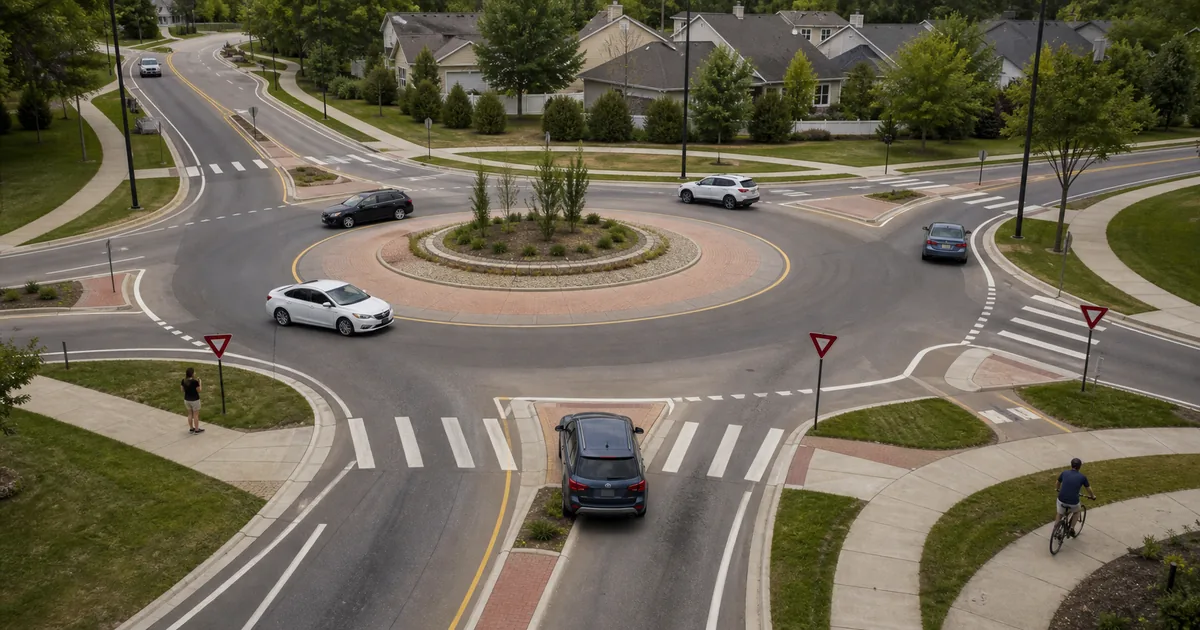
How do you drive through a roundabout? Slow down, check the lane-use sign, choose your lane before entering, yield to pedestrians and traffic already circulating, then enter a safe gap and travel counterclockwise. Stay in your lane, do not stop or pass inside the roundabout, and use the appropriate signal as you exit.
The most important multi-lane rule is simple: the signs and pavement arrows at that roundabout control your lane choice. A common pattern uses the right lane for a right turn, the left lane for a left turn or U-turn, and either marked lane for straight travel. That pattern is not universal, so never force a memorized lane rule over the posted diagram.
The rule to remember
Select, yield, enter, stay, exit
Select the correct lane before the entrance. Yield at the entry to pedestrians, bicyclists, and traffic in every circulating lane. Enter only when the gap is safe, stay in the chosen lane, and follow the lane markings out. If you miss the exit, continue around instead of stopping or cutting across a lane.
Use this six-step method at any modern roundabout
Read the lane-use sign early
Look for destination arrows, route shields, and pavement arrows before the lanes separate. Move into the lane assigned to your exit while you still have time to change safely.
Slow to the posted approach speed
Roundabout geometry is designed for low-speed decisions. Reduce speed before the crosswalk and keep enough space to stop for a person crossing or a queue at the yield line.
Check the crosswalk and look left
Yield to pedestrians in the approach crosswalk. Then look left for vehicles and bicycles already circulating, while continuing to scan the path ahead.
Yield to all circulating lanes
A clear nearest lane does not make a multi-lane entry safe. Check every circulating lane that your entry path will cross or join, and wait for a usable gap.
Enter and maintain your lane
Travel counterclockwise, follow the painted lane path, and avoid stopping, passing, or changing lanes inside. Give trucks, buses, motorcycles, and bicycles extra space.
Signal, scan, and exit
Use the signal required by your state and the local design, check the exit crosswalk, and leave in the lane directed by the pavement markings. Continue around if you miss the exit.
This method is more reliable than counting exits at the last moment. The correct decision starts before the yield line, when the lane-use diagram and arrows are easiest to read.
Is a roundabout the same as a traffic circle or rotary?
The terms are sometimes used casually as if they mean the same thing, but the design and right-of-way controls can differ. A modern roundabout normally has slow, curved approaches and a YIELD control for entering traffic. Vehicles already circulating have priority, and traffic moves counterclockwise around the central island.
Some older traffic circles or rotaries are larger, faster, or controlled differently. A neighborhood traffic circle may also be a traffic-calming feature rather than a modern yield-at-entry roundabout. Read the actual signs instead of assuming every circular intersection follows the same design.
| Feature | Modern roundabout | Other circular intersection |
|---|---|---|
| Entry control | Entering traffic normally faces YIELD control. | Control can differ; obey the posted signs. |
| Typical speed | Curved approaches encourage low-speed entry and circulation. | Older circles can be larger and faster. |
| Priority | Traffic already circulating normally has priority. | Do not assume; inspect the entry controls. |
| Lane guidance | Signs and pavement arrows direct movements. | Markings and lane patterns can vary widely. |
How to drive through a single-lane roundabout
A single-lane roundabout removes the lane-choice question, but the yielding sequence still matters:
- Slow down and identify your exit before reaching the crosswalk.
- Yield to pedestrians crossing the entrance.
- Look left and yield to vehicles or bicycles already in the roundabout.
- Enter when a safe gap reaches your approach. A complete stop is not required when the path is open, unless a sign, signal, traffic officer, or safety condition requires it.
- Travel counterclockwise without stopping or passing.
- Signal your exit as required or recommended by the state rule, then yield to pedestrians in the exit crosswalk.
Do not stop inside to let an entering vehicle go. The entering driver is responsible for yielding. Stopping unexpectedly can cause a rear-end crash and confuse every approach.
Which lane should you use at a multi-lane roundabout?
Use the lane assigned by the sign and pavement arrows. Many two-lane roundabouts follow the pattern below, but the local markings can assign straight, left, or right movements differently.
| Planned movement | Common approach lane | What to verify |
|---|---|---|
| First exit or right turn | Usually the right lane. | Confirm the right-lane arrow serves that exit and follow it into the correct exit lane. |
| Straight through | Often either lane. | Use only a lane marked for straight travel and remain in its painted path. |
| Left turn or later exit | Usually the left lane. | Confirm the left lane serves the destination and follow spiral or lane markings to the exit. |
| U-turn where permitted | Usually the left lane. | Check signs, vehicle restrictions, and the lane diagram before entering. |
Choose before the yield line. If you discover that you are in the wrong lane, follow that lane to a legal exit and reroute. Do not stop, turn from a prohibited lane, or cut across another circulating lane to rescue the route.
Multi-lane safety
Avoid lane changes inside the roundabout
Official guidance consistently tells drivers to stay in their lane and follow the markings. A lane change inside creates a side conflict while every driver is also watching exits, crosswalks, and circulating traffic. If a local design specifically guides a lane transition, follow its markings; otherwise remain in the lane you entered.
Read these roundabout signs and pavement markings
- Roundabout ahead warning sign: tells you to slow down and expect a circular intersection.
- Lane-use diagram: shows which approach lane reaches each direction or route.
- Pavement arrows: confirm permitted movements from the lane beneath your vehicle.
- YIELD sign and yield line: mark the entry point where circulating traffic has priority.
- Pedestrian crossing: identifies the setback crosswalk before an entrance or after an exit.
- Chevron or one-way signs: reinforce counterclockwise movement around the central island.
Destination signs can be more useful than counting the first, second, or third exit. If your route number or street name appears over one lane, position the vehicle there before the approach narrows.
Who has the right-of-way at a roundabout?
Drivers entering a modern roundabout yield to traffic already circulating. At a multi-lane entry, yield to traffic in all circulating lanes, not only the lane closest to you. A vehicle in an inner lane can be following markings toward your exit path.
Also yield to pedestrians in the crosswalk and to bicyclists using the roadway. A driver leaving the roundabout must check the exit crosswalk; circulating priority does not remove the duty to yield to a person crossing legally.
Do not wave someone into a gap you cannot verify. Another circulating lane may still be occupied. Predictable yielding is safer than inventing a courtesy rule that other road users cannot see.
How should you signal and exit?
State handbook wording on signals can differ. California tells drivers to signal when changing lanes or exiting, while Oregon directs drivers to use the right signal for the exit. Use the current rule in your state, but always make your exit predictable and never signal so early that another driver could mistake your intended exit.
As you approach the exit:
- Remain in the lane assigned to that exit.
- Use the required exit signal at a useful time.
- Check the path beside the vehicle for a bicycle or motorcycle.
- Look for pedestrians in the exit crosswalk and be prepared to stop after clearing the circulating roadway.
- Follow the exit lane without crossing a solid line or drifting into the adjacent lane.
If you miss the exit, stay calm and continue around. Take the exit on the next pass when the lane markings permit it. Reversing, stopping, or cutting across lanes is never the safe correction.
Pedestrians and bicyclists at roundabouts
Roundabout crosswalks are usually set back from the circular roadway. A splitter island may allow a pedestrian to cross one direction of traffic, pause, then check the other direction. Drivers must scan both the entrance and exit crosswalks because a person can be hidden by a queued vehicle.
A bicyclist may ride with traffic or dismount and use the pedestrian route, depending on the design and state rules. When a bicyclist rides in the lane, treat the bicycle as part of circulating traffic and do not pass inside the roundabout. When the person walks the bicycle through a crosswalk, treat that person as a pedestrian.
Large trucks and emergency vehicles
Give large vehicles the full space they need
Trucks and buses can off-track, meaning the rear wheels follow a tighter path than the front. Some roundabouts include a raised truck apron around the central island, and a large vehicle may need both lanes. Do not drive beside, squeeze past, or assume the truck will stay inside one narrow path.
Do not stop inside for an emergency vehicle
If an emergency vehicle approaches before you enter, pull right where safe and allow the roundabout to clear. If you are already inside, continue to your exit, then pull over as soon as it is safe. Stopping in the circulating roadway can block the emergency route.
Common roundabout permit-test traps
Stopping every time
A yield entrance does not automatically require a full stop. Slow, check, and stop only when traffic, pedestrians, a queue, or another control requires it.
Looking only at the nearest lane
At a multi-lane roundabout, yield to traffic in every circulating lane that affects the entry path.
Changing lanes inside
Select the lane before entering and follow the markings. Do not cross another lane to reach an exit.
Stopping for an entering car
Circulating traffic normally continues. The entering driver yields.
Ignoring the exit crosswalk
Scan for pedestrians and bicyclists before leaving the circular roadway.
Driving beside a truck
Large vehicles may straddle lanes or use the truck apron. Leave space and never pass them inside.
Roundabout mini self-test
Answer each scenario before opening the explanation.
1. You approach an empty single-lane roundabout with a YIELD sign. Must you stop?
Answer: Not automatically. Slow down, check the crosswalk and circulating roadway, and enter when the path is clear. Stop if safety or another control requires it.
2. You are going right at a two-lane roundabout. Which lane should you use?
Answer: Use the lane shown for that exit by the lane-use sign and pavement arrows. It is commonly the right lane, but the posted markings control.
3. The nearest circulating lane is clear, but a vehicle is in the inner lane. Can you enter?
Answer: Enter only when all circulating lanes affecting your path are clear. The inner-lane vehicle may be following markings toward the same exit.
4. You miss your exit. What should you do?
Answer: Continue around and take the exit on the next pass when the lane markings allow. Do not stop, reverse, or cut across a lane.
5. An ambulance approaches while you are already inside the roundabout. Where should you stop?
Answer: Do not stop inside. Continue through your exit, then pull over safely to let the emergency vehicle pass.
6. A large truck enters beside you in a two-lane roundabout. Should you pass it?
Answer: No. Drop back and give it space. The truck or trailer may straddle lanes or use the truck apron.
7. Who yields at the entrance?
Answer: Entering traffic yields to pedestrians at the crosswalk and vehicles or bicycles already circulating.
8. You realize before the yield line that your lane does not serve your exit. What is the safest choice?
Answer: Change lanes only if it is still legal and safely possible before entering. Otherwise follow the current lane to a legal exit and reroute.
Official sources checked
This guide summarizes common US roundabout principles. Signals, lane assignments, traffic-circle designs, and state statutes can differ, so the posted controls and current state driver handbook remain the final authority.
- FHWA: Modern Roundabouts – Do You Know the Rules?
- California DMV: Laws and Rules of the Road
- Oregon DMV: Turns, Intersections, and Roundabouts
- Washington State DOT: Roundabouts
- Minnesota DOT: Roundabout Guidance
Roundabout questions
Who has the right-of-way in a roundabout?
Traffic already circulating normally has priority. Drivers entering yield to circulating traffic and to pedestrians or bicyclists using the approach crosswalk.
Do you stop before entering a roundabout?
A YIELD sign requires you to slow and yield, not stop automatically. Stop when a pedestrian, circulating vehicle, queue, or unsafe gap prevents entry, or when another traffic control requires it.
Which lane should I use to go straight through a roundabout?
Use a lane marked for straight travel. Many two-lane roundabouts allow either lane to go straight, but some assign only one lane. The approach sign and pavement arrows control.
Which lane should I use to turn left at a roundabout?
The left lane is common for a left turn or later exit, but use the lane shown by the posted diagram and arrows. Stay in its marked path through the roundabout.
Can I change lanes inside a roundabout?
Avoid lane changes inside. Choose the correct lane before entering and follow its markings. If you are in the wrong lane, take a legal exit and reroute.
Do I use a turn signal at a roundabout?
Signal rules and handbook wording differ by state. Use the signal required for exiting or changing lanes in your state and make the signal timing clear enough that others do not mistake your intended exit.
What direction does traffic move in a US roundabout?
Traffic moves counterclockwise around the central island. Enter to the right and never drive left around the island.
What should I do if I miss my roundabout exit?
Continue around and take the exit on the next pass when your lane permits it. Never stop, reverse, or cut across another lane.
Editorial check
Official roundabout sources and state variation
This lesson summarizes common modern-roundabout principles reviewed against federal and state transportation guidance. Signal rules, lane assignments, traffic-circle designs, and statutes can differ, so obey the posted signs and markings and verify the current driver handbook for the state where you drive.
After the permit test
After you pass, here's what comes next
Passing the written permit test starts the supervised-driving stage. Use the After Permit guide to plan restrictions, driving hours, road-test practice, insurance questions, and the next steps toward a full license.
After you pass, here's what comes next →