Driving hours
Supervised Driving Hours Required by State (2026)
Most states require between 40-65 hours of supervised driving before you can take your road test. Some states split this into day and night hours. Here is the full breakdown by state.
July 26, 2026
State supervised-hour data was checked against the GHSA teen and novice driver law table, which cites IIHS and State Highway Safety Office review.
Quick answer
Use the required hours as your minimum, not your finish line
Find your state, note the total and night-hour requirement, then confirm the official driving log or certification form before scheduling a road test. A complete log helps with eligibility, but test readiness also depends on practicing intersections, parking, lane changes, night driving, and calm decisions with a licensed supervisor.
State-by-state supervised driving hours table
This table is a planning guide, not a substitute for your state DMV instructions. The GHSA table reports learner-stage supervised driving hours with night hours in parentheses when the state lists them. Each row has its own anchor link, so you can jump directly to a state such as Florida supervised driving hours, Texas supervised driving hours, or California supervised driving hours.
| State | Total Hours Required | Night Hours | Minimum Age for Road Test | Notes |
|---|---|---|---|---|
| Alabama | 50; 0 with driver education | Not separated | 16 | Learner age 15; typical permit hold 6 months; hours can change with approved driver education/training. |
| Alaska | 40 (10) | 10 hours | 16 | Learner age 14; typical permit hold 6 months. |
| Arizona | 30 (10); 20 (6) with defensive driving course; 0 with driver education | 10 hours | 16 | Learner age 15 / 6; typical permit hold 6 months; hours can change with approved driver education/training. |
| Arkansas | None listed in GHSA table | Not listed | 16 | Learner age 14; typical permit hold 6 months; no supervised-hour total is listed in the GHSA table; still follow local permit restrictions. |
| California | 50 (10) | 10 hours | 16 | Learner age 15 / 6; typical permit hold 6 months. |
| Colorado | 50 (10) | 10 hours | 16 | Learner age 15 with driver's ed 15 / 6 with driver awareness program 16 without driver's ed. or program; typical permit hold 12 months. |
| Connecticut | 40 | Not separated | 16 / 4 | Learner age 16; typical permit hold 4 with driver education, 6 without months. |
| Delaware | 50 (10) | 10 hours | 16 / 6 | Learner age 16; typical permit hold 6 months. |
| Florida | 50 (10) | 10 hours | 16 | Learner age 15; typical permit hold 12 months. |
| Georgia | 40 (6); 0 with behind the wheel training | 6 hours | 16 | Learner age 15; typical permit hold 12 months; hours can change with approved driver education/training. |
| Hawaii | 50 (10) | 10 hours | 16 | Learner age 15 / 6; typical permit hold 6 months. |
| Idaho | 50 (10) | 10 hours | 15 | Learner age 14 / 6; typical permit hold 6 months. |
| Illinois | 50 (10) | 10 hours | 16 | Learner age 15; typical permit hold 9 months. |
| Indiana | 50 (10) | 10 hours | 16 / 3 with driver's education 16 / 9 without driver's education | Learner age 15 with driver's education 16 without driver's education; typical permit hold 6 months. |
| Iowa | 20 (2) during Learner Stage 10 (2) during Intermediate Stage | 2 hours | 16 | Learner age 14; typical permit hold 12 months. |
| Kansas | 50 (10) | 10 hours | 16 (at 15, can drive without supervision to and from work or school) | Learner age 14; typical permit hold 12 months. |
| Kentucky | 60 (10) | 10 hours | 16 / 6 | Learner age 16; typical permit hold 6 months. |
| Louisiana | 50 (15) | 15 hours | 16 | Learner age 15; typical permit hold 6 months. |
| Maine | 70 (10) | 10 hours | 16 | Learner age 15; typical permit hold 6 months. |
| Maryland | 60 (10) | 10 hours | 16 / 6 | Learner age 15 / 9; typical permit hold 9 months. |
| Massachusetts | 40; 30 with advanced driver training | Not separated | 16 / 6 | Learner age 16; typical permit hold 6 months. |
| Michigan | 50 (10) | 10 hours | 16 | Learner age 14 / 9; typical permit hold 6 months. |
| Minnesota | 50 (15) or 40 (15) if parent completes 90 minute class | 15 hours | 16 | Learner age 15; typical permit hold 6 months. |
| Mississippi | None listed in GHSA table | Not listed | 16 | Learner age 15; typical permit hold 12 months; no supervised-hour total is listed in the GHSA table; still follow local permit restrictions. |
| Missouri | 40 (10) | 10 hours | 16 | Learner age 15; typical permit hold 6 months. |
| Montana | 50 (10) | 10 hours | 15 | Learner age 14 / 6; typical permit hold 6 months. |
| Nebraska | 50 (10); 0 with driver education | 10 hours | 16 | Learner age 15; typical permit hold 6 months; hours can change with approved driver education/training. |
| Nevada | 50 (10); 100 (10) if driver education not offered within 30 miles | 10 hours | 16 | Learner age 15 / 6; typical permit hold 6 months; hours can change with approved driver education/training. |
| New Hampshire | 40 (10) | 10 hours | 16 | Learner practice may begin before a formal permit stage; verify youth operator certificate and log rules with New Hampshire DMV. |
| New Jersey | None listed in GHSA table | Not listed | 17 | Learner age 16; typical permit hold 6 months; no supervised-hour total is listed in the GHSA table; still follow local permit restrictions. |
| New Mexico | 50 (10) | 10 hours | 15 / 6 | Learner age 15; typical permit hold 6 months. |
| New York | 50 (15) | 15 hours | 16 / 6 | Learner age 16; typical permit hold 6 months. |
| North Carolina | 60 (10) during Learner Stage 2 (6) during Intermediate Stage | 10 hours | 16 | Learner age 15; typical permit hold 6 months. |
| North Dakota | 50 for drivers under 16; otherwise none | Not separated | 16; 15 for a parent-requested restricted license (restricted license may only operate a vehicle owned by their parents, legal guardian, grandparent’s, sibling’s, aunt’s or uncle’s Class D noncommercial vehicle and may not drive a car with more passengers than the vehicle's manufacturer recommends). | Learner age 14; typical permit hold 12 for drivers under 16; otherwise, 6 months or until age 18 (whichever comes first). |
| Ohio | 50 (10) | 10 hours | 16 | Learner age 15 / 6; typical permit hold 6 months. |
| Oklahoma | 50 (10) | 10 hours | 16 | Learner age 15 / 6 with driver's ed; 15 without driver's ed; typical permit hold 6 months. |
| Oregon | 50; 100 without driver education | Not separated | 16 | Learner age 15; typical permit hold 6 months; hours can change with approved driver education/training. |
| Pennsylvania | 65 (10) + 5 in inclement weather | 10 hours | 16 / 6 | Learner age 16; typical permit hold 6 months. |
| Rhode Island | 50 (10) | 10 hours | 16 / 6 | Learner age 16; typical permit hold 6 months. |
| South Carolina | 40 (10) | 10 hours | 15 / 6 | Learner age 15; typical permit hold 6 months. |
| South Dakota | 50 (10 at night and 10 in inclement weather) | 10 at night and 10 in inclement weather | 14 + minimum of 6 months | Learner age 14; holding period is listed in days and may be shorter after approved driver education. |
| Tennessee | 50 (10) | 10 hours | 16 | Learner age 15; typical permit hold 6 months. |
| Texas | 30 (10) | 10 hours | 16 | Learner age 15; typical permit hold 6 months. |
| Utah | 40 (10) | 10 hours | 16 | Learner age 15; typical permit hold 18 months. |
| Vermont | 40 (10) | 10 hours | 16 | Learner age 15; typical permit hold 12 months. |
| Virginia | 45 (15) | 15 hours | 16 / 3 | Learner age 15 / 6; typical permit hold 9 months. |
| Washington | 50 (10) | 10 hours | 16 | Learner age 15 or 15 / 6 without driver's ed.; typical permit hold 6 months. |
| West Virginia | 50 (10); 0 with driver education | 10 hours | 16 | Learner age 15; typical permit hold 6 months; hours can change with approved driver education/training. |
| Wisconsin | 30 (10) | 10 hours | 16 | Learner age 15 / 6; typical permit hold 6 months. |
| Wyoming | 50 (10) | 10 hours | 16 | Learner age 15; GHSA lists a short 10-day minimum duration, so verify timing locally before scheduling. |
Source note: the table is based on the GHSA Teen and Novice Drivers law table, which lists IIHS and State Highway Safety Offices as sources and notes June 2025 state-office law review. Final DMV forms, eligibility, and road-test rules can still change locally.
Driving log
Download a simple supervised driving log
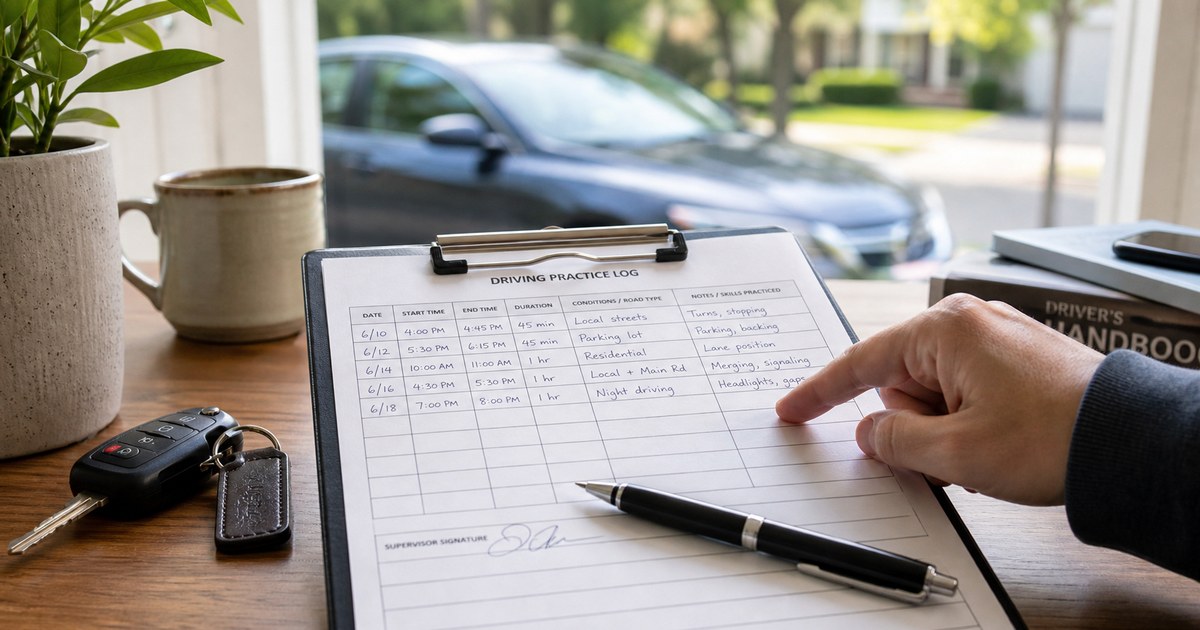
Use this printable log to track the date, start time, end time, minutes, day or night practice, road type, skills practiced, and supervisor initials. If your state provides an official log, use that official form for your final road-test paperwork.
How to log your hours
- Write the date, start time, end time, total duration, and whether the practice happened during the day or at night.
- Record the road type: parking lot, neighborhood streets, city traffic, rural roads, highway, rain, or low-light conditions.
- Add the main skills practiced, such as turns, lane position, parking, merging, scanning intersections, backing, or speed control.
- Ask the supervising adult to initial or sign the entry when your state requires parent or guardian verification.
- Keep your log in one place. A complete, clean log is easier to check before scheduling your road test.
Tips for parents and guardians
A good supervisor does more than sit in the passenger seat. Start with quiet routes, give one instruction at a time, and debrief after the drive instead of correcting every small mistake in the moment. As confidence improves, add busier intersections, lane changes, different weather, night driving, and highway practice only when your state allows it.
Try to structure practice sessions around one focus area. One session can be scanning and speed control, another can be turns and lane position, and another can be parking or backing. For a step-by-step practice plan, use our guide on how to structure practice sessions.
Supervised driving hours FAQs
Do supervised driving hours have to be logged on an official state form?
Some states require an official parent or guardian certification form, while others accept a simpler written record. Use your state DMV or licensing agency form when one is provided, and keep your own log as a backup.
Do night driving hours count toward total supervised hours?
In many states, night hours count toward the total but must also meet a separate minimum. For example, a state may require 50 total hours with 10 of those hours at night.
Can driver education reduce supervised driving hour requirements?
Yes, in some states approved driver education or behind-the-wheel training can reduce or replace a listed supervised-hours requirement. The table notes common alternatives, but the final rule should be verified with the official state source.
Should adults use the supervised driving hours table?
The table is most useful for teen and graduated-driver-license paths. Adult permit applicants may have different rules, shorter timelines, or no supervised-hours log requirement depending on the state.
Check your minimum holding period, logged hours, night-hour total, required signatures, vehicle documents, and appointment instructions. If you just passed your written test, start with what to do first after your permit, then come back to After Permit hub for the rest of the license path.
Sources and review note
This page summarizes supervised driving-hour rules from GHSA’s teen and novice driver law table and links learners back to their official state source before testing. US Permit Prep is independent and is not a DMV or state agency.