CDL skills test on-road segment
CDL Road Test Practice Test & Driving Guide (2026)
July 27, 2026
On-road skills, route situations, safety decisions, state variations, and official CDL sources were reviewed for this guide.
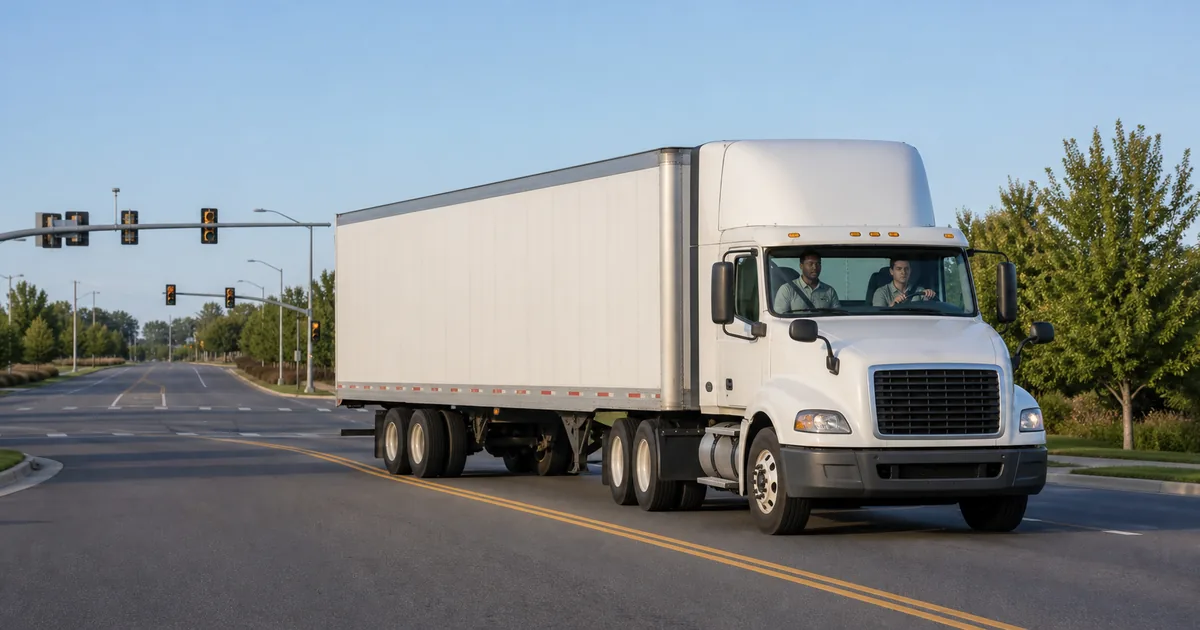
The CDL Road Test is the final on-road part of the commercial driver’s license skills test. It checks whether you can observe traffic, communicate, control speed and space, turn, change lanes, merge, cross railroad tracks, respond to route restrictions, and operate a representative commercial vehicle safely. This free scenario tool helps you rehearse those decisions, but it cannot replace legal behind-the-wheel training or the official state-administered test.
Quick answer
What is tested on the CDL Road Test?
Expect a route that gives the examiner opportunities to observe normal commercial driving: turns and intersections, traffic checks, lane use, speed and spacing, shifting and braking, curves, grades, roadside stops, highway or multilane driving when available, railroad crossings, and clearance or restriction signs. The exact route, error limits, critical-error rules, and retest process come from your state.
20 correct to reach 80%
216 original question variants
72 unique road-test concepts
The real Road Test is performed in traffic with a state examiner. Use this page to check judgment, then verify your state CDL manual and practice with a qualified CDL holder or approved instructor in the representative vehicle.
CDL Road Test scenario practice
Start a 25-scenario CDL Road Test practice session
Each session selects 25 different concepts from a 216-question bank. Practice observation, turns, lane changes, highway driving, speed and space, railroad crossings, clearances, and test-day judgment.
Crawlable sample scenarios
12 CDL Road Test decisions to review
These examples remain readable if JavaScript is unavailable. The interactive test selects no more than one variant from each concept group in a session.
- You realize you are about to miss the examiner’s turn. What should you do?Continue safely instead of making a sudden illegal maneuver, then wait for the examiner to redirect you.
- What must you check before changing lanes?Traffic ahead and behind, mirrors, the vehicle-appropriate blind area, the usable gap, and the full trailer path.
- Why must you watch both sides during a tight turn?The trailer can off-track to the inside while the rear of the vehicle swings outward on the opposite side.
- When should most slowing for an expressway exit happen?After the commercial vehicle has entered the deceleration lane, unless traffic or a hazard requires earlier action.
- How should you enter a curve?At a safe speed selected before the curve, using smooth steering and enough space to keep the entire vehicle in its legal path.
- What is the right response to traffic closing ahead?Release the accelerator early, preserve following distance, and brake smoothly rather than waiting for a hard stop.
- What should you do before a downgrade?Select a safe gear and speed before descending, then use the proper braking technique for the vehicle.
- When may you enter a railroad crossing?Only when the crossing is clear and there is enough room beyond it for the entire vehicle to clear the tracks.
- Should you shift gears while crossing railroad tracks?No. Select the needed gear before crossing so a missed shift cannot leave the vehicle on the tracks.
- What if overhead clearance is uncertain?Know the vehicle height and stop before the structure until a legal safe route is confirmed.
- Does an 80% online score mean you passed the official Road Test?No. It is a study benchmark; official scoring is hands-on and state-specific.
- What should you do after a minor mistake?Stay calm, restore safe control, and avoid turning one error into an unsafe correction.
On-road evaluation
The route is designed to reveal normal commercial-driving habits
Federal standards require states to test the skills needed to operate a commercial motor vehicle safely, while states select approved routes and administer scoring. A route should contain enough variety for the examiner to observe the required behaviors. When a suitable feature is unavailable, an approved simulated exercise may be used for certain items, such as a railroad crossing.
| Route situation | What the examiner can observe | Preparation focus |
|---|---|---|
| Urban streets and intersections | Stops, right-of-way, signal use, lane position, pedestrians, and smooth turns. | Scan early, reduce speed before turning, and protect the full vehicle path. |
| Multilane or highway driving | Merging, lane changes, following distance, speed choice, lane control, and exits. | Plan gaps early and move gradually with clear communication. |
| Curves and grades | Entry speed, steering, gear selection, brake use, stability, and space. | Choose speed and gear before the demand increases. |
| Roadside stop and start | Signaling, legal placement, securement, traffic checks, and reentry. | Do not stop in an unsafe location merely because the instruction was given. |
| Railroad or simulated crossing | Approach checks, required stops, available space, gear choice, and clearance. | Never enter unless the entire vehicle can clear the tracks. |
| Clearance and restriction signs | Whether the applicant notices height, weight, lane, or route limits. | Know vehicle dimensions and read commercial restrictions before committing. |
Do not memorize a rumored route as your main strategy. Construction, traffic, examiner direction, and testing-site procedures can change. Build transferable habits that remain correct wherever the approved route goes.
Observation and communication
Use a repeatable search pattern without losing the road ahead
Look far enough ahead
Identify signals, stopped traffic, lane closures, pedestrians, curves, clearance signs, and developing conflicts while there is still time to respond smoothly.
Scan mirrors frequently
Use the flat and convex mirrors for their proper purposes. Monitor traffic, lane position, trailer tracking, rear swing, and vehicles entering blind areas.
Check before every change
A signal does not create a gap. Verify the space before moving, continue checking during the maneuver, and cancel the signal afterward.
Communicate early
Signals, brake lights, lane position, and controlled speed tell other road users what the commercial vehicle is about to do.
Protect vulnerable users
Pedestrians, cyclists, and motorcycles can disappear near a large vehicle. If position is uncertain, reduce speed or stop until the path is confirmed.
Keep checks genuine
Use vehicle-appropriate head and eye movement. Overturning the body or staring at a mirror can remove attention from the path ahead.
Turns and intersections
Set up early so the trailer never forces a last-second decision
- Read the intersection.Identify the legal lane, signal phase, pedestrians, cross traffic, curb geometry, signs, and the space available after the turn.
- Signal and reduce speed before turning.Enter in an appropriate gear with a controlled speed. Late hard braking and shifting while turning reduce stability and attention.
- Plan for off-tracking and rear swing.Create only the legal space needed, keep checking both sides, and never use oncoming traffic, a curb, or another vehicle as part of the turning path.
- Keep the path clear.Yield as required and make sure the entire vehicle can complete the turn without blocking a crosswalk, striking an object, or trapping traffic.
- Finish in the legal lane.Use smooth steering, avoid changing lanes inside the intersection, straighten the vehicle, and cancel the signal.
A commercial driver may need more space, but must still obey signs, signals, lane rules, and yielding requirements. If a turn cannot be completed safely, stop before committing and follow the examiner’s direction.
Lane changes, highways, and curves
Make every large-vehicle movement gradual and predictable
| Situation | Safe sequence | Avoid |
|---|---|---|
| Lane change | Check ahead and behind, signal, verify the whole gap, move gradually, recheck, and cancel. | Moving as soon as the signal starts or forcing another driver to brake. |
| Highway merge | Use the acceleration lane to reach an appropriate speed and enter a planned gap. | Stopping at the lane end without need or crossing the gore. |
| Highway exit | Enter the correct lane early and reduce speed mainly in the deceleration lane. | Hard braking in a through lane or making a last-second multi-lane move. |
| Curve | Select a safe speed before entry and use smooth steering while monitoring vehicle path. | Hard braking, coasting in neutral, or abrupt correction inside the curve. |
| Lane closure | Recognize it early, communicate, and merge while usable space remains. | Driving to the last cone and demanding entry. |
Speed, space, braking, and shifting
Leave enough time to make smooth commercial-vehicle decisions
A heavy vehicle’s stopping distance and stability change with speed, load, grade, weather, brake condition, and traffic. The posted speed is a maximum under suitable conditions, not a target that must be maintained. The examiner is looking for a driver who sees risk early and creates options before hard braking or abrupt steering becomes necessary.
- Following space: use a gap appropriate for vehicle length, speed, road surface, visibility, and the traffic pattern.
- Downgrades: select a safe gear and speed before descending; do not coast in neutral or depend on continuous hard service braking.
- Wet or low-traction roads: reduce speed and increase space before reaching the hazard.
- Turns and intersections: complete major speed and gear adjustments before entering.
- Traffic slowing ahead: release the accelerator early and brake progressively while preserving an escape path when possible.
- Smooth control: coordinate steering, throttle, clutch, shifting, and braking without sudden inputs that upset the vehicle or cargo.
Special route situations
Railroad tracks and clearance signs demand decisions before commitment
Railroad clearance
Do not enter unless traffic beyond the tracks leaves room for the whole vehicle. Never wait with the tractor or trailer on a rail.
Required railroad stops
Buses and vehicles carrying certain hazardous materials have special duties. Follow the current state manual for stop position, checks, doors, windows, and signals.
Gear selection
Select the needed gear before crossing and avoid shifting on the tracks. A missed shift can strand the vehicle in the danger zone.
Height restrictions
Know the actual vehicle height and read marked clearances early. Stop before a low structure when safe clearance is uncertain.
Weight and route limits
Commercial restrictions are enforceable. Know vehicle weight and configuration before entering a bridge, lane, or restricted route.
Roadside stop/start
Choose a safe legal location, signal, position and secure the vehicle, then reenter only after checking all relevant traffic and blind areas.
Seven-session practice plan
Build consistency before trying a complete mock route
- Verify eligibility and the state procedure.Confirm CLP holding time, applicable ELDT completion, vehicle documents, testing appointment, representative vehicle, and current manual.
- Make cab setup automatic.Practice seat, mirrors, belt, controls, brake checks, and a full observation routine before movement.
- Train quiet-road fundamentals.Repeat smooth starts, stops, turns, lane position, signs, shifting, braking, and right-of-way with qualified supervision.
- Add multilane traffic.Practice gap choice, signals, mirror checks, lane changes, merging, exits, following space, and curves only when skill and conditions permit.
- Rehearse commercial restrictions.Identify railroad, height, weight, truck-route, lane, downgrade, and work-zone decisions using the current vehicle dimensions.
- Practice stop/start and recovery.Include a legal roadside stop, grade start, missed-turn recovery, stale signal, cut-in vehicle, and safe response to an unclear instruction.
- Run a state-style mock test.Have a qualified instructor observe the route without coaching, record repeated errors, and schedule targeted practice before testing.
FAQ
CDL Road Test questions
Is the CDL Road Test written or hands-on?
It is a hands-on on-road segment conducted in a representative commercial vehicle. This online tool checks judgment and route decisions, not physical driving skill.
How long does a CDL Road Test take?
Test length varies by state, site, traffic, route, and vehicle. Use your appointment instructions and state CDL manual rather than relying on one nationwide duration.
What mistakes cause an automatic CDL road-test failure?
States define critical and automatic-failure events. Unsafe acts, collisions, traffic-law violations, loss of control, and refusing or ignoring examiner directions are serious risks. Verify the exact state scoring rules.
Do I need to memorize the CDL road-test route?
No. The route can change, and the examiner provides directions. Build observation, lane, speed, spacing, turning, and restriction-sign habits that work on any approved route.
Will I have to drive on a highway?
The route should provide the situations required by the approved test standard when they are available. Highway or expressway driving, merging, multilane roads, curves, grades, or alternatives depend on the testing area and state procedure.
What happens if I miss the examiner’s turn?
Continue safely and wait for a new direction. Do not make a sudden lane change, prohibited turn, stop in a live lane, or back through an intersection.
What score should I aim for on this practice test?
Use 80%, or 20 correct answers out of 25, as the online knowledge benchmark. It is not the official hands-on score for every state.
Can this tool replace ELDT or behind-the-wheel training?
No. First-time Class A or B applicants and certain endorsement applicants may be subject to federal ELDT requirements. The official test also requires actual vehicle skill developed through legal supervised training.
Official sources
Verify your state route and scoring before test day
US Permit Prep is an independent study resource and is not FMCSA, a DMV, a driving school, or a testing agency. State routes, score sheets, critical errors, retest waiting periods, fees, documents, and vehicle requirements can change.
- FMCSA: How to get a Commercial Driver’s License
- FMCSA: State CDL programs and official manuals
- 49 CFR 383.113: Required CDL skills
- 49 CFR 383.133: Skills-test methods and standards
- AAMVA: Commercial Driver License testing
- California DMV Commercial Driver Handbook: Road Test examples
- FMCSA Training Provider Registry: ELDT and skills-test FAQs
- Find your official state CDL manual and licensing source
Complete the skills sequence