CDL combination vehicles
CDL Combination Vehicles Practice Test (2026)
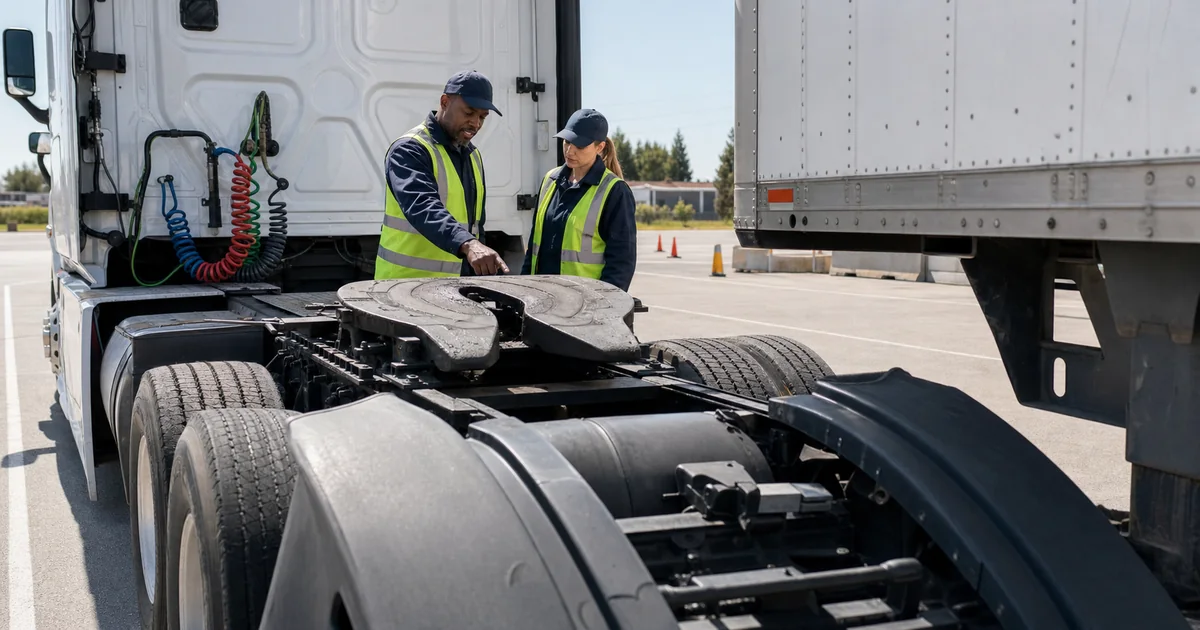
Use this free CDL Combination Vehicles practice test to review tractor-trailer handling, rollover prevention, off-tracking, trailer air systems, coupling and uncoupling, fifth-wheel inspection, ABS, and combination brake checks. Each session gives you 20 different concepts from a 171-question bank, with immediate feedback and an explanation after every answer.
Quick answer
Who needs the CDL Combination Vehicles test?
The Combination Vehicles knowledge test is generally required for applicants seeking a Class A CDL to operate Group A combinations such as tractor-trailers. FMCSA training material describes a 20-question test. It does not replace separate knowledge tests that may apply to air brakes, doubles/triples, tank vehicles, or hazardous materials.
16 correct to pass practice
171-question bank
No sign up
CDL Combination Vehicles practice test
Start a 20-question Combination Vehicles test
Each session draws 20 different concepts from a 171-question bank. Review safe handling, trailer air systems, coupling, fifth-wheel inspection, ABS, backing, and combination brake checks.
Crawlable sample questions
10 Combination Vehicles questions to review
These examples remain visible without JavaScript. The interactive test randomizes the answers and selects one question from each concept group so a session does not repeat the same rule in different wording.
- What reduces combination-vehicle rollover risk?Keep cargo low and centered, and slow before turns, ramps, and sudden direction changes.
- What is off-tracking?The rear wheels follow a path inside the front wheels, with the last trailer tracking farthest inward.
- How should you recover from a trailer skid caused by locked trailer wheels?Release the brakes so the wheels can regain traction; do not apply the trailer hand valve harder.
- What is the trailer hand valve for?Testing trailer service brakes, not routine driving or parking.
- What are the two jobs of the emergency air line?Charge the trailer air tanks and control the trailer emergency brakes.
- What can crossed service and emergency lines cause?The trailer tanks may not charge and the trailer brakes may not release or operate correctly.
- How high should a trailer be before coupling?Low enough that the tractor raises it slightly as the fifth wheel moves under the trailer.
- Where should fifth-wheel jaws close?Around the shank of the kingpin, not the head.
- How much gap should remain between upper and lower fifth-wheel plates?No visible gap after correct coupling.
- How are trailer emergency brakes checked?Charge the trailer, pull out the red trailer air-supply control, then tug gently against the trailer.
What to study
The Combination Vehicles test areas that matter most
The test is broader than coupling steps. A strong Class A study plan connects vehicle dynamics, trailer air systems, fifth-wheel security, brake checks, and low-speed maneuvering.
Rollover and steering
Center of gravity, load placement, safe turn speed, rearward amplification, smooth steering, and following distance.
Turns and backing
Off-tracking, wide turns, avoiding right-side traps, driver-side backing, mirror use, pull-ups, and getting out to look.
Trailer skids
Mirror recognition, locked trailer wheels, releasing brakes to restore traction, and why the hand valve can worsen a skid.
Trailer air systems
Service and emergency lines, glad hands, tractor protection, trailer air supply, tanks, shut-off valves, and chocks.
Coupling and uncoupling
Fifth-wheel setup, trailer height, alignment, air connections, tug test, jaw inspection, landing gear, and support surface.
Inspection and ABS
Slider pins, coupling security, line clearance, trailer ABS lamp, air flow, protection-valve checks, and trailer brake tests.
Quick reference
Trailer air lines and controls
Safety note: Color coding helps identify lines, but always confirm the labels and connections on the actual equipment. Follow your state manual, employer procedure, and vehicle manufacturer instructions.
| Part | Common identification | Primary purpose | Common test point |
|---|---|---|---|
| Service line | Often blue | Carries the foot-brake or hand-valve application signal to trailer relay valves. | Verify air reaches the rear while the service brake or hand control is applied. |
| Emergency line | Often red | Charges trailer tanks and controls emergency braking. | Loss of pressure applies trailer emergency brakes and closes tractor protection. |
| Trailer air supply | Red eight-sided knob on newer tractors | Opens or closes the trailer supply through the tractor protection valve. | Commonly pops out in the manufacturer range, often about 20-45 psi. |
| Trailer hand valve | Trolley valve or Johnson bar | Applies trailer service brakes for testing. | Use for a low-speed trailer service-brake check, not normal driving or parking. |
| Glad hands | Paired hose couplers | Join tractor and trailer service and emergency lines. | Check seals, cleanliness, correct pairing, secure lock, and leaks. |
| Shut-off valves | At the rear of trailers and dollies | Continue or stop air flow through a multi-unit combination. | Open between units; closed at the back of the last trailer. |
Coupling safety
Five checks that prevent a false coupling
This is a study summary, not a substitute for hands-on training. Coupling procedures differ by equipment. Use a qualified instructor and the exact procedure for the tractor and trailer you operate.
- Set up the fifth wheel. Confirm secure mounting, no missing or damaged parts, proper lubrication, open jaws, a seated release handle, and locked slider pins.
- Align and set trailer height. Back square to the trailer. The trailer should be low enough to rise slightly as the fifth wheel moves under it, not so high that the kingpin can ride above closed jaws.
- Connect and charge safely. Inspect and connect the service and emergency lines, supply trailer air, listen for leaks, and confirm trailer brakes apply and release.
- Perform the tug test. With trailer brakes locked and landing gear just clear of the ground, pull gently to confirm the kingpin is held.
- Inspect visually before travel. Verify no gap between fifth-wheel plates, jaws fully around the kingpin shank, release arm and safety lock secured, lines routed safely, landing gear fully raised, and turning clearance available.
On-road control
Why combination vehicles turn, stop, and back differently
Rear wheels cut inward
Plan for off-tracking before entering a turn. Watch the trailer and keep vulnerable road users out of the inside path.
Light can mean less traction
Bobtail tractors and lightly loaded combinations can lock wheels easily. Leave room, look far ahead, and brake early.
Back slowly and visibly
Set up for a straight or driver-side path, use both mirrors, correct drift early, take pull-ups, and get out to look when unsure.
Raised railroad crossings require special attention. Lowboy, car-carrier, moving-van, and other low-clearance trailers can become stuck. If a rig is stuck on tracks, leave the vehicle and tracks immediately, then contact the railroad using the posted emergency information or call 911.
Study plan
How to use this practice test effectively
- Take one 20-question baseline. Finish without opening the manual and note the weak categories shown on the result screen.
- Study by system. Separate vehicle dynamics, trailer air, coupling, uncoupling, inspection, and brake checks instead of memorizing isolated answers.
- Explain each safety consequence. For every correct answer, state what can go wrong if the step is skipped.
- Use the equipment language. Practice identifying the fifth wheel, kingpin, jaws, release arm, landing gear, glad hands, service line, and emergency line.
- Retake a fresh set. Use New Test until you can score at least 90% twice, then verify the procedure in your current state CDL manual.
FAQ
CDL Combination Vehicles test questions
How many questions are on the CDL Combination Vehicles test?
FMCSA National CDL Program training material describes a 20-question Combination Vehicles test. States administer their own tests under federal standards, so confirm the current format with your state licensing agency.
What score do I need to pass the Combination Vehicles test?
FMCSA requires at least 80% correct on CDL knowledge tests. On this 20-question practice session, that means at least 16 correct answers.
Is the Combination Vehicles test required for a Class A CDL?
It is generally part of the knowledge testing for applicants who want to operate Group A combinations such as tractor-trailers. Your state determines the final testing sequence.
Does this test include Air Brakes questions?
Combination-vehicle manuals include trailer air-line and brake-control topics, but applicants operating air-brake vehicles also need the separate Air Brakes knowledge and skills requirements. Use the dedicated CDL Air Brakes practice test as well.
Does this test cover doubles and triples?
It covers the combination-vehicle foundation, but doubles and triples have additional coupling, inspection, and handling material and require the applicable endorsement knowledge test.
Does this practice test replace hands-on coupling training?
No. Written questions cannot confirm that you can safely inspect, couple, uncouple, or perform the skills test. Practice with a qualified instructor using the type of equipment you expect to operate.
Will every new session show the same questions?
No. Each session selects 20 different concepts from 57 study groups and randomizes the answer order. The bank contains 171 question variants.
Official sources
Verify Combination Vehicles rules before testing
US Permit Prep is an independent study site and is not affiliated with FMCSA, any DMV, or any state licensing agency. Procedures, equipment, and test wording can change.
- FMCSA CDL knowledge-test standards and state manual guidance
- FMCSA National CDL Program training – Combination Vehicles test format
- California DMV Commercial Driver Handbook – Section 6: Combination Vehicles
- New York DMV Commercial Driver Manual – Section 6
- Find your state’s CDL guide and official agency link
Next CDL steps