CDL process
How to Get Your CDL — Complete Step-by-Step Guide (2026)
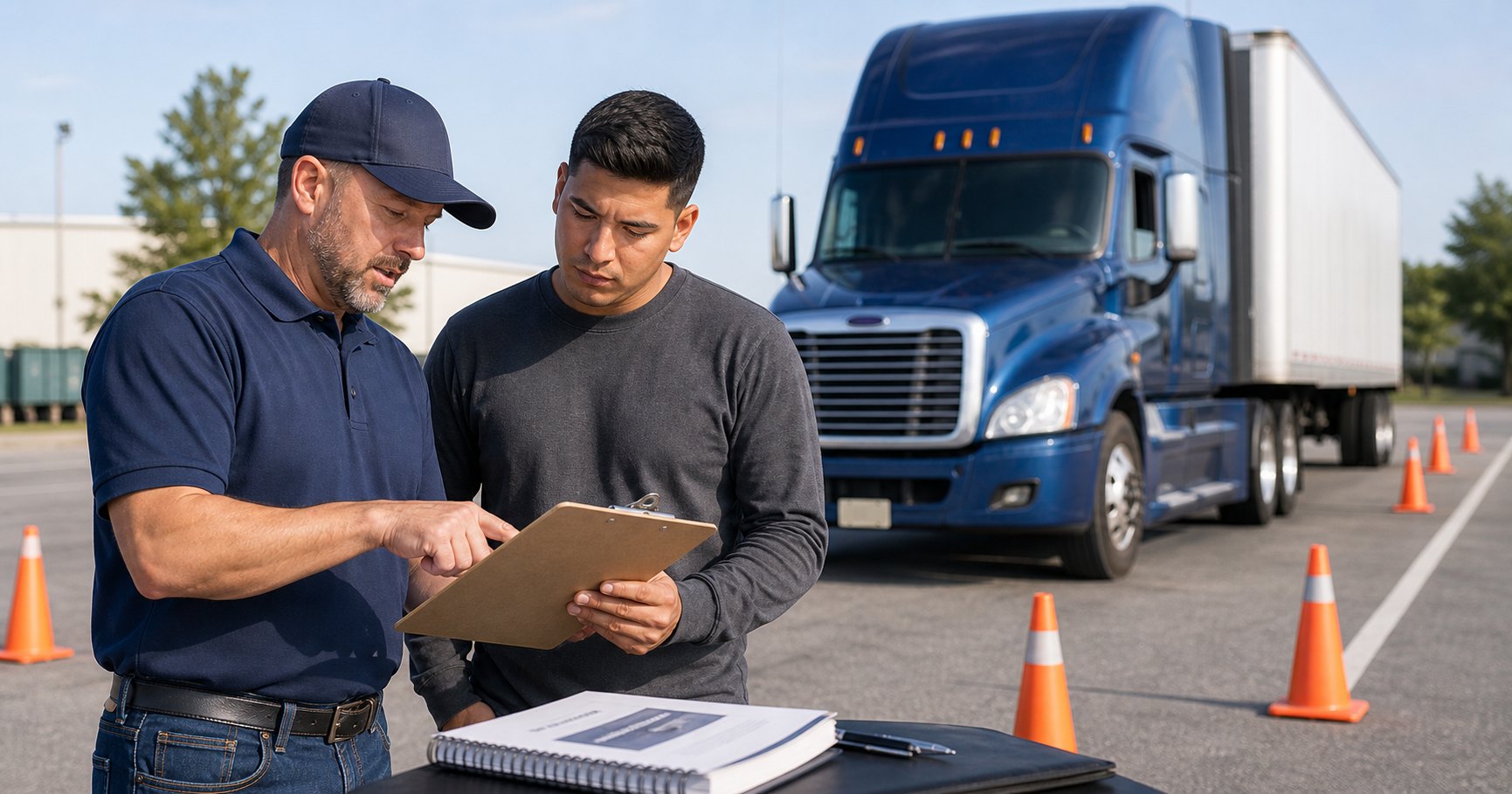
Getting a Commercial Driver’s License is not one single test. Most applicants move through eligibility checks, medical certification, CDL manual study, knowledge tests, a Commercial Learner’s Permit, training, and a three-part skills test before the license is issued.
Quick answer
The CDL path starts with a regular license and ends with a state-issued CDL after knowledge, training, and skills testing.
The exact paperwork and fees vary by state, but the main process is similar nationwide because CDL standards are federally regulated. Use this guide as the roadmap, then confirm your state-specific fees, documents, and appointment steps before you test.
Timeline summary
How long does it take to get a CDL?
| Path | Typical timing | What affects it |
|---|---|---|
| Fastest possible | About 3–4 weeks | Requires quick testing appointments, completed prerequisites, and enough time to satisfy the CLP hold. |
| Average applicant | 1–3 months | Study time, DOT medical exam, CLP scheduling, ELDT, skills-test availability, and state processing can stretch the timeline. |
| With CDL school | 3–7 weeks full time | Full-time training can move faster, but availability, class size, and state testing dates still matter. |
Step 1
Make sure you qualify
Before you apply for a Commercial Learner’s Permit, make sure you meet the basic CDL eligibility rules. You normally need a valid regular driver’s license, state residency, and a clean enough licensing record to apply.
- You generally need a valid non-commercial driver’s license first.
- You generally need to be at least 18 for intrastate commercial driving and 21 for interstate driving or certain endorsements.
- You must apply through your home state licensing agency.
- You cannot hold CDLs from more than one state.
If you are still deciding which license class fits your vehicle, review which CDL class you need before testing.
Step 2
Get a DOT medical exam
Most CDL applicants need a DOT physical from a certified medical examiner. The examiner checks whether you meet medical standards for the type of commercial driving you plan to do, and your certification status is usually filed with your state DMV or licensing agency.
Do this early if possible. A missing or expired medical certification can delay your CLP, test scheduling, or license issuance.
Step 3
Study the CDL manual
Every state publishes a CDL manual. Much of the core CDL content is based on federal commercial driving standards, but states can add local forms, fees, office rules, and testing instructions.
Start with general knowledge, then add class-specific and endorsement topics. When you are ready to test yourself, use the practice test to review safe driving, inspection, cargo, and commercial vehicle basics.
Step 4
Pass the CDL knowledge test and get your CLP
The General Knowledge test is commonly 50 questions with 80% needed to pass. Your exact testing package depends on the CDL class, air brake status, endorsements, and state system.
- General Knowledge is the core test for CDL applicants.
- Air brakes, passenger, school bus, tanker, hazmat, or doubles/triples can require extra tests.
- Passing the required knowledge tests lets you receive a Commercial Learner’s Permit, or CLP.
Step 5
Hold the CLP for at least 14 days
Federal CDL rules require you to hold the Commercial Learner’s Permit for at least 14 days before taking the CDL skills test. During this time, practice only under the supervision rules that apply to your CLP and state.
Use the 14-day period to build inspection habits, basic control skills, backing practice, and safe road driving with a qualified CDL holder supervising.
Step 6
Complete Entry-Level Driver Training (ELDT)
Entry-Level Driver Training applies to many first-time Class A and Class B applicants and certain endorsement applicants. When ELDT applies, training must be completed through a provider listed in FMCSA’s Training Provider Registry before the skills test or endorsement test can move forward.
ELDT includes theory and behind-the-wheel training. The exact schedule depends on the provider and the CDL path you choose.
Step 7
Pass the CDL skills test
The CDL skills test has three major parts. You must show that you can inspect the vehicle, control it in a closed-area setting, and drive safely on public roads.
Pre-trip vehicle inspection
Explain and demonstrate vehicle safety checks before driving.
Basic vehicle control
Show backing, turning, positioning, and maneuvering control in a test area.
On-road driving
Drive in traffic while demonstrating safe observation, control, lane use, and decision-making.
Step 8
Get your CDL issued
After you pass the skills test, your state licensing agency finishes the issuance step. Some states issue the CDL the same day, while others mail the physical license after processing.
Fees, paperwork, and timing vary by state. Before your final visit, check your state’s fees and rules so you know what to bring.
Next steps
Keep preparing
Review the basics
If you are new to commercial licensing, start with what a CDL is.
Choose the right class
Compare Class A, Class B, and Class C before you apply.
Practice knowledge topics
Use the practice test to prepare for your written exam.
Back to the CDL hub for all CDL guides and state pages.
CDL process FAQ
Common questions about getting a CDL
How long does it take to get a CDL?
The fastest path can take about 3 to 4 weeks, but many applicants take 1 to 3 months depending on training schedules, CLP timing, test appointments, endorsements, and state processing.
Do I need a DOT medical exam before getting a CDL?
Most CDL applicants need a DOT medical exam from a certified medical examiner. Your medical certification status is usually recorded with your state licensing agency.
How long do I have to hold a Commercial Learner’s Permit?
Federal CDL rules require the Commercial Learner’s Permit to be held for at least 14 days before taking the CDL skills test.
Is Entry-Level Driver Training required for every CDL applicant?
ELDT applies to many first-time Class A and Class B applicants and certain endorsement applicants. Training must be completed with a provider listed in FMCSA’s Training Provider Registry when the rule applies.
Official sources
Official CDL process sources checked
US Permit Prep is an independent study site and is not affiliated with FMCSA, any DMV, or any state licensing agency. CDL rules can change, so verify final requirements with official sources before testing or driving.