CDL skills test range
CDL Basic Control Skills Practice Test (2026)
July 27, 2026
Current and modernized maneuver sets, scoring terms, range-safety guidance, and official CDL sources were reviewed for this guide.
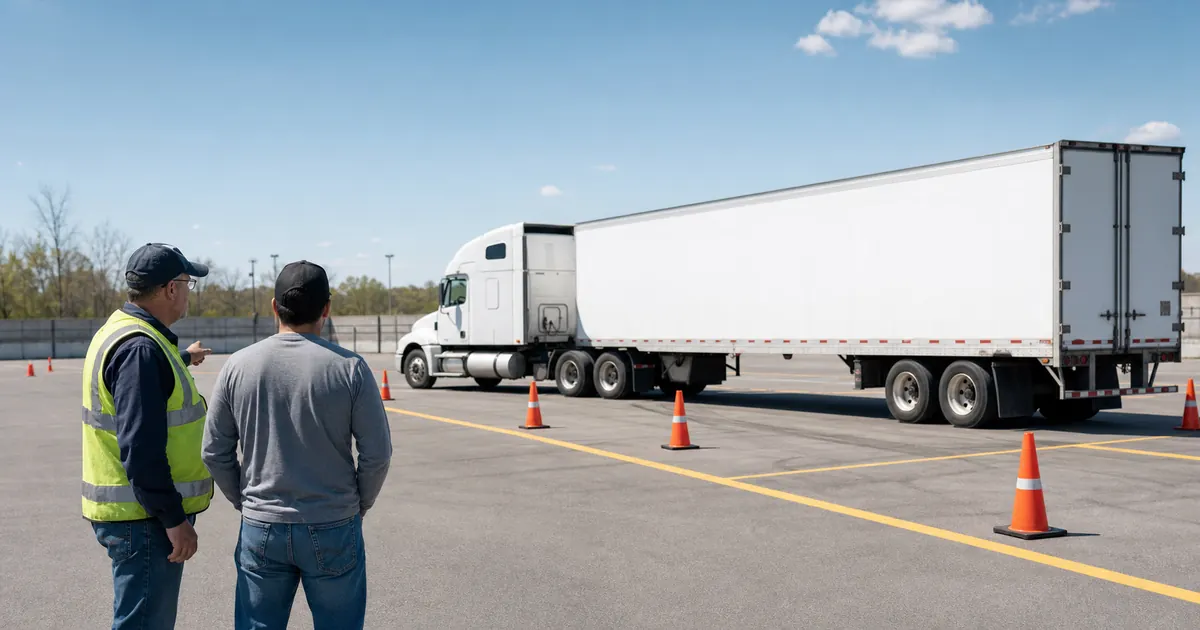
This free CDL Basic Control Skills practice test teaches the decisions behind low-speed commercial-vehicle maneuvers. It covers the modernized test exercises, the current backing and parking exercises, mirror use, reference points, pull-ups, encroachments, final position, range safety, and test-day judgment. The official Basic Control Skills test is performed in a vehicle, not on a screen, so pair this tool with supervised range practice and your current state CDL manual.
Quick answer
What is on the CDL Basic Control Skills test?
Your state may use the current CDL test, the modernized test, or both. The modernized sequence uses forward stop, straight-line backing, forward offset tracking, and reverse offset backing. The current system commonly tests straight-line backing, an offset back, and one parallel-parking or alley-dock exercise. The examiner scores position control, boundary encroachments, pull-ups, permitted outside observations, final position, and safe compliance with instructions.
20 correct to reach 80%
216 original question variants
72 unique control concepts
AAMVA confirms that jurisdictions may offer the current CDL test, the modernized test, or both. Exercise names, dimensions, permitted looks, pull-up limits, scoring, and automatic-failure rules must come from the current manual for the state where you will test.
CDL Basic Control Skills practice test
Start a 25-question Basic Control Skills test
Each session draws 25 different concepts from a 216-question bank. Review current and modernized exercises, scoring, range safety, mirror use, straight backing, offset maneuvers, parking, alley docking, and test-day decisions.
Crawlable sample questions
12 CDL Basic Control Skills questions to review
These examples remain readable without JavaScript. The interactive test selects no more than one prompt from each concept group during a session.
- What does the Basic Control Skills test measure?Your ability to control a commercial vehicle at low speed and judge its position relative to boundaries and other objects.
- What are the modernized BCS exercises?Forward stop, straight-line backing, forward offset tracking, and reverse offset backing.
- What does the current test commonly include?Straight-line backing, an offset back, and one selected parallel-parking or alley-dock exercise.
- What is an encroachment?Any part of the vehicle touching or crossing a scored boundary or cone.
- What is a pull-up?Changing from reverse to forward to improve position or avoid a worse error; a simple stop without changing direction is not automatically a pull-up.
- Why must outside observations follow state rules?States control how many looks are allowed, how they are performed, and how they are scored.
- How should you correct small drift in straight-line backing?Make a small early correction, observe the result in both mirrors, and return toward center as alignment improves.
- Why monitor the tractor nose during offset backing?Front swing can approach the opposite boundary while the trailer moves toward the target lane.
- Why do vehicle-specific reference points matter?Seat position, wheelbase, trailer length, mirrors, and course dimensions change what the driver sees.
- What should you do if a spotter disappears from view during practice?Stop immediately and do not move until communication and safe positioning are restored.
- Does an 80% quiz score mean you passed the official BCS test?No. It is an online study benchmark; the official test is hands-on and uses the state scoring method.
- What is the best final preparation?Practice the current state course in a representative vehicle with qualified supervision and repeatable safety procedures.
Current versus modernized
Prepare for the approved test system your state uses
FMCSA requires the Basic Controls Test as one part of the CDL skills test. AAMVA supports both the current and modernized testing systems, and a jurisdiction chooses which approved system to administer. The two systems evaluate the same underlying abilities but organize the range differently.
| System | Exercises | What the driver demonstrates |
|---|---|---|
| Modernized | Forward stop, straight-line backing, forward offset tracking, reverse offset backing. | Precise stopping, lane tracking, controlled backing, lateral position change, and final alignment. |
| Current | Straight-line backing; offset back left or right; one conventional/sight-side parallel park or alley dock. | Backing alignment, controlled articulation, boundary judgment, parking or dock placement, and final position. |
| Both systems | Use marked boundaries and examiner instructions in a closed or controlled test area. | Low-speed control, observation, corrections, clearance, and safe decision-making. |
Do not combine exercise instructions from the two systems during the official test. Download your state manual, identify the named test version, and rehearse that exact sequence and scoring vocabulary.
Scoring language
Know what the examiner records while you maneuver
Encroachments
A tire, bumper, trailer corner, or other part touching or crossing a marked boundary can count as an error. Monitor rear path, inside tracking, front swing, and final clearance.
Pull-ups
A forward correction after backing is commonly recorded as a pull-up. A controlled pull-up can still be safer than allowing a collision or major encroachment, but state limits apply.
Outside observations
A safe stop to look at the external position may be permitted and scored. Never open a door, leave the seat, or lean outside while the vehicle is moving.
Final position
Finishing inside the required area and at the instructed stop point matters. Getting most of the vehicle into the space is not enough when the tractor, trailer, or rear overhang remains outside.
Unsafe acts
Collisions, ignoring a stop command, endangering a person, refusing an exercise, or otherwise losing safe control can terminate the test.
State scoring
Permitted corrections, look limits, error thresholds, retest rules, and score carryover are jurisdiction-specific. The examiner and current state manual control.
Foundation maneuvers
Build precision with forward stop and straight-line backing
- Set the cab first.Adjust the seat and mirrors, fasten the belt, clear loose distractions, and understand the course before the vehicle moves.
- Use very low controlled speed.Idle-speed movement creates time to scan, steer, brake, and stop before a developing error reaches a boundary.
- Verify the forward-stop reference.During supervised practice, match a repeatable cab reference to the actual front stop position for that vehicle. Do not copy another truck’s mark without checking it.
- Compare both mirrors while backing.Unequal side clearance reveals drift. Make a small correction early, watch the response, and begin centering before the vehicle crosses the desired path.
- Finish on command.Stop at the specified rear or forward boundary, secure the vehicle as instructed, and do not make an unapproved correction after the exercise ends.
Tractor wheelbase, trailer length, bus overhang, mirror adjustment, seat position, and course dimensions change what you see. Learn principles here, then verify actual references in the vehicle you will test in.
Lateral movement
Control the angle instead of chasing the trailer
| Phase | Driver task | Common risk |
|---|---|---|
| Setup | Start at the assigned position with mirrors set and both destination boundaries identified. | Beginning from a poor angle or moving before instructions are complete. |
| Create movement | Use a controlled steer to create the needed lateral path or trailer angle. | Full-lock steering without watching rear path or front swing. |
| Track clearance | Alternate mirrors and monitor the destination lane, inside path, opposite-side swing, and course boundaries. | Fixating on one cone while another part of the vehicle approaches a line. |
| Follow and straighten | Reduce articulation and bring the tractor or straight vehicle into parallel alignment before the final boundary. | Holding the initial steering input too long and overshooting the lane. |
| Finish | Stop fully inside the target lane in the specified position. | Leaving the tractor and trailer split between lanes or crossing the rear boundary. |
The modernized test separates forward offset tracking from reverse offset backing. The current test uses offset back left or right. Practice the exact diagram your state provides and both directions when either can be assigned.
Current-test exercises
Study parallel parking and alley dock only when your state tests them
Conventional parallel park
The parking space is on the passenger side. Visibility and front swing differ from sight-side parking, so monitor both sides and use vehicle-specific references.
Sight-side parallel park
The space is on the driver side, where the target side is more directly visible. Final position still requires the whole vehicle to remain within the assigned boundaries.
Alley dock
Create a controlled angle, track the trailer or rear body toward the marked alley, watch opposite-side tractor swing, and begin straightening before alignment is lost.
GOAL in practice
Get Out And Look is a valuable real-world safety habit after a complete stop. During the official test, use only the outside-observation process the examiner permits.
A memorized steering-wheel count is fragile. The same count changes when seat position, wheelbase, trailer length, initial setup, tire angle, or course dimensions change. Practice repeatable setup, observation, angle control, and recovery with a qualified instructor.
Six-session range plan
Move from basic alignment to a complete test sequence
- Identify your state test system.Download the current official CDL manual and mark the exact exercises, dimensions, scoring rules, and automatic failures.
- Build cab consistency.Use the representative vehicle, set the same safe seat and mirror position, and verify actual reference points with an instructor.
- Master slow straight movement.Practice forward stopping and straight backing while comparing both mirrors and making small early corrections.
- Add lateral control.Practice the assigned forward or reverse offset pattern, focusing on angle creation, front swing, follow-up steering, and final alignment.
- Add state-specific legacy exercises.If your state uses the current system, practice the selected parallel-parking or alley-dock exercise with accurate course dimensions.
- Run a scored mock test.Have a qualified instructor use the state criteria, record encroachments, pull-ups, looks, final position, and unsafe acts, then retest weak maneuvers.
FAQ
CDL Basic Control Skills test questions
Is the CDL Basic Control Skills test written or hands-on?
It is a hands-on part of the CDL skills test performed in a representative commercial vehicle. This online tool checks maneuver knowledge, scoring terms, observation, and safe decision-making.
Which maneuvers will I have to perform?
It depends on your state. Modernized testing uses forward stop, straight-line backing, forward offset tracking, and reverse offset backing. The current system commonly includes straight-line backing, an offset back, and a selected parallel-parking or alley-dock exercise.
What is an encroachment on the CDL test?
An encroachment occurs when any part of the vehicle touches or crosses a scored boundary line or cone. The examiner observes the tractor, trailer, wheels, bumpers, rear overhang, and final position.
How many pull-ups or outside looks are allowed?
Limits and scoring vary by test system and state. Use the current state CDL manual and examiner instructions instead of relying on a nationwide number.
Can I use a spotter during the official BCS test?
The examiner administers the test, and applicants generally cannot use an outside coach for steering directions. During training, a properly positioned spotter can improve safety; stop immediately if the spotter disappears from view.
Does every state use alley docking and parallel parking?
No. Those are current-system exercise options. A state using the modernized system may use the four modernized exercises instead.
What score should I aim for on this practice test?
Use 80%, or 20 correct answers out of 25, as the online knowledge benchmark. Official BCS scoring is hands-on and state-specific.
Can this quiz replace truck-driving school or range practice?
No. It helps you understand the test, but vehicle control must be practiced legally with qualified supervision, accurate range dimensions, and a representative vehicle.
Official sources
Verify the test system before range practice
US Permit Prep is an independent study resource and is not a licensing agency or driving school. State procedures, course dimensions, scoring, permitted looks, pull-ups, retests, and fees can change.
- FMCSA: How to get a Commercial Driver’s License
- FMCSA: State CDL programs and skills-test standards
- 49 CFR 383.113: Required CDL skills
- 49 CFR 383.133: Skills-test methods and standards
- AAMVA: CDL testing and skills-test modernization
- California DMV: CDL Modernization Supplement, Section 12M
- California DMV: Current Basic Control Skills Test examples and scoring
- Find your official state CDL manual and licensing source
Next steps