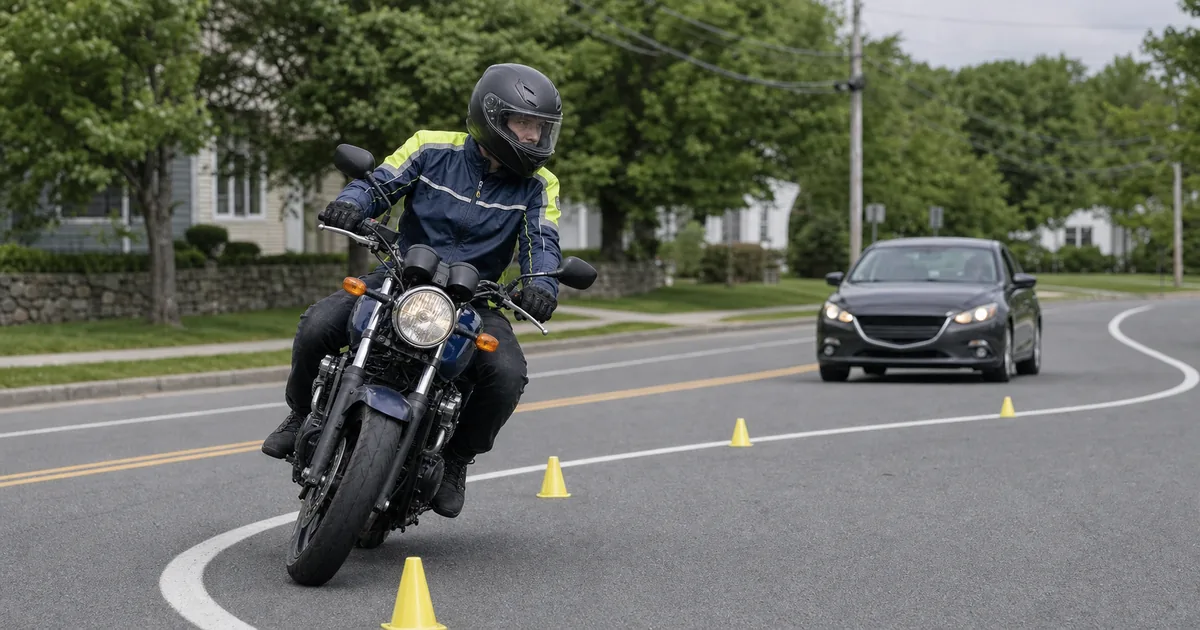
What happens on the New York motorcycle road test? The New York State Motorcycle Manual says the test includes normal riding maneuvers plus left and right circles and figure-eights on public streets. The examiner may evaluate safe speed, path control, stops, turns, swerves, communication, visibility, and decisions around traffic.
The part that surprises many applicants is transportation: you must provide the motorcycle and a properly operating, registered, and inspected car or truck with a qualified driver so the examiner can follow and observe you. This guide separates the official requirements from practical preparation advice so you can organize the test without a last-minute cancellation.
Quick answer
Prepare the rider, the motorcycle, and a separate follow car
For a standard New York motorcycle road test, bring a valid M or MJ learner permit, the documents required for your age and license history, a roadworthy registered and inspected motorcycle, and a separate roadworthy car or truck with a qualified driver to carry the examiner. Practice circles, figure-eights, controlled stops and turns, observation, signaling, lane position, and normal public-street decisions.
New York motorcycle road test at a glance
| Question | New York DMV answer | What to do |
|---|---|---|
| Where is it performed? | The manual says left/right circles and figure-eights are performed on public streets, alongside normal riding maneuvers. | Practice in legal public-street conditions with the required permit supervision; do not practice at a DMV road-test site. |
| How much practice is recommended? | At least 30 motorcycle hours, including at least 10 in medium-to-high-volume traffic. | Build low-speed control first, then add ordinary traffic, intersections, lane changes, and hazard response. |
| What extra vehicle is needed? | A properly operating, registered, and inspected car or truck for the examiner. | Arrange it before booking and confirm its driver is properly licensed for the vehicles involved. |
| When should you arrive? | Up to 15 minutes before the appointment. | Check closings and relocations before leaving; lateness can require rescheduling. |
| When are results posted? | After 6 p.m. on test day through the road-test results system. | Keep the result instructions the examiner gives you and follow the correct licensing path. |
| What if you fail? | The permit remains valid until expiration; wait at least 14 days before another non-commercial road test. | Use the result to guide practice and pay an additional fee after the first two road tests are used. |
Who can schedule a New York motorcycle road test?
You need a valid New York Class M or MJ motorcycle learner permit. If you are under 18, New York DMV requires at least six months from the permit issue date before you may schedule the road test. Junior applicants also need the supervised-driving certification discussed below.
If you do not already hold another class of New York driver license, you must complete a DMV-approved pre-licensing course or qualifying driver-education course before scheduling. An online pre-licensing provider reports completion electronically. Other course formats can require an original MV-278 or MV-285 certificate.
Junior rider rule
Class MJ applicants have a six-month wait and documented practice
A rider who is 16 or 17 must hold the junior permit for at least six months before the road test. New York’s general junior-license rules require at least 50 hours of supervised practice, including 15 hours after sunset, certified on form MV-262 by a parent or guardian. The certificate is presented each time the junior applicant takes a road test.
What maneuvers are on the New York motorcycle road test?
New York publishes two levels of detail. Its state-specific motorcycle manual explicitly names left circles, right circles, and figure-eights on public streets. The manual’s on-cycle skills section also describes the broader control and crash-avoidance abilities that may be evaluated.
Left and right circles
Use steady low-speed control, keep your head and eyes directed through the path, and avoid a sudden throttle or brake correction that widens the circle.
Figure-eights
Link two controlled turns while maintaining balance, path, awareness, and enough speed for stability. The maneuver occurs in a live street environment, not an isolated skill pad.
Normal starts and stops
Accelerate smoothly, stop under control, use the correct foot support, and remain aware of traffic behind and beside you.
Turns and lane position
Signal clearly, choose a safe entry speed, stay in the proper path, complete the turn without drifting, and cancel the signal when needed.
Quick stop or swerve response
The manual identifies quick stops, turns, and swerves as crash-avoidance skills. Practice them with qualified instruction in a safe legal setting before relying on them in traffic.
Traffic observation
Show that you see hazards, communicate your intentions, adjust speed and position, and make safe decisions rather than merely completing a shape.
What does the examiner score?
New York DMV does not publish a simple consumer points sheet that promises a specific deduction for each motorcycle mistake. Avoid websites that claim an exact universal scorecard without an official source. The state manual says an examiner may score safety factors including:
- selecting a safe speed for each maneuver;
- choosing the correct path and staying within boundaries;
- completing normal and quick stops;
- completing normal and quick turns or swerves;
- accelerating, braking, and turning safely;
- seeing, being seen, and communicating with other road users;
- adjusting speed and position to the traffic situation; and
- making critical decisions and carrying them out safely.
The practical lesson is simple: do not train only for the geometry of a figure-eight. You are being observed as a rider in traffic. A technically neat circle does not compensate for poor scanning, an unsafe gap, a missed signal, or speed that does not fit the situation.
What should you bring to the New York motorcycle road test?
| Item | Who needs it | Check before leaving |
|---|---|---|
| NYS photo motorcycle learner permit | Every applicant | Physical document is valid and not suspended or expired. |
| Corrective lenses | Applicant whose permit requires them | Bring the glasses or contacts named by the restriction. |
| Current New York driver license | Applicant who already holds another NY license class | Bring the physical license when adding M or MJ. |
| MV-278 or MV-285 | Original-license applicant when a physical certificate is required | Bring the original, unexpired certificate; copies are not accepted. |
| MV-262 supervised-driving certification | Applicant age 16 or 17 | Parent or guardian has completed and signed it for this attempt. |
| Motorcycle registration, inspection, and insurance | Test motorcycle | Records are current and the motorcycle is legally operable on public roads. |
| Follow car/truck records | Examiner transport vehicle | Registration and inspection are current; insurance and safe operation are confirmed. |
| Accompanying driver’s physical license | Driver transporting the examiner | The class and endorsements are valid for the vehicle arrangement. |
No extra passengers: New York limits the road-test-site arrangement to the required accompanying driver. Also remember that mobile ID is not accepted in place of the required physical license documents for the road-test arrangement.
The motorcycle and follow-car requirement
The examiner does not ride behind you. You provide a separate car or truck in which the examiner can observe the test. New York’s motorcycle page requires a properly operating, registered, and inspected motorcycle, plus a properly operating, registered, and inspected motor vehicle and qualified driver.
- Check the motorcycle. Test the brakes, tires, lights, signals, horn, mirror, controls, fuel, and visible leaks. Confirm registration, annual inspection, and liability coverage are current.
- Check the follow vehicle. It must be legal, clean, and safe enough to transport the examiner. Do not treat it as an optional ride home.
- Check the driver’s credentials. The accompanying driver must bring a physical license and meet the age and vehicle-class rules published for the test arrangement.
- Plan how the motorcycle reaches the site. If the accompanying driver is not licensed with motorcycle privileges, New York DMV says the motorcycle must be brought by trailer or pickup truck rather than ridden there under that person’s authority.
- Do not use an ineligible three-wheeler. New York’s current RT-3 instructions state that a three-wheeled vehicle with two wheels in front, a steering mechanism, safety belts, and non-straddle seating cannot be used for the motorcycle road test.
How to schedule the motorcycle road test
Use the official New York road-test scheduler or call 518-402-2100. You need the permit identification information, the location ZIP code, and at least one unused road test. If you do not already hold another New York license class, the pre-licensing requirement must be complete and properly recorded.
The scheduling system shows available sites near the ZIP code you enter. You do not have to test in your home county. Use the official road-test location finder and filter for motorcycle testing; not every location offers every test type.
DMV says the earliest appointment is commonly within three to five weeks but can extend to about ten weeks during busy summer and school-break periods. Those are scheduling estimates, not guarantees. Check the official cancellation and relocation page before traveling.
A practical New York motorcycle road test plan
Confirm eligibility and paperwork
Check the permit date, junior six-month requirement, pre-licensing record, MV-262 when applicable, and physical license documents.
Build stable low-speed control
Practice clutch/throttle coordination, straight starts and stops, head-and-eye direction, tight left and right circles, and connected figure-eights in a safe legal practice area.
Move the skills into public traffic
Under the required supervision, practice intersections, lane position, signaling, gap judgment, controlled turns, stops, and hazard response. DMV recommends 30 total motorcycle hours, including 10 in medium-to-high-volume traffic.
Rehearse the full vehicle arrangement
Confirm the motorcycle, follow car, qualified driver, documents, route to the site, and transport method. Do this before booking around someone else’s schedule.
Run a calm final session
Practice accuracy and observation at a sustainable pace. Stop before fatigue makes inputs rough. The goal is repeatable control, not one lucky perfect figure-eight.
Check the appointment on test day
Review cancellations, weather, vehicle condition, fuel, tire pressure, required papers, and arrival timing before leaving home.
Ride for safety, not theater
Make deliberate head checks and signals that match real observation. Choose safe gaps and speeds; do not exaggerate movements so much that they affect control.
Use the result correctly
Check after 6 p.m. If you pass, follow the temporary-license or amendment process. If you fail, wait the required period and repair the specific weak skills before retesting.
Can you waive the New York motorcycle road test?
Yes, but the waiver is not automatic and an out-of-state course does not qualify. New York DMV says an eligible rider must:
- be at least 16;
- hold a valid New York Class A, B, C, D, DJ, or E driver license;
- hold a valid New York Class M or MJ motorcycle learner permit; and
- present a qualifying Basic RiderCourse or BRC2 License/Waiver completion card from the New York State Motorcycle Safety Program within two years of completing the course.
A rider course can be the better path when you need structured instruction rather than more uncoached repetition. Verify the provider through the official New York program before paying, because a generic “MSF-style” or out-of-state completion card is not the same as a New York-approved waiver card.
What happens after the road test?
If you pass
The examiner gives you instructions for accessing the result after 6 p.m. If this is your first New York license, DMV says you receive a temporary motorcycle license and the photo license arrives by mail in about two weeks.
If you already hold another New York driver license class, wait at least seven days after passing before applying at a DMV office to add Class M or MJ. Bring the required MV-44, temporary motorcycle license, motorcycle permit, and current photo license. New York currently lists a $12.50 amendment fee; verify that fee before the office visit.
If you fail
Your valid learner permit does not disappear solely because of the failed test. New York requires at least 14 days before another non-commercial road test. The original application fee covers the first two road tests; after those are used, an additional fee applies before another test can be scheduled.
Do not spend the waiting period repeating the entire routine without diagnosis. Separate the result into low-speed control, path, speed, observation, communication, traffic judgment, and vehicle/setup issues. Practice the failed area until it is stable across several sessions.
Common New York motorcycle road test mistakes
Arriving with only the motorcycle
The examiner needs the separate car or truck and qualified driver you arrange. Missing that setup can stop the test before riding begins.
Practicing only in a parking lot
Low-speed control matters, but New York specifically uses public-street maneuvers and evaluates traffic awareness.
Staring at the front wheel
Looking down tightens control and hides hazards. Direct your head and eyes through the desired path while scanning traffic.
Using too little stable speed
Creeping without clutch/throttle balance can make the motorcycle wobble. Use smooth coordinated inputs rather than abrupt corrections.
Forgetting age-specific paperwork
A junior applicant needs the MV-262 and the six-month permit period. An original-license applicant may need the pre-licensing certificate.
Booking an auto-only location
Use the official location finder and confirm that the selected site offers motorcycle tests.
Assuming any rider course waives the test
The waiver depends on a qualifying New York State Motorcycle Safety Program course and the other DMV eligibility conditions.
Practicing at the test site
New York DMV states that practice driving is not allowed at road-test sites. Use other legal practice locations.
Next step
Pair road-test practice with New York rule review
The road test measures practical riding, but permit restrictions and motorcycle rules still control every practice session. Review the full state path and keep the current manual close.
Official New York sources checked
This article was reviewed against New York DMV sources on July 31, 2026. Appointments, locations, forms, fees, closures, and program rules can change. Check the official page again before scheduling or traveling.
- NY DMV: Get a Motorcycle Learner Permit and License
- NY DMV: Motorcycle Operator’s Manual (MV-21MC)
- NY DMV: Road Test Scheduling Instructions (RT-3)
- NY DMV: Road Test Locations
- NY DMV: Complete Pre-Licensing Requirements
- NY DMV: Cancellations, Closings, and Delays
New York motorcycle road test questions
What is on the New York motorcycle road test?
The test includes normal public-street riding plus left and right circles and figure-eights. The examiner may evaluate safe speed, correct path, stops, turns, swerves, communication, observation, and traffic decisions.
Why do I need a car for a New York motorcycle road test?
The examiner observes from a separate car or truck. You provide that vehicle and a qualified driver in addition to the motorcycle.
How much practice does New York DMV recommend?
DMV recommends at least 30 hours on a motorcycle, including at least 10 hours in medium-to-high-volume traffic. Junior applicants also have documented supervised-practice requirements.
Can I take the motorcycle road test without another driver?
No. The published arrangement requires a qualified accompanying driver and separate vehicle to transport the examiner. Check the exact age and license rules before test day.
Can a motorcycle safety course waive the New York road test?
Yes, for eligible riders using a qualifying New York State Motorcycle Safety Program course. You must also hold an eligible New York driver license and a valid M or MJ permit, and the course card must meet the DMV time limit.
How long must a rider under 18 wait?
A rider under 18 must wait at least six months from the issue date of the motorcycle learner permit before scheduling the road test.
What happens if I fail?
Your learner permit remains valid until it expires. Wait at least 14 days before another non-commercial road test, and pay the required additional fee after using the first two tests included with the application.
When do New York motorcycle road test results appear?
Check the official road-test results system after 6 p.m. on the day of the test, using the instructions the examiner gives you.
After the permit test
After you pass, here's what comes next
Passing the written permit test starts the supervised-driving stage. Use the After Permit guide to plan restrictions, driving hours, road-test practice, insurance questions, and the next steps toward a full license.
After you pass, here's what comes next →