State road-test maneuvers
Is Parallel Parking on the Driving Test?
Parallel parking is still tested in several states, but it is not a universal DMV road-test requirement. Use this official-source comparison to learn which maneuver your state publishes before setting up cones or booking practice time.
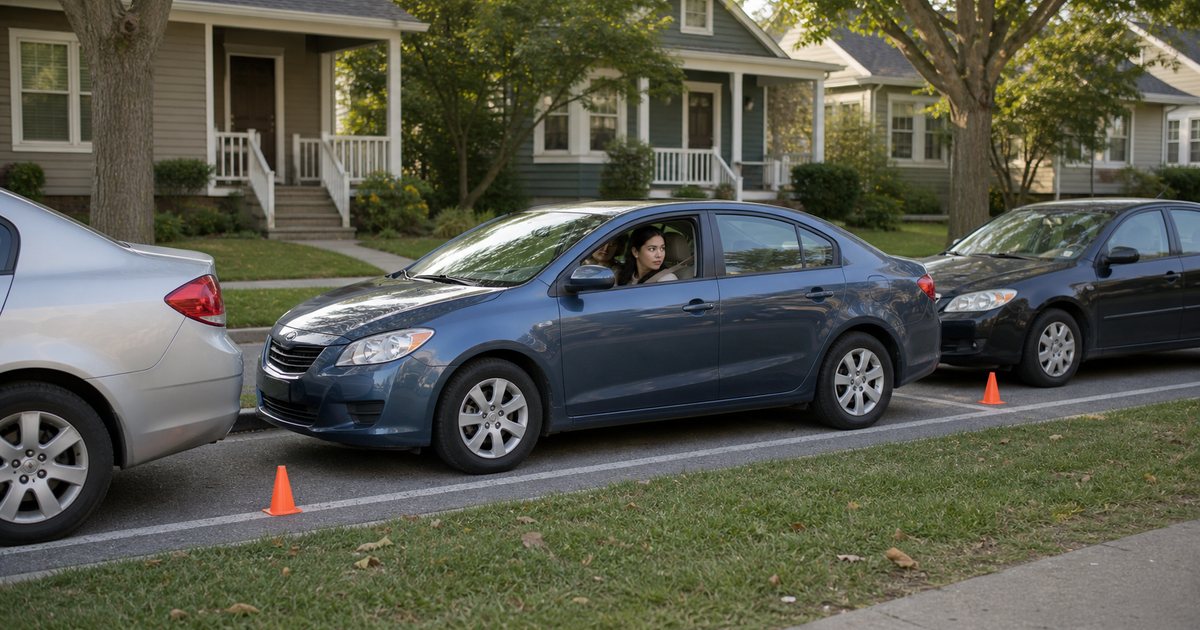
Official-source comparison
Parallel parking requirements by state
This table focuses on states for which a current official page, manual, or agency document gives useful public guidance. It does not turn an unpublished local practice into a statewide rule.
| State | Published status | What the official guidance says | Official source |
|---|---|---|---|
| Arizona | Traditional maneuver not named | MVD scoring includes whether the vehicle is outside the parking space, not parallel to the curb, or too far from the curb. Parking-assistance features are prohibited during the test. | Arizona MVD |
| California | Different backing exercise | The regular Class C DPE scores straight-line backing for three vehicle lengths while remaining within three feet of the curb. Automated parallel parking is not permitted. | California DMV |
| Florida | Not in published standard skill list | The current handbook lists straight-in parking and other skills rather than traditional parallel parking. Confirm current instructions at the test site. | Florida driver handbook |
| Georgia | Included | DDS publishes a 22-foot by 10-foot parallel-parking space and says the vehicle should be no more than 18 inches from the curb. | Georgia DDS |
| Illinois | Confirm test location | The Illinois Rules of the Road teaches parallel parking, but the public non-CDL test information does not publish one universal statewide maneuver list. | Illinois Rules of the Road |
| Iowa | Not required | Iowa DOT explicitly says parallel parking is not required on the driving test. | Iowa DOT |
| Maryland | Removed from Class C test | MVA removed parallel parking from the noncommercial Class C skills test statewide in 2015. | Maryland MVA notice |
| Michigan | Included as curved-path backing | The basic-control test uses a blind-side curved-path backing exercise commonly described as parallel parking. The official guide sets the space at the vehicle length plus six feet and eight feet wide. | Michigan skills-test guide |
| New Jersey | Included | MVC lists parallel parking among road-test skills. Backup cameras and parking sensors may be used, but self-parking vehicles are prohibited. | New Jersey MVC |
| New York | Included on every road test | The New York manual says parallel parking is part of every road test and describes finishing within one foot, or 30 centimeters, of the curb. | New York DMV |
| North Carolina | Parking tested; maneuver not specified | NCDMV’s public description includes stopping, starting, and parking but does not name one statewide parallel-parking exercise. | North Carolina DMV |
| Ohio | Different maneuverability test | Ohio separates the driving test from a maneuverability test through markers. This is not a conventional curbside parallel-parking setup. | Ohio BMV |
| Oklahoma | Included | The Service Oklahoma drive-test skill list explicitly includes parallel parking. | Service Oklahoma |
| Oregon | Not in published test-skill list | Oregon DMV’s current road-test page lists backing but not parallel parking. The driver manual still teaches parallel parking as a useful driving skill. | Oregon DMV |
| Pennsylvania | Included | PennDOT identifies parallel parking as a road-test component. Its parking guide teaches finishing no more than 12 inches from the curb. | PennDOT parking guide |
| Texas | May be graded | The Texas Driver Handbook says the test may grade parallel parking. A backup camera is permitted, but automated parking is not. | Texas Driver Handbook |
| Wisconsin | May be included | WisDOT’s road-test terminology includes an examiner instruction to parallel park, so applicants should prepare for it and confirm local instructions. | Wisconsin DOT road-test terms |
Not listed does not mean forbidden: a state may teach parallel parking without including it in the current standard test, and a local examiner may provide site-specific setup directions. Use the agency link and your appointment confirmation as the final word.
Published measurements
How close to the curb do you need to be?
There is no national curb-distance or space-size rule for noncommercial road tests. Published examples show why one memorized number is unreliable:
Practice precision, but also practice observation. A technically close finish will not offset unsafe movement, curb contact, missed checks, or failure to yield.
Practice method
How to practice parallel parking safely
This sequence is general practice guidance, not a replacement for the exact examiner directions used in your state.
Avoid these errors
Common parallel-parking test deductions
- Starting without a signal or blind-spot check.
- Reversing too quickly or relying only on mirrors or a screen.
- Contacting the curb, cone, marker, or another vehicle.
- Finishing outside the marked area or beyond the state’s published curb distance.
- Using too many corrections when the state limits attempts or corrections.
- Failing to observe traffic before entering or leaving the space.
Cameras and driver assistance
Can you use a backup camera to parallel park?
State rules differ. California allows safety technology as an aid but still requires visual checks and prohibits automated parallel parking. Texas allows a backup camera but not automated parking. New York and New Jersey allow certain cameras or sensors but do not allow the car to perform the maneuver. Arizona prohibits parking-assistance and similar ADAS features during its road test.
Best practice: train with your head, mirrors, and direct observation first. A camera may show distance behind the car, but it does not replace a blind-spot check or prove that the side path is clear.
Parallel-parking FAQ
Questions learners ask before the road test
Which states do not require parallel parking on the driving test?
Iowa DOT says parallel parking is not required. Maryland removed it from the noncommercial Class C test. Ohio uses a different marker-based maneuverability test, while California scores straight-line backing. Other states may not publish a universal maneuver list, so confirm locally.
How many attempts do you get to parallel park?
Attempt and correction limits depend on the state scoring system. California’s straight-line backing criterion allows one correction, while other states score positioning, observations, curb contact, or the number of adjustments differently.
Can you fail the whole test for hitting the curb?
Consequences vary by state and severity. Curb or marker contact can create a deduction, end the parking exercise, or contribute to a failure, especially when it creates an unsafe situation. Use the official scoring guidance for your state.
Can you use a backup camera during parallel parking?
Some states allow a camera as an aid but still require direct observation and prohibit automatic parking. Other states restrict parking-assistance technology. Confirm the rule before test day and follow the examiner.
How big is the parallel-parking space on a driving test?
There is no national size. Georgia publishes a 22-foot by 10-foot space. Michigan’s curved-path backing area is the test vehicle’s length plus six feet and eight feet wide. Your state or test site may use a different setup.