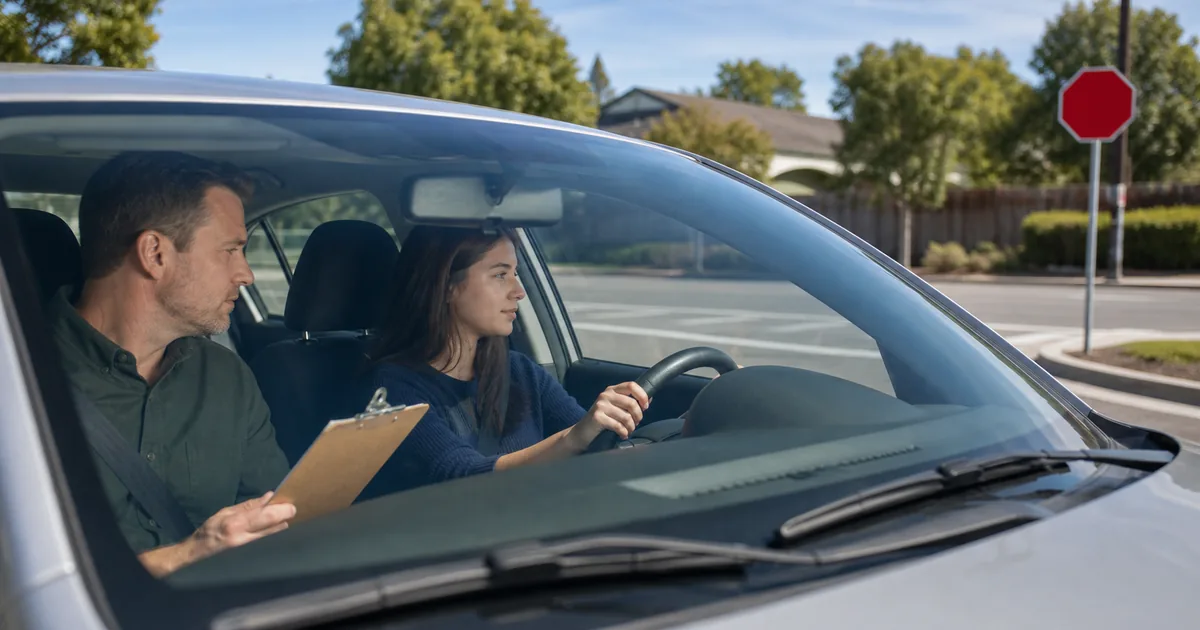
What are automatic fails on the driving test? They are serious mistakes that can end the road test or make the result unsatisfactory even if the rest of the drive looked acceptable. The exact scoring language changes by state, but the pattern is consistent: collisions, traffic-law violations, dangerous maneuvers, unsafe observation, vehicle-safety failures, and examiner intervention are the mistakes to avoid first.
Use this guide as a practical road-test preparation checklist, then verify final rules with your official state DMV or driver licensing agency. Some states publish a points sheet, some use critical-error language, and others use broader pass/fail judgment. Your examiner, test route, vehicle, and state scoring sheet control the final result.
Quick answer
Avoid danger, violations, and missing safety checks
The biggest automatic-fail risks are causing or nearly causing a crash, breaking a traffic law, ignoring right-of-way, running a red light or stop sign, speeding, making an unsafe lane change, hitting an object, failing the pre-drive safety check, or forcing the examiner to intervene. Build your practice around these errors before worrying about small deductions.
What counts as an automatic fail?
There is no single national road-test score sheet. California, for example, uses a Driving Performance Evaluation with critical driving errors and a pre-drive safety check. Alabama’s official road-test handout says an applicant may fail for an accident, law violation, reckless or dangerous driving, failure to cooperate with the examiner, or several safe-driving errors caused by habit or lack of practice. Texas publishes a driving-test preparation form that emphasizes signals, correct lanes, defensive driving, and safe control.
That means the phrase automatic fail is a learner-friendly shorthand, not always the exact official wording. A better way to think about it is: Would this mistake show the examiner that you are unsafe, illegal, unprepared, or unable to control the vehicle? If yes, treat it like a possible immediate fail.
| Risk type | Why it is serious | Practice focus |
|---|---|---|
| Safety event | A crash, near miss, curb strike, unsafe gap, or examiner intervention shows immediate risk. | Slow decisions down and do mock tests without coaching. |
| Law violation | Running a signal, rolling a stop, speeding, or ignoring a posted sign can fail the test even if control is smooth. | Practice legal stops, speed control, and sign scanning. |
| Observation failure | Mirrors alone are not enough when a blind-spot check is required. | Build visible mirror-head-blind-spot habits. |
| Vehicle problem | The test may be rescheduled or failed before driving if the car does not meet safety rules. | Inspect the vehicle the night before and again before leaving. |
| Control problem | Jerky braking, poor steering, drifting lanes, or backing without looking shows weak command of the car. | Practice at low speed until inputs are smooth and predictable. |
15 automatic-fail risks and how to avoid them
Do not memorize this list as a script. Use it to diagnose your practice drives. If one item still happens when you are nervous, tired, or in traffic, keep practicing before scheduling the test.
Stop control
1. Rolling through a stop sign
A rolling stop is one of the easiest habits to miss because experienced drivers sometimes do it casually. On a road test, the vehicle must come to a complete stop at the correct place: before the limit line, crosswalk, sidewalk edge, or intersection edge depending on the location.
Fix it: brake early, stop fully, pause long enough to feel the car settle, scan left-right-left, then move only when safe.
Signals
2. Running a red light or stale yellow
Trying to beat a light is a test-day disaster. If the signal changes and you can stop safely before the line, stop. If you are too close to stop safely, continue smoothly and legally. Panic braking and late acceleration both look unsafe.
Fix it: approach every controlled intersection with a plan: speed, mirror, signal if turning, brake point, crosswalk, and gap.
Right-of-way
3. Failing to yield to pedestrians, bicyclists, or vehicles
Right-of-way mistakes are serious because they can force another road user to stop, swerve, or hesitate. This includes unprotected left turns, crosswalks, four-way stops, roundabouts, bike lanes, and turning right across a pedestrian path.
Fix it: say the conflict out loud during practice: “pedestrian first,” “oncoming car first,” or “circulating traffic first.”
Speed
4. Driving too fast or too slow for conditions
Speed errors are not only about exceeding the posted limit. California’s DPE criteria warn that driving 10 mph over or under the speed limit, unless conditions justify it, is a critical driving error. Other states may use different scoring language, but unsafe speed judgment is always a major issue.
Fix it: practice matching speed to the posted limit, traffic flow, weather, school zones, turns, visibility, and hazards.
Lane changes
5. Changing lanes without a blind-spot check
Mirrors show part of the picture, not all of it. The examiner needs to see that you check traffic, signal, verify the gap, look over the correct shoulder when required, and move smoothly without cutting off another driver.
Fix it: use the same sequence every time: mirror, signal, mirror, blind spot, gap, smooth steer, cancel signal.
Vehicle control
6. Hitting a curb, cone, parked car, or other object
Light curb contact may be scored differently by state and situation, but striking an object can show loss of control. It is especially risky during parking, backing, right turns, and tight residential maneuvers.
Fix it: slow down before the maneuver, keep your eyes moving, and stop if your path is unclear.
Turns
7. Turning from or into the wrong lane
A smooth turn can still fail if it starts from the wrong lane, cuts through a bike lane incorrectly, swings wide, or finishes in the wrong lane. Multiple-turn-lane intersections need extra attention because the lane markings decide your path.
Fix it: read signs and arrows early. Enter the correct lane before the turn, signal, check, turn, and finish in the legally assigned lane.
Backing
8. Backing without looking in the direction of travel
Backup cameras and mirrors can help, but they do not replace direct observation when your state requires it. California’s criteria specifically warn that a camera cannot be the only thing used on the driving test.
Fix it: look over the correct shoulder, move slowly, pause if a pedestrian or vehicle appears, and use mirrors/camera only as aids.
Examiner safety
9. Making the examiner intervene
If the examiner must brake, grab control, give an urgent safety command, or prevent a collision, the test result is in serious trouble. Even without physical controls, a verbal intervention can show the applicant missed a dangerous situation.
Fix it: practice with a supervisor who stays quiet during mock tests. If they feel forced to warn you, record why and repair that habit.
Traffic signs
10. Ignoring road signs or pavement markings
Do Not Enter, One Way, Stop Ahead, No Turn on Red, lane-use arrows, school zone signs, and work zone controls are not decoration. Missing one can create a law violation or unsafe maneuver.
Fix it: practice naming signs as you approach: “speed limit,” “one way,” “school crossing,” “right lane must turn.”
Following distance
11. Tailgating or stopping too close
A safe driver leaves space to react. Following too close, stopping on another vehicle’s bumper, or crowding parked cars during residential driving can create deductions or a serious safety judgment.
Fix it: use at least a three-second following gap in normal conditions and leave enough room at stops to see the rear tires of the vehicle ahead.
Seat belt
12. Forgetting the seat belt or basic controls
Seat belts are checked before the car moves. You may also need to locate headlights, wipers, defroster, hazard lights, parking brake, horn, and arm signals depending on state rules.
Fix it: run a 30-second cockpit checklist before every practice drive: seat, mirrors, belt, controls, signal, brake, and route.
Dangerous habits
13. Using a phone or showing distracted behavior
A phone should not be in your hand, lap, or attention during the test. Distraction can also look like staring at the speedometer, missing pedestrians, or failing to respond to traffic changes.
Fix it: put the phone away before check-in, set navigation only if your state/test allows it, and keep your eyes moving outside the vehicle.
Instructions
14. Refusing or misunderstanding examiner directions unsafely
The examiner should not ask you to do anything illegal or unsafe, but you are responsible for completing directions only when it is safe. A missed turn is usually better than a dangerous last-second turn.
Fix it: if confused, ask calmly. If a direction comes too late to complete safely, continue legally and wait for the next instruction.
Vehicle readiness
15. Showing up with an unsafe or unqualified test vehicle
This one can end the appointment before the road portion begins. Broken brake lights, inoperative turn signals, unsafe tires, a cracked windshield blocking view, missing insurance, or a door/seat belt problem can stop the test.
Fix it: inspect the car the night before with the road-test vehicle requirements checklist.
Vehicle and document problems that can stop the test before you drive
Many learners focus only on the driving route and forget that the test begins before the car moves. California’s pre-drive checklist says certain mechanical failures cause the test to be rescheduled, and being unable to locate or demonstrate several controls can make the result unsatisfactory. Your state may name the items differently, but the practical checklist is similar.
| Check | What the examiner needs | What to do the night before |
|---|---|---|
| Brake lights and turn signals | Required lights work from front/back where applicable. | Ask a helper to stand outside while you test every light. |
| Mirrors and windshield | Clear visibility and secure mirrors. | Clean glass and repair any view-blocking damage before the appointment. |
| Tires | Safe tread and no visible unsafe condition. | Check pressure, tread, sidewall damage, and spare/rental restrictions if relevant. |
| Doors and seat belts | Examiner and driver can enter, exit, and buckle safely. | Test both front doors and both front seat belts. |
| Horn, wipers, defroster, hazards, headlights | You can locate and demonstrate controls. | Practice the cockpit control check without looking down too long. |
| Registration, insurance, appointment, permit/license | State-required paperwork is current and accepted. | Use the DMV what-to-bring checklist and keep originals where required. |
Practice priority
Fix safety errors before polishing parking
Parking and backing matter, but they are not the first priority if you still roll stops, miss blind spots, choose unsafe gaps, drift lanes, or speed through turns. A clean parking maneuver will not rescue a drive that looks unsafe in traffic.
A 7-day plan to remove automatic-fail habits
Day 1: Inspect the test car
Use the vehicle checklist and fix any brake light, signal, tire, mirror, windshield, insurance, or registration issue before practicing route skills.
Day 2: Rebuild full stops
Practice stop signs, red lights, limit lines, crosswalks, right turns on red, and four-way stops. Count every rolling stop as a failed repetition.
Day 3: Rebuild observation
Repeat lane changes, merges, curb pullouts, backing, and turns with visible mirror and blind-spot checks. Smooth steering comes after correct observation.
Day 4: Practice right-of-way decisions
Use residential intersections, crosswalks, roundabouts, school areas, and unprotected left turns. If another road user must brake for you, mark it as a serious error.
Day 5: Practice speed judgment
Drive different road types and say the target speed aloud during practice. Slow before curves, work zones, pedestrians, parked cars, and limited visibility.
Day 6: Run a quiet mock test
Your supervisor should give directions but avoid coaching. Afterward, review only serious safety events first, then minor deductions.
Day 7: Light review and document pack
Do not cram a long stressful drive. Confirm documents, vehicle, route, sleep, and arrival time. Use the printed checklist instead of memory.
Mini self-test: would this fail?
You stop after the crosswalk, then look both ways
Risk: high. The scan is good, but the stopping position can be wrong. Stop before the limit line or crosswalk, then creep forward only if you need a better view and it is legal/safe.
You miss the examiner’s turn direction
Risk: usually lower than a dangerous turn. Ask for clarification or continue legally. Never cut across lanes or brake suddenly to catch a missed turn.
You change lanes with mirror and signal but no shoulder check
Risk: high. If your state/test requires a blind-spot check, mirrors alone do not prove the gap is safe.
Your brake light is out but the car drives fine
Risk: high before the road portion. A safety-equipment failure can cancel or reschedule the test even if you are prepared to drive.
State rules can change the exact result
One state may call an error a critical driving error, another may count points, and another may use a broader examiner judgment. Some states publish score sheets; others publish preparation handouts or only give result feedback after the test. That is why this article uses the phrase automatic-fail risk for safety problems that commonly end or fail a road test, while still telling you to verify the official local rule.
Before scheduling, open your state road-test source and confirm:
- whether your vehicle and documents qualify;
- whether parallel parking, straight-line backing, three-point turns, or maneuverability are tested;
- whether backup cameras, rental cars, interpreters, or accompanying drivers are allowed;
- how many attempts, wait days, and retest fees apply after a fail; and
- what the score sheet or result page calls critical errors.
Next step
Turn this list into practice
Use the printable checklist before your appointment, then play short mistake scenarios to train fast recognition. If you are still building driving hours, go back to the supervised-practice plan before scheduling.
Official sources checked
US Permit Prep is independent and is not affiliated with any DMV or government agency. This article summarizes common road-test risks using official scoring/checklist examples and original preparation advice. Always follow your own state examiner’s instructions and current state source.
- California DMV Driving Test Criteria
- California DMV DPE Scoring Criteria
- California DMV Pre-Drive Checklist
- Texas DPS How to Prepare for a Driving Test
- Alabama ALEA Road Test Study Guide
Questions about automatic fails on the driving test
What is the most common automatic fail on the driving test?
It varies by state and examiner route, but rolling stops, unsafe lane changes, failure to yield, speeding, hitting a curb or object, and vehicle-safety problems are among the most common serious risks. Practice full stops and visible observation first.
Can you fail the driving test for going too slow?
Yes, if the speed is unsafe or far below the normal speed without a valid reason. California’s DPE criteria treat driving 10 mph over or under the speed limit, unless justified by conditions, as a critical driving error. Other states may use different wording.
Is hitting the curb an automatic fail?
It depends on the state, maneuver, severity, and whether the action is unsafe. Light contact may be scored differently from striking a curb hard, mounting it, hitting a cone, or creating danger. Treat curb contact as a serious practice problem.
Will a broken brake light cancel my road test?
It can. Many states inspect basic vehicle safety before the driving portion. California’s pre-drive checklist requires operational brake lights and turn signals, among other items. Check the vehicle before leaving for the appointment.
Can the examiner trick me into failing?
No official road test should ask you to do anything illegal or unsafe. California DMV says the examiner gives directions, but the applicant remains responsible for completing each action only when safe. If a direction cannot be done safely, continue legally and wait for the next instruction.
What should I practice the week before the driving test?
Practice full stops, right-of-way, blind-spot checks, lane changes, speed control, backing, parking or your state maneuver, and the pre-drive vehicle check. Do at least one quiet mock test where your supervisor does not coach you.
What happens if I fail the road test?
Your next steps depend on the state. You may need to wait a required number of days, pay a retest fee, keep practicing with your permit, or bring a corrected vehicle/document issue. Use the result sheet or official state instructions before rescheduling.
After the permit test
After you pass, here's what comes next
Passing the written permit test starts the supervised-driving stage. Use the After Permit guide to plan restrictions, driving hours, road-test practice, insurance questions, and the next steps toward a full license.
After you pass, here's what comes next →