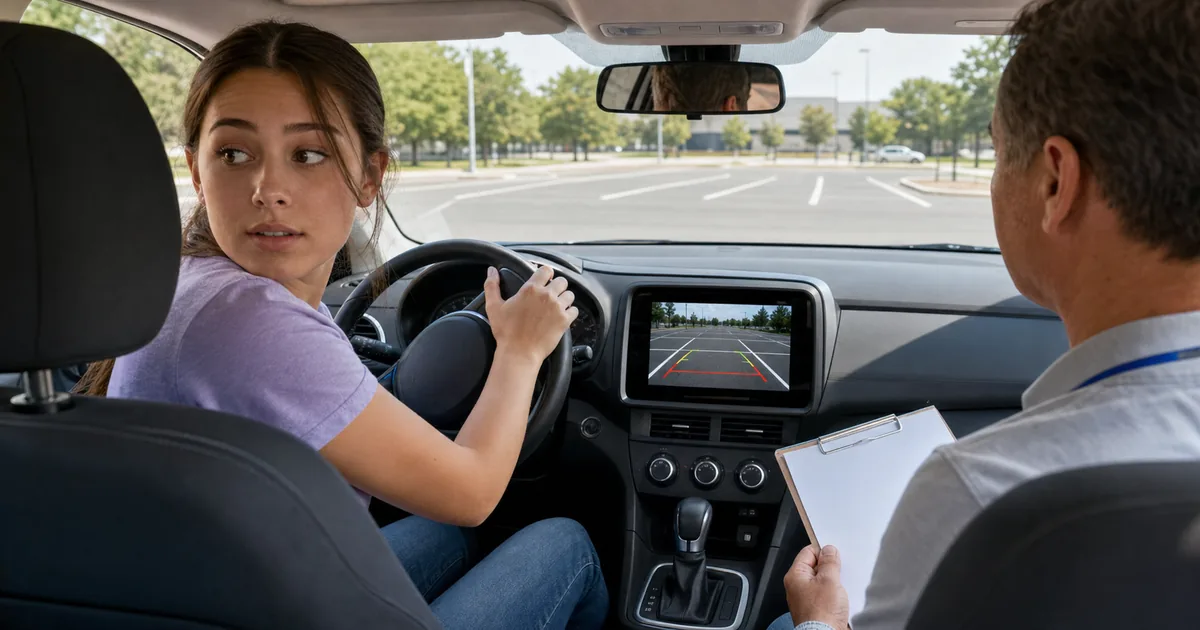
Can you use a backup camera on the driving test? In many states, yes, but only as an assistive safety feature. You still have to make real visual checks, look through the rear window when backing, use mirrors, check blind spots, and control the vehicle without letting technology drive for you.
This guide explains the difference between using a backup camera correctly and relying on it in a way that can hurt your road-test score. Rules vary by state, so use this as a practice guide and verify the final rule with your official DMV or driver licensing agency before test day.
Quick answer
Use the camera as a helper, not as your only check
On a road test, the safest habit is: stop, scan around the vehicle, shift into reverse, turn your head and look through the rear window, use mirrors, glance at the backup camera, move slowly, and keep checking until the maneuver is finished. If you stare only at the screen or let self-parking do the work, the examiner may treat that as unsafe or not permitted.
Backup camera, sensors, parking assist: what is usually allowed?
The main rule is simple: safety technology can support your driving, but it cannot replace your driving. A backup camera, blind spot monitor, rear cross-traffic alert, or parking sensor may help you notice a risk. The examiner still expects you to show the normal driving skill: observation, judgment, steering, braking, speed control, and right-of-way.
| Feature | How to treat it on test day | Risk if you rely on it |
|---|---|---|
| Backup camera | Use as a quick extra view while also looking over your shoulder and using mirrors. | Staring at the screen can look like you are not checking the real path of travel. |
| Parking sensors | Use beeps as a warning, then stop and verify visually. | Waiting for the beep instead of scanning can lead to curb or object contact. |
| Blind spot monitor | Use it as backup information after mirror and shoulder checks. | Changing lanes without a visible blind-spot check can still be scored as unsafe. |
| Rear cross-traffic alert | Take it seriously, stop, and look for the source of the warning. | Moving because the alert is silent does not prove the path is clear. |
| Automatic parallel parking | Do not depend on it unless your state explicitly allows it. | Many test programs want you to demonstrate the maneuver yourself. |
| Adaptive cruise control | Leave it off for the test unless instructed otherwise. | The examiner is grading your speed and space management, not the car’s automation. |
What official state sources say
States do not always use the same wording, but the pattern is clear: camera technology is usually allowed only when the driver remains fully engaged. Here are official-source examples that show how to think about the rule.
California
Backup cameras may be used, but visual checks still matter
California’s driver handbook says backup cameras and blind spot monitors may be used on the drive test, but they are not replacements for actual mirror and blind-spot checks. California’s scoring criteria also tells applicants backing in a straight line to turn the head and look through the back windshield instead of relying on mirrors or the camera alone.
New York
Warning systems can be permitted, but the driver is still scored
New York’s ADAS chapter lists camera technologies and parking sensors as permitted for testing, while automatic parallel parking and adaptive cruise control are not permitted. It also states that the license examiner evaluates whether the applicant safely operates the vehicle and does not rely on ADAS features.
Pennsylvania
A camera is an additional tool, not a substitute for your eyes
PennDOT’s parent guide teaches backing practice with mirrors and a backup camera, but reminds learners that a camera cannot substitute for looking. It also tells learners to check all areas behind the vehicle before and while backing.
How to use a backup camera correctly on the road test
The safest approach is to make your camera use obvious but secondary. The examiner should see that you are aware of everything around the car, not just the dashboard screen.
- Stop fully before backing. Do not roll into reverse while still moving forward.
- Scan around the vehicle first. Look ahead, to both sides, and behind before moving.
- Turn your head. Look over the correct shoulder and through the rear window while backing.
- Use mirrors. Check side mirrors for spacing, curb position, lane edges, and nearby vehicles.
- Glance at the backup camera. Use it to confirm distance and hidden low objects, not as your only view.
- Move slowly. Backing should be controlled enough that you can stop immediately.
- Keep checking until finished. Do not stare in one direction for the whole maneuver.
Simple test-day habit
Mirror, shoulder, camera, move slowly
Use this rhythm in practice: mirror check, shoulder check, quick camera glance, slow movement, repeat. It is not about performing for the examiner. It is about building a scan pattern that keeps the car controlled when you are nervous.
Backup-camera mistakes that can cost points
Observation
Staring only at the screen
The screen may not show every pedestrian, cyclist, curb, pole, or vehicle angle. If your head never turns, the examiner may not see a real traffic check.
Control
Backing too fast
A camera does not make speed safe. If you back quickly, you reduce time to react and make the maneuver look rushed.
Judgment
Trusting colored guide lines too much
Guide lines vary by vehicle and camera angle. Use them as a clue, then verify with real reference points, mirrors, and shoulder checks.
Automation
Letting the car park itself
Automatic parking systems may be blocked by state testing rules. Even where technology is present, the test is designed to evaluate your skill.
Lane changes
Using blind spot monitor instead of a shoulder check
A blind spot warning is useful, but it does not replace the visible check the examiner expects before lane changes, turns, merges, and curb pull-outs.
Equipment
Taking the test in a car you do not understand
If the camera lines, alerts, gear selector, parking brake, or sensors are unfamiliar, you will waste attention during the test. Practice in the exact car if possible.
15-minute backup-camera practice plan
Do this short routine in a quiet parking lot with a licensed supervising driver. The goal is not to become dependent on the screen. The goal is to blend technology into normal safe observation.
| Minute | Practice task | What success looks like |
|---|---|---|
| 0-3 | Stationary camera check | You understand the camera view, colored guide lines, and blind zones without moving. |
| 3-6 | Straight-line backing | You look over your shoulder, glance at the camera, and keep the vehicle straight at walking speed. |
| 6-9 | Back toward a parking line | You stop before the line without relying only on beeps or guide lines. |
| 9-12 | Back out of a parking space | You check left, right, behind, mirrors, camera, and cross traffic before moving. |
| 12-15 | Mock-test backing command | Your supervisor gives one instruction and you perform it without coaching. |
If this routine still feels awkward, do not schedule the road test yet. Backing is a small part of the exam, but unsafe observation during backing can reveal the same weakness that causes lane-change, merge, and parking mistakes.
What if your backup camera is broken?
A broken backup camera does not automatically mean the car is unsafe for every state road test, but other vehicle equipment can stop the appointment. Before test day, verify brake lights, turn signals, tires, windshield, mirrors, horn, registration, insurance, seat belts, and any state-specific inspection items. If the camera warning light, dashboard display, or reverse gear behavior creates confusion, use another test vehicle or call the testing office before the appointment.
Next step
Use this with your full road-test checklist
The backup camera rule is only one part of road-test prep. Before test day, practice automatic-fail risks, print the road-test checklist, and confirm that your vehicle meets state requirements.
Official sources and review note
US Permit Prep is independent and is not affiliated with any DMV or government agency. This guide summarizes official-source examples and safe-practice advice for learner drivers. Final road-test rules are controlled by your state examiner and licensing agency.
- California DMV – The Testing Process
- California DMV – DPE Scoring Criteria
- New York DMV – Advanced Driver Assistance Systems
- New York DMV – Pre-Licensing Course Student Manual PDF
- PennDOT – Parent’s Supervised Driving Program PDF
Questions
Can I use a backup camera during my driving test?
Often yes, but not as your only check. Use it with mirrors, shoulder checks, rear-window checks, and slow vehicle control. Verify your state rule before test day.
Can I fail for looking only at the backup camera?
Yes, it can hurt your score or create a serious safety issue because the examiner may expect visible head movement, mirror checks, and awareness of pedestrians, bicyclists, vehicles, curbs, and blind spots.
Is automatic parallel parking allowed on the road test?
Do not assume it is allowed. New York lists automatic parallel parking as not permitted for testing, and California says advanced systems such as automated parallel parking are not permitted during the drive test.
Can I use parking sensors on the road test?
Some states allow warning systems such as parking sensors, but they are only warnings. You still need to observe directly and control the car safely.
Should I turn off backup camera alerts before the test?
Usually no. Do not disable normal safety warnings unless your examiner instructs you to. The key is to respond to alerts safely while still driving and observing yourself.
What if my test car has no backup camera?
That is usually fine if the vehicle otherwise meets your state road-test requirements. You must still demonstrate safe backing with mirrors, shoulder checks, rear-window checks, and slow control.
Does a blind spot monitor replace checking over my shoulder?
No. Treat the monitor as an extra warning. For lane changes, merges, turns, and curb pull-outs, the examiner may still expect a visible blind-spot check.
After the permit test
After you pass, here's what comes next
Passing the written permit test starts the supervised-driving stage. Use the After Permit guide to plan restrictions, driving hours, road-test practice, insurance questions, and the next steps toward a full license.
After you pass, here's what comes next →