CDL T endorsement
CDL Doubles/Triples Practice Test (2026)
July 27, 2026
Doubles/triples endorsement rules, coupling procedures, inspection points, and air-brake checks were reviewed against current official CDL sources.
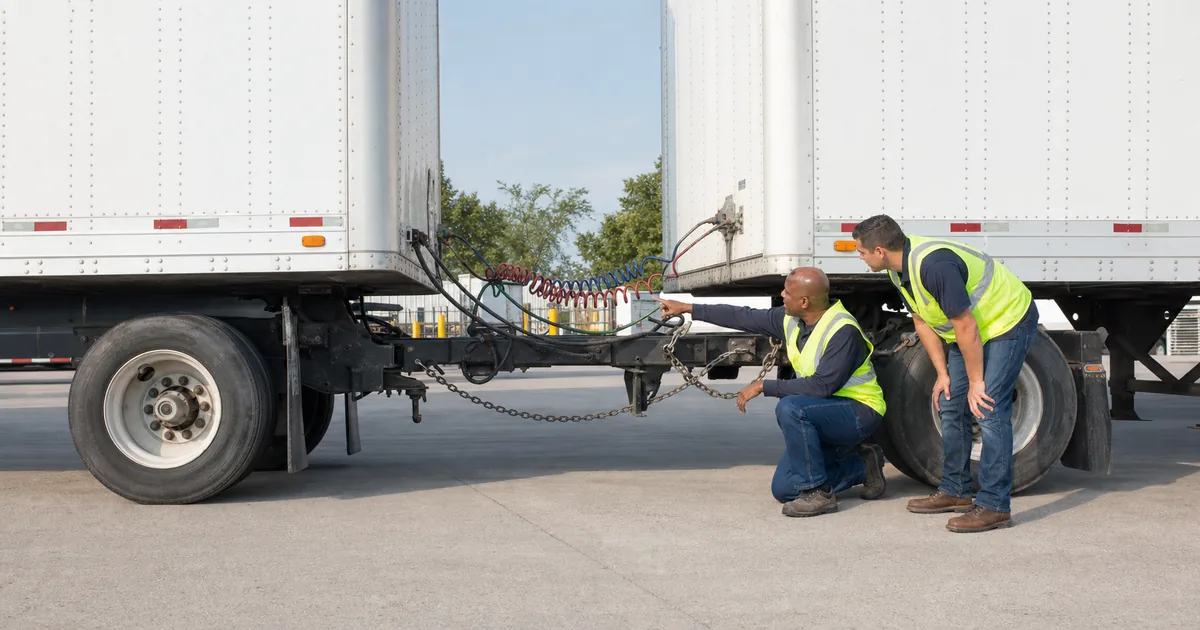
Use this free CDL Doubles/Triples practice test to study the T endorsement, crack-the-whip effect, converter dollies, coupling and uncoupling, trailer shut-off valves, inspection points, and air flow to every trailer. Each session gives you 20 different concepts from a 174-question bank, with immediate feedback and a clear explanation after every answer.
Quick answer
Who needs the CDL T endorsement?
A driver operating qualifying double or triple trailer combinations needs the T endorsement in addition to the correct CDL class. FMCSA lists T as a knowledge-test-only endorsement. It does not make triples legal in a state or on a route where that configuration is prohibited.
16 correct to reach 80%
174 original question variants
58 unique concepts
CDL Doubles/Triples practice test
Start a 20-question Doubles/Triples test
Each session draws 20 different concepts from a 174-question bank. Review stability, crack-the-whip, converter dollies, coupling, shut-off valves, inspections, and multi-trailer air-brake checks.
Crawlable sample questions
12 doubles and triples questions to review
These examples remain visible without JavaScript. The interactive test selects no more than one prompt from each concept group during a session.
- Which trailer is most likely to roll over from crack-the-whip motion?The last trailer.
- What position should the rear shut-off valves have on the last trailer?Closed.
- What position should rear shut-off valves have on trailers ahead of the last unit?Open.
- Why should the dolly be pulled from under the rear trailer before releasing the pintle hook?The tow bar can fly upward and cause injury if released while loaded.
- What should secure a second trailer without spring brakes?Wheel chocks.
- How should a driver approach curves with doubles or triples?Slow before the curve and steer gently.
- Where should fifth-wheel locking jaws sit?Around the kingpin shank, not the head.
- How can a driver check air flow through every trailer?Open the emergency-line shut-off at the rear of the last trailer and listen for escaping air.
- What should be checked about dolly safety chains?They are secured to the trailer and not damaged or dragging.
- Why do doubles and triples need larger traffic gaps?The longer combination cannot accelerate, turn, or clear traffic suddenly.
- What does T add to a CDL?Authority to operate qualifying double or triple trailer combinations after the required knowledge test.
- Does T make triples legal everywhere?No. State and route restrictions still apply.
Vehicle control
Control crack-the-whip and rollover risk
Steer gently
Sudden steering can amplify toward the rear. The last trailer is normally the most vulnerable to rollover.
Slow before curves
A speed that works for a single trailer can still be too fast for doubles or triples.
Look far ahead
Early hazard recognition gives you time to brake and change lanes gradually.
Leave more space
Allow extra following distance and larger gaps for crossing, merging, and changing lanes.
Respect poor conditions
Rain, snow, mountain grades, and additional dead axles increase skid and traction risk.
Brake smoothly
Early, balanced braking helps prevent a rear trailer from pushing, swinging, or jackknifing.
Converter dolly sequence
Know the safe coupling and uncoupling order
| Stage | Key action | Why it matters |
|---|---|---|
| Secure the rig | Park straight on firm, level ground; apply parking brakes; chock units without spring brakes. | Prevents uncontrolled movement. |
| Support the trailer | Lower landing gear enough to remove some weight from the dolly. | Controls trailer height and dolly load. |
| Isolate lines | Close required shut-offs, then disconnect and secure air and electrical lines. | Prevents line damage and air loss. |
| Release rear coupling | Release the dolly fifth-wheel latch and pull the dolly from under the rear trailer. | Removes the rear trailer’s weight from the dolly. |
| Secure the dolly | Lower dolly landing gear and apply spring brakes or wheel chocks. | Stops the converter gear from rolling. |
| Release pintle connection | Disconnect safety chains and release the pintle hook only after the dolly is supported and clear. | Prevents the tow bar from flying upward. |
Pre-trip inspection
Inspect every repeated and trailer-specific component
| Area | Verify | Do not operate when |
|---|---|---|
| Fifth wheels | Secure mounting, grease, no gap, jaws around kingpin shank, release arm seated, safety latch engaged. | Parts are missing, damaged, unlocked, or visibly separated. |
| Pintle connection | Eye is seated, hook is latched, and safety chains are secured. | Hook, eye, chains, or mounts are damaged or loose. |
| Air and electric lines | Correct glad-hand connections, no leaks, protected routing, enough slack for turns. | Lines leak, rub, drag, stretch, or are cross-connected. |
| Shut-off valves | Front trailer rear valves open; last trailer rear valves closed; dolly drain closed. | Valve positions prevent proper charging or release air. |
| Landing gear | Fully raised for travel, undamaged, crank secured, no air or hydraulic leaks. | Gear is bent, loose, leaking, or can strike the road. |
| Every trailer | Tires, wheels, lights, reflectors, brakes, cargo, doors, and frames are safe. | Any critical repeated component fails inspection. |
Air brake checks
Prove air reaches and controls every trailer
- Build normal pressure.Secure the vehicle, then push in the trailer air supply control.
- Send air through the service line.Use the trailer hand valve for the inspection procedure.
- Check the rear of the last trailer.Open the emergency shut-off briefly and listen for escaping air, then close it.
- Check protection and supply controls.Follow the official manual procedure for simulated emergency-line loss.
- Test trailer brake response.At low speed, apply the hand valve and confirm the trailers brake and the combination pulls straight.
- Check ABS indicators.A persistent warning after the normal lamp sequence can indicate a fault.
Study plan
Prepare by procedure, not answer position
- Take one 20-question baseline.Use the result to identify your weakest category.
- Draw the air path.Mark open front-trailer valves and closed last-trailer valves.
- Rehearse the uncoupling order.Focus on support, brakes or chocks, lines, dolly release, and pintle-hook timing.
- Inspect a real combination safely.With a qualified instructor, identify the fifth wheels, dolly, pintle hook, chains, glad hands, and light cords.
- Retake with a new mix.Aim for scores above 80% across several sessions, then verify state rules in your official manual.
FAQ
CDL doubles and triples endorsement questions
How many questions are on the doubles/triples endorsement test?
The live T endorsement test length varies by state. This practice tool uses 20 questions per session from a 174-question bank. Verify the current format with your state licensing agency.
What score counts as passing on this practice test?
The benchmark is 80%, or at least 16 correct answers out of 20.
Is the T endorsement a skills test?
FMCSA lists T as a knowledge-test-only endorsement. The driver still needs the appropriate CDL class and must comply with employer qualification and road-test rules.
Does a T endorsement allow triples in every state?
No. The endorsement does not override state configuration, length, route, or operating restrictions.
Which trailer is most likely to roll over?
The last trailer is generally the most vulnerable because crack-the-whip motion can amplify toward the rear.
How should trailer shut-off valves be positioned?
Rear shut-off valves on trailers ahead of the last unit should be open so air can continue rearward. The rear shut-off valves on the last trailer should be closed.
Does this replace the official CDL manual?
No. Use the test to locate weak topics, then verify procedures and state-specific requirements in your official CDL manual.
Will a new test repeat the same questions?
Each session selects 20 different concepts from 58 study groups. The bank contains 174 variants and randomizes answer order, so a new session produces a different mix.
Official sources
Verify doubles and triples rules before testing or driving
US Permit Prep is an independent study resource. State test length, fees, legal trailer configurations, route limits, and retake rules can change. Verify final requirements with your state licensing agency and employer.
Next steps