CDL hazardous materials endorsement
CDL HazMat Practice Test (2026)
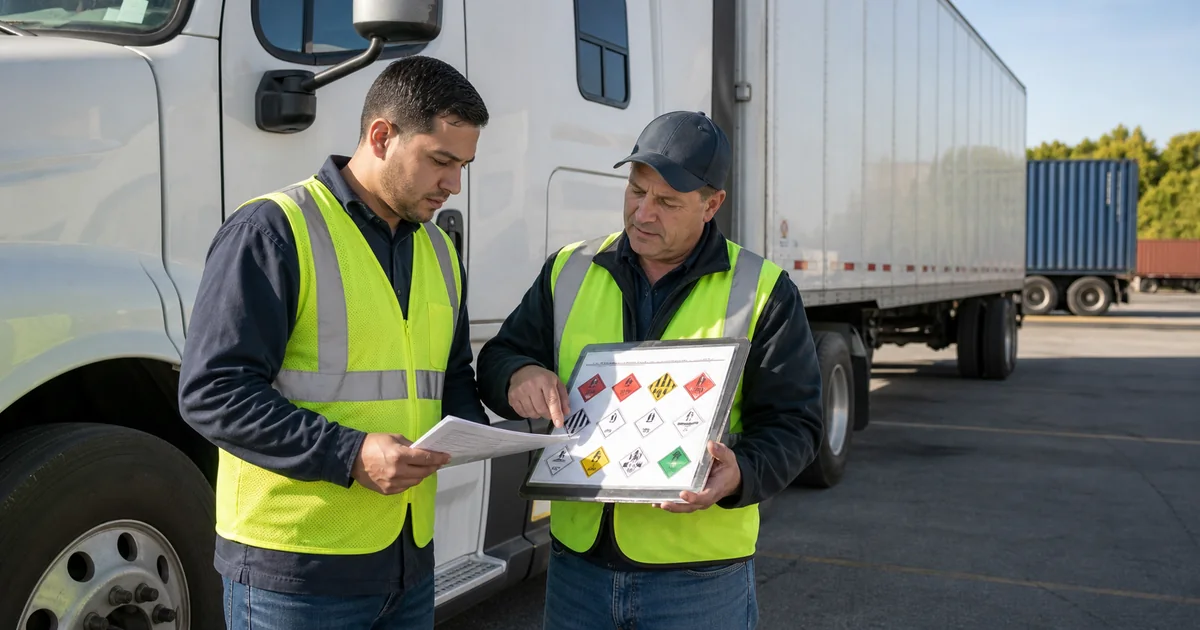
Use this free CDL HazMat practice test to review hazard classes, shipping papers, labels, placards, loading and segregation, safe driving, security, and emergency response. Each session gives you 30 different concepts from a 198-question bank, with immediate feedback and an explanation after every answer.
Quick answer
What is required for a CDL HazMat endorsement?
A driver seeking an H endorsement must meet state CDL requirements, pass the state hazardous-materials knowledge test, and receive a favorable TSA security threat assessment. First-time H endorsement applicants subject to FMCSA Entry-Level Driver Training must complete the HazMat theory curriculum through a provider listed on the Training Provider Registry before taking the knowledge test. State fees, test length, retake rules, and application order vary.
24 correct to pass practice
198-question bank
66 tested concepts
No sign up
CDL HazMat practice test
Start a 30-question HazMat test
Each session draws 30 different concepts from a 198-question bank. Review the endorsement process, hazard classes, shipping papers, placards, loading, driving rules, security, and emergency response.
Crawlable sample questions
12 HazMat questions to review
These examples remain visible without JavaScript. The interactive test randomizes answer order and selects no more than one question from each concept group in a session.
- What does the H endorsement authorize?Transport of hazardous material that requires placarding under federal rules.
- What does an X endorsement represent?A combined tank vehicle and hazardous-materials endorsement.
- What training applies to many first-time H endorsement applicants?HazMat ELDT theory training from a provider listed on FMCSA’s Training Provider Registry before the state knowledge test.
- Where must shipping papers be kept while driving?Within immediate reach while belted or in a pouch on the driver’s door.
- How many major hazard classes are there?Nine.
- When do nonbulk Table 2 materials generally require placards?At an aggregate gross weight of 1,001 pounds or more, subject to specific rules and exceptions.
- What is the standard placard shape?A square displayed on point, forming a diamond.
- What should a driver do with a leaking package?Refuse it and notify the proper shipper or carrier contact.
- How should HazMat packages be secured?Braced so they cannot fall, slide, or bounce during transportation.
- Where should a placarded vehicle stop at a railroad crossing when the stop rule applies?Between 15 and 50 feet from the nearest rail.
- What fire extinguisher is required on the power unit of a placarded vehicle?A 10 B:C rated extinguisher or greater.
- What is the first priority after discovering a dangerous leak?Park safely, secure the area, keep people away, and contact emergency authorities.
Application path
The HazMat endorsement process has three separate checks
The sequence differs by state, so begin with your state driver licensing agency. These three federal or state-administered parts are distinct and may overlap in timing.
- Complete applicable ELDT theory training. First-time H endorsement applicants who are subject to ELDT must use a training provider listed on FMCSA’s Training Provider Registry. The state verifies completion before administering the H knowledge test.
- Pass the state HazMat knowledge test. The exam is based on federal hazardous-materials principles and your state’s current CDL manual. This page uses a 30-question practice format and an 80% benchmark; your state’s live test length and retake policy may differ.
- Complete the TSA security threat assessment. The state cannot issue the H endorsement until TSA reports that the applicant does not pose a security threat. Enrollment, fingerprints, identity documents, fees, and timing should be verified through TSA and your state.
Important: A commercial learner’s permit holder may not transport hazardous material that requires placarding. Passing a practice test or completing ELDT does not itself authorize HazMat transport.
What to study
Nine areas covered in the 198-question bank
Endorsement process
H versus X, ELDT theory training, the TSA threat assessment, and the restriction on placarded HazMat for CLP holders.
Driver responsibilities
Shipment inspection, refusing leaks, securing cargo, checking placards, recurrent training, and keeping documents available.
Hazard classes
The nine federal classes and common examples for explosives, gases, flammable liquids, oxidizers, poisons, radioactive material, and corrosives.
Shipping papers
Basic descriptions, identification numbers, proper shipping names, packing groups, emergency information, and required paper locations.
Placards and markings
Table 1 and Table 2, DANGEROUS placards, inhalation hazards, bulk packages, labels, ID numbers, and four-side visibility.
Loading and segregation
Heat and smoking rules, package protection, incompatible materials, cylinders, poisons near food, nitric acid, cyanides, and radioactive separation.
Driving rules
Railroad crossings, route restrictions, open fires, fueling, extinguishers, smoking distance, and tire checks.
Emergencies
Leak priorities, incident communication, cargo fires, shipping information, and the Emergency Response Guidebook.
Security
Security awareness, suspicious activity, shipment information, attendance rules, safe havens, and required security plans.
Quick reference
The nine hazardous-material classes
| Class | Primary hazard | Common example | Study cue |
|---|---|---|---|
| 1 | Explosives | Fireworks or ammunition | Know divisions, placarding, parking, and attendance rules. |
| 2 | Gases | Propane, helium, toxic gas | Separate flammable, nonflammable, and poisonous gas divisions. |
| 3 | Flammable liquids | Gasoline | Review smoking, fueling, cargo heater, and placard rules. |
| 4 | Flammable solids | Matches or dangerous-when-wet material | Keep required materials dry and recognize spontaneous-combustion hazards. |
| 5 | Oxidizers and organic peroxides | Ammonium nitrate or peroxide | Oxidizers can intensify combustion and require careful segregation. |
| 6 | Toxic and infectious material | Pesticide or infectious substance | Study food segregation and poison-inhalation-hazard rules. |
| 7 | Radioactive | Uranium-containing package | Know labels, transport index, accumulation, and separation. |
| 8 | Corrosives | Battery acid | Keep breakable containers upright and segregate incompatible loads. |
| 9 | Miscellaneous | Material posing a transport hazard not in another class | Domestic Class 9 placarding differs from package marking requirements. |
Communication rules
Shipping papers, labels, markings, and placards do different jobs
| Method | Where it appears | What it communicates | Driver check |
|---|---|---|---|
| Shipping paper | Cab document location | Material identity, hazard class, ID number, quantity, and emergency contact information. | Keep it distinguishable, accessible, and paired with emergency response information. |
| Package label | Individual package | Primary and subsidiary hazards. | Confirm the label matches the shipping description and is near the proper shipping name. |
| Package marking | Package or bulk container | Proper shipping name, ID number, orientation, RQ, marine pollutant, or other required information. | Refuse damaged, leaking, or improperly marked packages. |
| Placard | Vehicle or freight container | Hazard warning visible to road users and responders. | Confirm the correct placard is attached on required sides, clean, visible, and readable. |
Weight thresholds are not the only placarding rule. Table 1 materials require specified placards in any quantity. Many nonbulk Table 2 loads use the 1,001-pound aggregate threshold. Inhalation hazards, bulk packages, mixed loads, and state or route rules can add requirements. Use current regulations and shipping papers for an actual load.
Safety decisions
Loading, driving, and emergency rules to connect
Before loading
Set the parking brake, inspect packages, keep heat and smoking away, avoid damaging hooks, and reject any leak or improper shipment.
During loading
Brace packages, protect valves, keep incompatible materials apart, position cylinders securely, and follow product-specific loading rules.
Before moving
Verify papers, emergency information, markings, placards, securement, doors, tires, fire extinguisher, and the planned HazMat route.
On the road
Follow route restrictions, stop at railroad crossings when required, avoid open fires, refuel with the engine off, and recheck tires when parked.
If a leak occurs
Protect people first. Park safely if possible, keep others away, avoid contact or inhalation, call emergency services, and provide the shipping description.
If cargo burns
Do not improvise. Move people away, contact trained responders, share shipping papers, and follow the ERG and carrier emergency plan.
Study plan
How to prepare without memorizing answer positions
- Take one 30-question baseline. Use the result screen to identify the categories you miss most often.
- Study the communication chain. Practice moving from shipping paper to package marking and label, then to the vehicle placard and emergency guide.
- Learn classes by hazard. Explain why each class creates a different loading, segregation, placarding, or emergency concern.
- Use short scenarios. Ask what changes when a load is bulk, mixed, leaking, an inhalation hazard, near food, or subject to a special route.
- Verify exact rules. Check your current state CDL manual and the applicable 49 CFR provisions before using a number or threshold on the job.
- Aim above the minimum. Score at least 90% on two fresh sessions before relying on practice results.
FAQ
CDL HazMat endorsement questions
How many questions are on the CDL HazMat test?
The number varies by state. This practice tool uses 30 questions per session from a 198-question bank. Confirm the current live test length and retake policy with your state driver licensing agency.
What score do I need to pass the HazMat knowledge test?
Federal CDL knowledge-test standards use an 80% minimum. On this 30-question practice session, that means at least 24 correct answers.
Do I need ELDT for a HazMat endorsement?
First-time H endorsement applicants who are subject to FMCSA’s ELDT rules must complete the HazMat theory curriculum through a registered training provider before the state knowledge test. Review FMCSA exceptions and your state process.
Is a TSA background check required for the H endorsement?
Yes. A state may not issue the endorsement until TSA completes the security threat assessment and determines the applicant does not pose a security threat.
Can I haul HazMat with a commercial learner’s permit?
No. A CLP holder may not transport hazardous material that requires placarding.
What is the difference between H and X endorsements?
H is the hazardous-materials endorsement. X combines hazardous materials with the tank vehicle endorsement.
Does this practice test copy real DMV questions?
No. The bank contains original US Permit Prep questions based on official federal rules and state CDL manual study topics. It does not reproduce a state’s live test.
Will every new test show the same questions?
No. A session draws 30 different concepts from 66 groups and randomizes answer order. Use New Test for another mix.
Official sources
Verify HazMat rules before testing or transporting
US Permit Prep is an independent study site and is not affiliated with FMCSA, TSA, PHMSA, any DMV, or any state licensing agency. Hazardous-material regulations and state procedures can change.
- FMCSA Entry-Level Driver Training requirements
- FMCSA Training Provider Registry
- TSA Hazardous Materials Endorsement threat assessment
- 49 CFR Part 172 – communication, placarding, training, and security plans
- 49 CFR Part 177 – carriage by public highway
- California DMV Commercial Driver Handbook – Section 9: Hazardous Materials
- Find your state CDL guide and official agency link
Next CDL steps