CDL tank vehicle endorsement
CDL Tanker Practice Test (2026)
July 27, 2026
Tank vehicle definitions, inspection steps, and safe-driving guidance were checked against current official CDL sources.
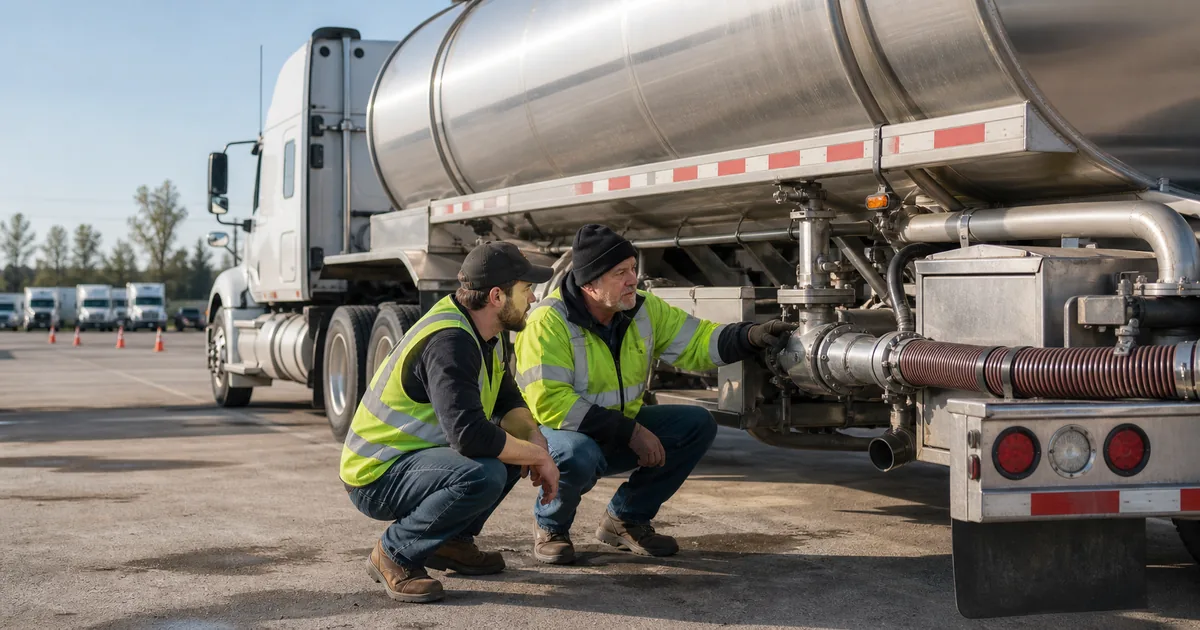
Use this free CDL Tanker practice test to study the N endorsement, tank definitions, leak inspections, valves and emergency equipment, high center of gravity, liquid surge, baffles, smooth-bore tanks, outage, loading weight, curves, stopping, and skids. Each session gives you 25 different concepts from a 174-question bank, with immediate feedback and an explanation after every answer.
Quick answer
Who needs a CDL tank vehicle endorsement?
A driver generally needs the N endorsement when operating a CDL-required vehicle that transports liquid or gas in qualifying tanks. Under the federal definition, the tanks include an individual rated capacity greater than 119 gallons and an aggregate rated capacity of 1,000 gallons or more. The cargo does not have to be hazardous. A driver hauling placarded hazardous material in a qualifying tank generally needs the combined X endorsement.
20 correct to pass practice
174-question bank
58 tested concepts
No sign up
CDL Tanker practice test
Start a 25-question Tanker test
Each session draws 25 different concepts from a 174-question bank. Review tank-vehicle definitions, inspections, outage, surge, tank design, loading, and safe tanker operation.
Crawlable sample questions
12 tanker questions to review
These examples remain visible without JavaScript. The interactive test randomizes answer order and selects no more than one question from each concept group during a session.
- What does the N endorsement cover?Qualifying commercial tank vehicles transporting liquid or gas.
- Does the cargo have to be hazardous?No. The tank configuration can require N even for nonhazardous liquid or gas.
- What is the combined tank and HazMat endorsement?X.
- What may a CLP holder with N operate?Only an empty tank vehicle; a former HazMat tank must also be purged of residue.
- What is the most important tank inspection item?Leaks.
- What is outage?Space left in the tank for liquid expansion.
- How do baffles affect surge?They reduce forward-and-back movement but do not eliminate side-to-side surge.
- What is a smooth-bore tanker?An unbaffled tank with strong forward-and-back liquid surge.
- Why can a partially filled tank be difficult to handle?The liquid has room to move and build surge.
- How should a tanker enter a curve?Slow before the curve and use smooth control through it.
- Can an empty tanker take longer to stop than a full tanker?Yes.
- What can abrupt steering while braking cause?A rollover.
License codes
N, X, and the CLP restriction are different
| Code | Meaning | Testing | Important limit |
|---|---|---|---|
| N | Tank vehicle endorsement | Specialized knowledge test | The correct CDL class is still required. |
| X | Tank vehicle plus hazardous materials | Tank and HazMat knowledge requirements | TSA and applicable HazMat requirements also apply. |
| N on a CLP | Tank vehicle learner authority | Subject to CLP supervision rules | The tank must be empty; a former HazMat tank must be purged. |
An endorsement does not upgrade the underlying CDL class. The driver must hold the Class A, B, or C qualification required by the vehicle. State testing appointments, fees, retakes, and card-issuance procedures vary.
Federal definition
Know when the tank vehicle definition applies
| Definition element | Federal benchmark | Study note |
|---|---|---|
| Material | Liquid or gaseous material | It does not have to be hazardous. |
| Individual tank | Rated capacity greater than 119 gallons | Read the rated capacity, not the amount currently loaded. |
| Aggregate tanks | Rated capacity of 1,000 gallons or more | Multiple qualifying tanks can be considered together. |
| Attachment | Permanently or temporarily attached | FMCSA guidance also addresses qualifying portable tanks and totes. |
| Hazardous cargo | Not required for N | Placarded HazMat in a qualifying tank generally requires X. |
Use the exact federal definition and your state CDL manual for a real vehicle. Rated tank capacity, configuration, cargo, CDL class, and whether HazMat rules apply all matter.
Before operation
Tank-specific inspection checklist
| Check | What to verify | Do not move when |
|---|---|---|
| Tank body or shell | No dents, damage, or leaks | Liquid or gas is leaking. |
| Valves | Intake, discharge, and cut-off valves are leak-free and correctly positioned | A required valve is open or defective. |
| Pipes and hoses | Connections and joints are secure and dry | A joint or hose is damaged or leaking. |
| Manhole covers | Gaskets are sound and covers close correctly | A cover is open or cannot seal. |
| Vents | Clear and able to operate as designed | A required vent is blocked or damaged. |
| Special equipment | Vapor recovery, grounding/bonding, emergency shutoff, and built-in extinguisher work when equipped | Required equipment is missing or inoperative. |
| Emergency equipment | Correct equipment is present and functional | The required equipment is unavailable. |
Do not carry liquid or gas in a leaking tank. Protect people, secure the area, and follow the carrier, shipper, and emergency reporting procedure appropriate to the cargo.
Tank behavior
Bulkheads, baffles, and smooth-bore tanks
| Design | Inside the tank | Handling effect | Driver focus |
|---|---|---|---|
| Compartmented with bulkheads | Solid dividers create separate compartments | Each compartment holds its own portion of the load | Distribute weight so front, rear, and axles are not overloaded. |
| Baffled | Dividers have openings that let liquid flow through | Forward-and-back surge is reduced; side surge remains | Use smooth turns and protect against rollover. |
| Smooth bore | No baffles slow the liquid | Strong forward-and-back surge | Be especially smooth while starting and stopping. |
Outage and loading weight
Never load a liquid cargo tank completely full. Liquids expand as temperature rises, and outage is the empty space left for that expansion. The safe load amount depends on the liquid’s expansion, density or weight, legal vehicle and axle limits, and load temperature. A dense product can reach the legal weight limit before the tank reaches its volume capacity.
Why partial loads need extra care
A partial load gives liquid room to move. The wave can push forward during braking, return after the vehicle stops, and move sideways during a turn. On a slippery surface, surge can even shove a stopped tanker into an intersection.
Safe operation
Connect surge control with rollover prevention
Start and stop smoothly
Use gradual throttle and brake well in advance. Keep steady brake pressure until the vehicle and liquid settle.
Slow before curves
Posted curve and ramp speeds may still be too fast for a tanker. Reduce speed before entry, then use smooth control through the curve.
Leave more space
Increase following distance so you can avoid hard braking. Wet roads can double normal stopping distance.
Respect the empty tanker
An empty tanker may have less traction and can take longer to stop than a loaded tanker.
Avoid abrupt steering
Quick steering while braking transfers force sideways and can roll a top-heavy vehicle.
Prevent skids
Do not oversteer, overaccelerate, or overbrake. If a skid begins, use the correct technique to restore wheel traction.
Study plan
How to prepare without memorizing answer positions
- Take one 25-question baseline.Use the result to find the categories you miss most.
- Learn the definition first.Separate the N endorsement, X endorsement, CDL class, and CLP empty-tank restriction.
- Walk through an inspection.Trace the shell, valves, pipes, hoses, manholes, vents, and special equipment.
- Draw the three tank designs.Explain solid bulkheads, baffles with holes, and smooth-bore tanks in your own words.
- Connect loading to handling.Practice explaining outage, density, legal weight, partial loads, surge, and high center of gravity.
- Verify your state process.Check the current state manual for the live test format, fee, retake rule, and application steps.
FAQ
CDL tanker endorsement questions
How many questions are on the CDL tanker endorsement test?
The live N endorsement test length is set by the state. This practice tool uses 25 questions per session and an 80% benchmark so you can cover a broad mix of concepts. Confirm the actual test format with your state licensing agency.
What score counts as passing on this practice test?
You need 20 correct answers out of 25, which is 80%. State knowledge-test scoring and retake procedures can differ.
Do I need a tanker endorsement to haul water or milk?
Possibly. The tank endorsement can apply to qualifying tanks even when the liquid is not hazardous. Tank capacities, aggregate capacity, attachment, vehicle class, and state rules must be checked.
What is the difference between N and X endorsements?
N is the tank vehicle endorsement. X combines tank vehicle and hazardous-materials authority. A qualifying tank carrying HazMat that requires the H endorsement generally requires X.
Does the tanker endorsement require ELDT?
The federal ELDT endorsement requirement specifically covers first-time H, P, and S endorsements, not N by itself. A driver may still need ELDT for a first Class A or Class B CDL, and X includes HazMat requirements.
Can I practice in a loaded tanker with an N endorsement on my CLP?
No. A CLP holder with N may operate only an empty tank vehicle while properly supervised. A tank that previously contained HazMat must also be purged of residue.
What is the difference between a baffled and smooth-bore tanker?
A baffled tank has dividers with openings that reduce front-to-back surge. A smooth-bore tank has no baffles, so liquid can move strongly during starts and stops.
Why can an empty tanker take longer to stop?
An empty tanker can have less tire traction than a loaded vehicle. Tank vehicles also remain top-heavy and require smooth speed and steering control.
Official sources
Verify tanker rules before testing or driving
US Permit Prep is an independent study resource. It is not a licensing agency, training provider, or motor carrier. Use these official pages for the controlling definitions and your current state process.
Next steps