CDL S endorsement
CDL School Bus Endorsement Practice Test (2026)
July 27, 2026
School bus danger zones, loading, unloading, railroad crossing, evacuation, student management, and endorsement rules were reviewed against current federal and official CDL sources.
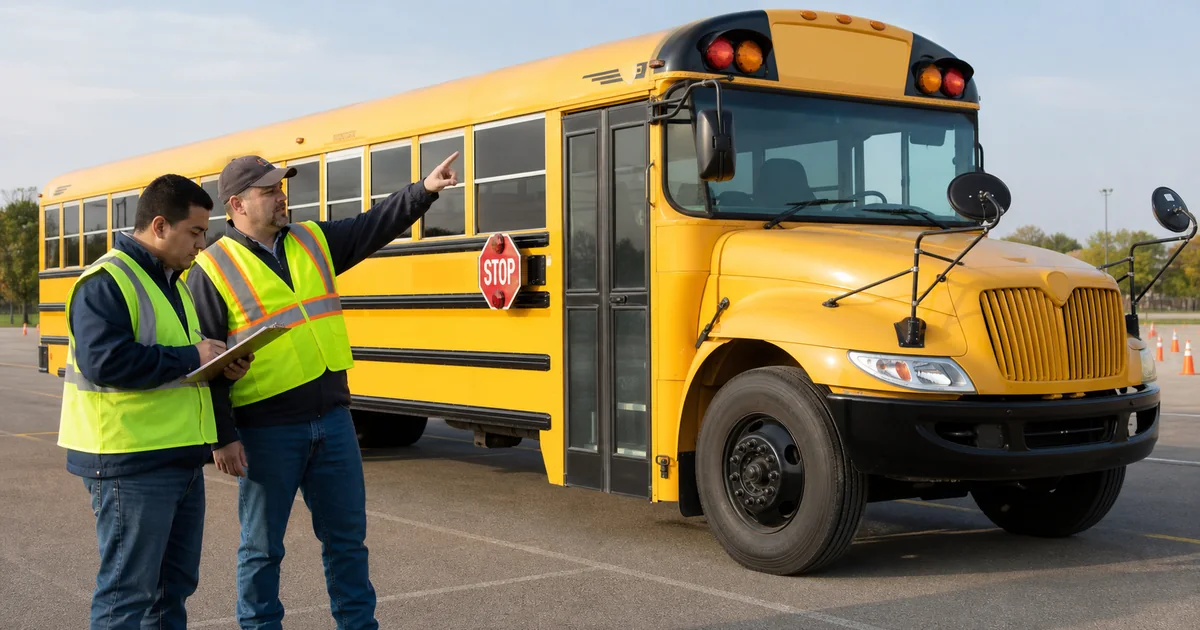
Use this free CDL School Bus endorsement practice test to study the S endorsement knowledge areas: danger zones, mirror use, student loading and unloading, emergency evacuation, railroad crossings, student management, backing, ABS, and special operating conditions. Every session gives you 20 different concepts from a 228-question bank, with immediate feedback and a plain-language explanation after each answer.
Quick answer
What do you need for a CDL School Bus endorsement?
A school bus driver generally needs the correct CDL class plus both Passenger (P) and School Bus (S) endorsements. The federal path includes knowledge and skills testing, and first-time S applicants are generally subject to Entry-Level Driver Training. States and school employers can add background checks, medical, training, and route-specific requirements.
16 correct to reach 80%
228 original question variants
76 unique concepts
CDL School Bus endorsement practice test
Start a 20-question School Bus endorsement test
Each session draws 20 different concepts from a 228-question bank. Review danger zones, mirror systems, loading and unloading, student crossings, evacuation, railroad crossings, student management, ABS, high winds, and backing.
Crawlable sample questions
12 School Bus endorsement questions to review
These examples stay visible without JavaScript. The interactive test selects no more than one prompt from each concept group during a session.
- Which endorsements are generally required to transport students in a school bus?Both Passenger (P) and School Bus (S), with the correct CDL class.
- What is the most dangerous area around a school bus?The danger zone surrounding the bus, especially the front, rear, and right side where children can disappear from view.
- What should a driver do if a student drops an object near the bus?The student should leave it and tell the driver; the driver must control when it is safe to retrieve.
- When should the alternating red warning lights be activated?As required by state procedure when the bus is stopped to load or unload students, after the advance amber warning sequence where used.
- What should the driver confirm before moving after a stop?Every student is seated or safely clear, mirrors show no one in a danger zone, doors are closed, and traffic conditions permit movement.
- May a school bus driver change an approved stop location without authorization?No. Follow the approved route and stop procedure unless the responsible authority directs a change.
- Where should a school bus generally stop at a railroad crossing?Between 15 and 50 feet from the nearest rail, unless an official exception applies.
- What is the purpose of a post-trip inspection?To check for sleeping or hidden students, belongings, damage, and safety or mechanical problems.
- When is backing a school bus acceptable?Only when necessary, with a clear path and proper assistance or procedure; avoid backing at student stops.
- What determines whether students should evacuate?Whether staying on the bus presents greater danger than moving to a safe location.
- How should a driver respond to serious student behavior while moving?Pull over safely, secure the bus, and address the behavior without trying to manage it while driving.
- Does ABS always shorten stopping distance?No. ABS helps maintain control and avoid wheel lock, but it does not guarantee a shorter stop.
Testing path
The School Bus endorsement builds on Passenger qualification
| Stage | What it covers | Important limit |
|---|---|---|
| Choose the CDL class | Match Class A, B, or C to the school bus weight and passenger configuration. | The S endorsement does not replace the correct CDL class. |
| Passenger qualification | Complete the Passenger knowledge and skills requirements for the vehicle group. | School bus transportation generally requires both P and S. |
| School Bus knowledge | Danger zones, mirrors, loading, unloading, student management, evacuation, railroads, and special operation. | Live question count and retake rules vary by state. |
| Complete ELDT | First-time School Bus applicants generally use a federally registered training provider. | Required training must be reported before the skills test when ELDT applies. |
| Practice with a CLP | Operate under a properly licensed, classed, and endorsed supervisor. | Ordinary student passengers are not permitted during CLP practice. |
| Pass skills testing | Complete vehicle inspection, basic control, and road testing in a representative school bus. | State and employer qualification steps can continue after licensing. |
Do not study the S endorsement as a replacement for Passenger knowledge. Start with the CDL Passenger endorsement practice test, then use this tool for school-bus-specific procedures.
Danger zones and mirrors
Know where students can disappear from view
Front danger zone
Students crossing in front must remain far enough ahead to be visible. The driver should establish eye contact and use the approved signal before they cross.
Right-side danger zone
The loading-door side is especially risky because students may be close to the bus, wheels, or curb while boarding and unloading.
Rear danger zone
Never allow students to walk behind the bus. The rear is difficult to see and exposes them to backing and passing traffic hazards.
Left-side traffic area
Use flat and convex mirrors to monitor approaching vehicles, but do not let mirror checks replace direct observation and the approved crossing procedure.
Mirror adjustment
Adjust mirrors before the route so they show the sides, rear tires, traffic lanes, and required danger-zone areas without large blind spots.
Dropped objects
A child should never bend down near the bus to retrieve an item. The child tells the driver, who controls when and how retrieval happens.
Exact student crossing distances, hand signals, mirror checks, warning-light timing, and stop-arm use can differ. Treat the figures in a model CDL manual as a study baseline and follow your state manual, district policy, and route training.
Loading and unloading
Use the same controlled sequence at every approved stop
- Approach with time to observe.Scan students, traffic, escape space, and the stop location. Activate the required advance warning system at the point specified by state procedure.
- Stop in the correct position.Secure the bus as required, maintain control of traffic, and open the entrance door only when the stop is protected and students can move safely.
- Monitor every danger zone.Use flat, convex, and crossover mirrors in a deliberate sequence. Count students when practical and know where each child went.
- Control crossing students.Students should wait for the driver’s approved signal, walk far enough ahead to remain visible, and check traffic before entering the roadway.
- Close the stop only after a final check.Confirm students are seated or safely away, no one is near the wheels or body, the roadway is clear, and all warning equipment can be canceled in the correct order.
| Risk | Correct response | Do not |
|---|---|---|
| Student is missing from view | Keep the bus secured and locate the student before moving. | Assume the child has cleared the bus. |
| Motorist passes the stop arm | Keep students out of the roadway, record details only if safe, and follow reporting policy. | Wave children across into moving traffic or chase the vehicle. |
| Student drops an item | Instruct the student to leave it and communicate with the driver. | Let the student crawl near or under the bus. |
| Stop location is obstructed | Follow dispatch or district procedure for a safe authorized response. | Invent a new loading point without approval. |
| Backing is requested | Avoid it when possible; use the approved spotter and backing procedure if unavoidable. | Back while students are outside near the bus. |
Emergency planning
Decide whether the bus or the outside location is safer
Evacuation is not automatic after every breakdown. The driver compares the immediate danger inside or around the bus with the hazards students would face outside. Fire, smoke, fuel leakage, an unsafe railroad position, or an exposed crash location can make evacuation urgent.
Choose the exit
Select the front, rear, side, roof, or combination of exits that leads students away from traffic, fire, tracks, water, and other hazards.
Secure and communicate
Set the parking brake, shut down as conditions require, activate hazards, contact dispatch or emergency services, and give concise commands.
Use helpers carefully
Assign capable students only when appropriate, place helpers where they can assist safely, and keep control of the evacuation order.
Move to a safe area
Take students to the safe distance and direction required by the emergency and local plan, then account for everyone.
Do not re-enter casually
Once evacuated, keep students together and away from the bus until emergency personnel or the responsible authority says it is safe.
Practice before an emergency
Know the bus exits, release handles, extinguisher, first-aid equipment, communication system, and district evacuation plan.
Railroads and special operation
Protect the bus where recovery space is limited
| Situation | Core study rule | Verify locally |
|---|---|---|
| Railroad crossing | When a stop is required, stop 15 to 50 feet from the nearest rail, silence distractions, look and listen, and cross only when there is enough room to clear fully. | Exempt crossings, door/window procedure, gear use, and local route directions. |
| Traffic containment | Do not enter a crossing unless the bus can clear the far rail without stopping. Account for the full bus length and a safety margin. | State manual measurements and employer route plan. |
| ABS braking | Brake normally for the conditions; ABS helps retain steering control during hard braking but does not erase stopping distance. | Vehicle-specific warning lamps and brake-system procedure. |
| High winds | Reduce speed, maintain steering control, increase space, and stop in a safe place if control becomes uncertain. | Employer wind thresholds and road closures. |
| Student behavior | Set expectations before moving. If behavior threatens safety, stop and secure the bus before intervening. | District discipline and communication policy. |
| Post-trip | Walk the interior, inspect seats and floor areas, check for students and belongings, and report defects. | Required alarm, sign-off, and child-check procedure. |
Study plan
Turn each missed question into a physical procedure
- Pass a Passenger baseline first.The S endorsement adds school-bus-specific duties; it does not remove the P endorsement knowledge and vehicle skills.
- Take one 20-question School Bus session.Use the weak-topic result to choose one section of your official manual instead of rereading everything.
- Walk the danger zones with an instructor.Stand where a child might be hidden and verify what each mirror can and cannot show.
- Say the loading sequence aloud.Rehearse warning lights, position, securement, mirrors, student crossing, final sweep, and departure in the order your state requires.
- Practice evacuation and railroad decisions.Use scenarios rather than memorizing a single sentence. Explain why the chosen action reduces the immediate risk.
- Retake with a new mix.Aim above 80% in several sessions, then verify your state’s manual, application, background, medical, and skills-test requirements.
FAQ
CDL School Bus endorsement questions
How many questions are on the CDL School Bus endorsement test?
The live S endorsement test length varies by state. This tool uses 20 questions per session from a 228-question bank. Verify the current format with your state licensing agency.
What score counts as passing here?
The practice benchmark is 80%, or at least 16 correct answers out of 20.
Does the School Bus endorsement require a skills test?
Yes. Federal standards require School Bus knowledge and skills testing in addition to Passenger endorsement requirements.
Do school bus drivers need both P and S endorsements?
Generally yes when transporting school students in a school bus for school routes or events. The driver also needs the correct CDL class.
Is Entry-Level Driver Training required?
A first-time School Bus endorsement applicant is generally subject to federal ELDT requirements.
Can a School Bus CLP holder carry students?
No. Ordinary student passengers are not permitted during CLP practice. Only specifically authorized people and the supervising CDL holder may ride under the federal restriction.
Are all school bus stop rules identical in every state?
No. Use the federal and model-manual concepts as a baseline, then follow your state manual, school district procedures, and route training.
Does this replace the official CDL manual?
No. Use it to locate weak areas, then verify every final procedure and state rule in your official CDL manual.
Official sources
Verify School Bus rules before testing or driving
US Permit Prep is an independent study resource and is not a licensing or school transportation agency. State applications, criminal-history checks, medical standards, training, live test length, stop procedures, and employer qualifications can change.
- FMCSA CDL endorsements, CLP limits, and restrictions
- FMCSA Entry-Level Driver Training requirements
- 49 CFR 383.123 School Bus endorsement requirements
- FMCSA: When both Passenger and School Bus endorsements are required
- California CDL handbook Section 10: School Buses
- New York State Commercial Driver’s Manual
- Find your official state CDL source
Next steps