CDL P endorsement
CDL Passenger Endorsement Practice Test (2026)
July 27, 2026
Passenger endorsement testing, inspection, loading, railroad crossing, emergency, and operating topics were reviewed against current federal and official CDL sources.
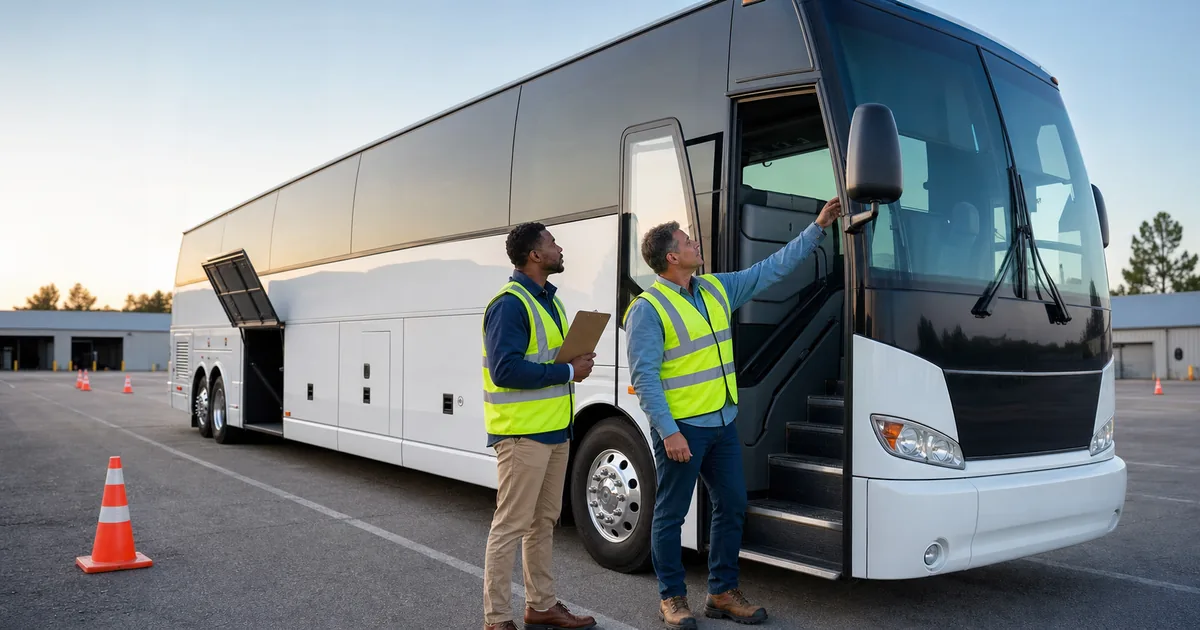
Use this free CDL Passenger endorsement practice test to study the P endorsement knowledge areas: vehicle inspection, boarding and unloading, baggage, passenger management, prohibited practices, railroad crossings, drawbridges, emergency procedures, and safe bus operation. Every session gives you 20 different concepts from a 204-question bank, followed by immediate feedback and a clear explanation.
Quick answer
What is required for a CDL Passenger endorsement?
The federal P endorsement path includes a Passenger knowledge test and a skills test in a representative passenger vehicle. First-time P applicants are generally subject to Entry-Level Driver Training. State application steps, test length, fees, and retake rules still vary.
16 correct to reach 80%
204 original question variants
68 unique concepts
CDL Passenger endorsement practice test
Start a 20-question Passenger endorsement test
Each session draws 20 different concepts from a 204-question bank. Review inspections, boarding and unloading, passenger management, prohibited practices, railroad crossings, drawbridges, emergencies, and safe bus operation.
Crawlable sample questions
12 Passenger endorsement questions to review
These examples remain visible without JavaScript. The interactive tool selects no more than one prompt from each concept group during a session.
- What tests are generally required for the P endorsement?A Passenger knowledge test and a Passenger skills test.
- Which passengers may normally ride with a P-endorsed CLP holder during practice?Authorized examiners, auditors or inspectors, other trainees, and the supervising CDL holder.
- Where must carry-on baggage be placed?Where it cannot block aisles, doors, steps, or emergency exits.
- May a driver fuel a passenger vehicle with riders aboard?Avoid it unless absolutely necessary, and never refuel in a closed building with passengers aboard.
- What does the standee line show?The forward limit beyond which passengers may not stand.
- Where should emergency equipment be checked?During the pre-trip inspection before carrying passengers.
- How far from railroad tracks should a bus generally stop?Between 15 and 50 feet from the nearest rail when a stop is required.
- How close may a bus approach a drawbridge without a signal or attendant control?It should stop at least 50 feet before the draw unless an exception applies.
- When may a driver open the passenger entry door while moving?Never. The door should remain closed while the vehicle is moving.
- What should the driver do before moving after boarding?Ensure riders are seated or behind the standee line, doors are closed, and the path is clear.
- Can hazardous materials be carried in a passenger compartment?Only limited materials under applicable rules; many hazardous materials are prohibited.
- What vehicle should be used for the Passenger skills test?A passenger vehicle representative of the group the applicant intends to operate.
Testing path
Know the P endorsement steps and restrictions
| Stage | What it covers | Important limit |
|---|---|---|
| Choose the CDL class | Match Class A, B, or C to the vehicle weight and passenger configuration. | The P endorsement does not replace the correct CDL class. |
| Pass Passenger knowledge | Inspection, passengers, baggage, prohibited practices, emergencies, railroads, drawbridges, and safe operation. | Live question count and retake rules vary by state. |
| Complete ELDT | First-time Passenger applicants generally use a registered training provider. | Training must be reported before the skills test when ELDT applies. |
| Practice with a CLP | Operate under a properly licensed and endorsed supervisor. | Ordinary passengers are not permitted during CLP practice. |
| Pass the skills test | Pre-trip, basic control, and road skills in a representative passenger vehicle. | Testing in a limited vehicle can create M or N restrictions. |
| Complete state issuance | Pay fees and submit required documents to the licensing agency. | State processing, medical, and renewal rules still apply. |
Pre-trip inspection
Inspect the bus as a passenger-carrying system
Emergency exits
Check doors, roof hatches, windows, release handles, warning devices, and required markings.
Passenger entry
Verify steps, handrails, lighting, tread condition, door controls, and clear entry space.
Seats and restraints
Confirm seats are secure and required driver or passenger restraints work properly.
Aisles and standee line
Keep aisles and exits clear; standing riders must remain behind the marked limit.
Emergency equipment
Check fire extinguishers, reflective warning devices, and any additional equipment required by the vehicle or state.
Exterior and brakes
Inspect tires, wheels, lights, mirrors, steering, suspension, service brakes, and parking brakes.
Loading and passengers
Protect aisles, exits, riders, and baggage
| Situation | Safe practice | Avoid |
|---|---|---|
| Boarding | Secure the vehicle, watch the doorway, count riders when needed, and wait until boarding is complete. | Moving while a rider is entering, exiting, or standing in front of the standee line. |
| Baggage | Secure baggage so it cannot shift and keep every aisle, doorway, stairwell, and emergency exit clear. | Loose items that can strike riders or block evacuation. |
| Passenger conduct | Give safety instructions, enforce seating or standing limits, and stop safely if behavior becomes dangerous. | Arguing while driving or allowing riders to distract the driver. |
| Hazardous materials | Know what limited materials are permitted and where they may be carried under the rules. | Forbidden explosives, gases, poisons, or improperly packaged and labeled material. |
| Unloading | Stop in a safe location, secure the vehicle, monitor traffic, and confirm riders are clear before moving. | Opening the door while moving or pulling away before the exit area is clear. |
Road operation
Drive for passenger comfort and emergency margin
- Accelerate and brake smoothly.Standing and seated passengers can be injured by abrupt movement even without a collision.
- Use extra following distance.A heavy passenger vehicle needs space for controlled stops and changing traffic.
- Scan stops and clearance.Watch mirrors, curbs, overhangs, pedestrians, bicycles, and the rear swing of the bus.
- Handle railroad crossings correctly.When a stop is required, stop 15 to 50 feet from the nearest rail, open the door or window as required to listen, and cross only when safe.
- Approach drawbridges cautiously.Without a traffic signal or attendant control, stop at least 50 feet before the draw and confirm it is completely closed.
- Keep the door closed in motion.Do not use the door as a braking aid or drive with it open.
- Plan emergencies before departure.Know evacuation exits, extinguisher location, communication procedure, and a safe place to stop.
Study plan
Study by procedure, not memorized answer position
- Take a 20-question baseline.Use your result to identify the category costing you the most points.
- Walk a real passenger vehicle.With a qualified instructor, locate every emergency exit, door control, extinguisher, step, handrail, and standee line.
- Practice the loading sequence.Rehearse vehicle securement, boarding, baggage, doors, mirrors, and the final departure check.
- Rehearse rail and drawbridge steps.Write the stopping distances and observation sequence from your official manual.
- Retake with a new mix.Aim above 80% across several sessions, then verify your state’s live test format and appointment requirements.
FAQ
CDL Passenger endorsement questions
How many questions are on the Passenger endorsement test?
The live P endorsement test length varies by state. This tool uses 20 questions per session from a 204-question bank. Verify the current format with your state licensing agency.
What score counts as passing here?
The practice benchmark is 80%, or at least 16 correct answers out of 20.
Does the P endorsement require a skills test?
Yes. Federal standards require both knowledge and skills testing for the Passenger endorsement.
Is Entry-Level Driver Training required?
A driver obtaining the Passenger endorsement for the first time is generally subject to federal ELDT requirements.
Is Passenger the same as School Bus?
No. A school bus driver generally needs both P and S endorsements and must meet additional federal and state requirements.
Can a Passenger CLP holder carry ordinary passengers?
No. Passenger CLP practice is limited to the supervising CDL holder and specific authorized people such as examiners, auditors, inspectors, or other trainees.
Do buses require Air Brakes testing?
Many do. Complete the air-brake knowledge and skills requirements for the vehicle you will drive so an air-brake restriction is not added when it applies.
Does this replace the official CDL manual?
No. Use this page to find weak areas, then verify every procedure and state rule in your official CDL manual.
Official sources
Verify Passenger endorsement rules before testing
US Permit Prep is an independent study resource. Test length, fees, skills-test scheduling, vehicle requirements, and retake rules can change. Verify final instructions with your state licensing agency and training provider.
Next steps