Quick answer
What should parents do when a teen gets a learner permit?
Verify the state licensing path, prepare the permit appointment, read every restriction, plan varied supervised practice, keep an accurate driving log, and use a written family driving agreement through the learner and provisional stages.
- Treat required practice hours as a minimum, not a complete driving curriculum.
- Use the official state source for supervisor, passenger, night, education, and holding-period rules.
- Call the vehicle insurer when the permit is issued and confirm how learner coverage works.
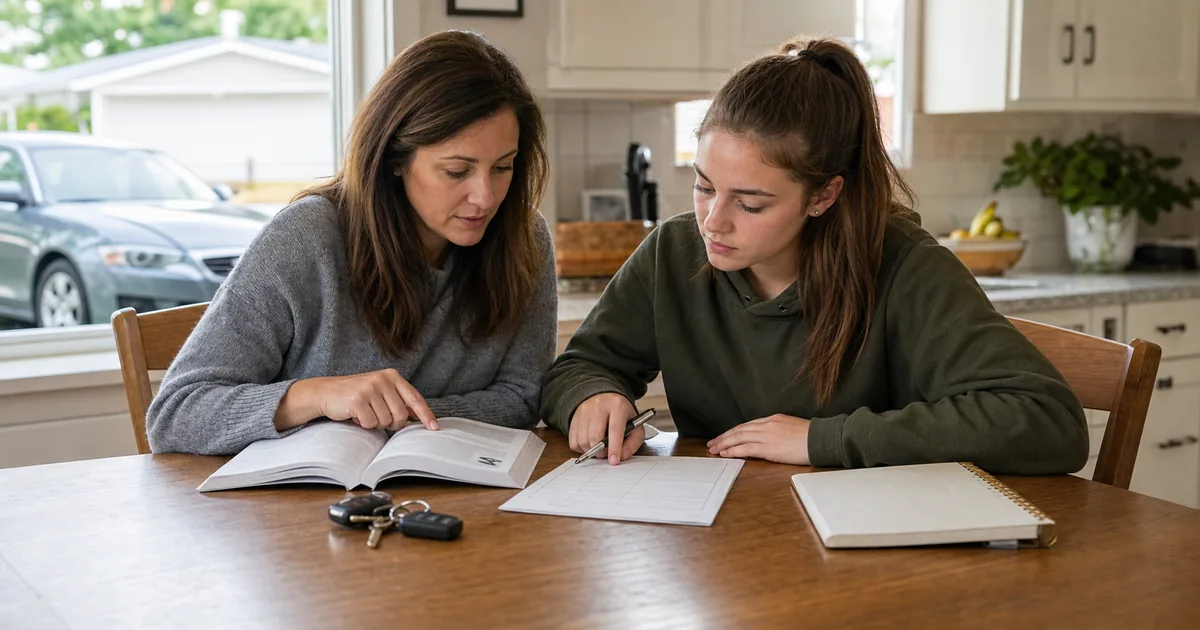
A parent’s role in a teen learner permit does not end at the DMV counter. Before the appointment, you may need to confirm driver education, sign an application, gather accepted documents, and understand financial-responsibility rules. After the permit is issued, your larger job begins: provide calm, varied supervised practice and help your teen follow every restriction printed on the permit.
Every state runs its own graduated driver licensing program. Ages, permit holding periods, required practice hours, supervisor qualifications, passenger limits, and nighttime restrictions differ. Use this guide as a parent workflow, then verify the final rule on your state licensing agency’s website.
Parent planning note
Treat the permit as a supervised training stage
A learner permit is not a small version of a full license. It authorizes practice only under the conditions set by the issuing state. Read the permit, official teen-driver page, driving log, and insurance policy before the first session.
Your role in the three graduated licensing stages
The National Highway Traffic Safety Administration describes graduated driver licensing as a three-stage system: a learner stage with supervised driving, an intermediate stage with some unsupervised driving and restrictions, and full licensure. The names differ by state, but the parent responsibilities are similar.
1. Learner stage
Confirm who may supervise, where and when the teen may drive, whether passengers are allowed, and how practice must be logged. Build skill gradually instead of racing to complete hours.
2. Intermediate stage
After the road test, enforce nighttime, passenger, phone, seat-belt, and vehicle-use rules. A passed test does not remove the elevated risk that comes with inexperience.
3. Full license stage
Keep household rules for distraction, impaired driving, passengers, check-ins, and vehicle care even after state restrictions lift.
The CDC highlights several danger zones for teen drivers, including inexperience, teen passengers, nighttime driving, not using seat belts, distraction, drowsiness, reckless driving, and impairment. A good family plan addresses those risks directly instead of relying on one lecture before the road test.
Before the learner permit appointment
Separate the licensing paperwork from the knowledge-test study plan. A teen can know the handbook and still be turned away because a document, consent form, course record, or payment method is missing.
| Parent check | What to confirm | Useful site tool |
|---|---|---|
| Eligibility | Minimum age, school or driver-education requirement, application path, and whether an appointment is required. | State requirements |
| Identity and residency | Original or certified identity proof, Social Security or status proof, residency documents, and name-change records. | Document checklist |
| Parent participation | Who must sign, whether the signer must attend, custody or guardianship proof, and financial-responsibility language. | What to bring |
| Testing | Knowledge-test delivery, passing score, vision screening, language options, and retake rules. | 10-question drill |
| Payment | Permit fee, accepted payment method, card convenience fees, and whether the fee covers retesting. | DMV fee guide |
Do not sign a form you have not read. A parent or guardian signature can include consent and financial-responsibility commitments. If custody, guardianship, residency, or identity documents are unusual, call the licensing office before the visit rather than hoping the counter will accept an alternative.
Teen permit rules: eight state planning examples
The examples below show why parents must check the exact state. They are planning summaries reviewed in July 2026, not permission to drive. Follow the linked official agency and the conditions printed on the permit.
| State | Learner age | Minimum hold | Supervised practice | Parent action |
|---|---|---|---|---|
| California | 15 years, 6 months | 6 months | 50 hours, including 10 at night | Check driver education, permit validation, 25-or-older supervisor rules, and the signed practice certification. California DMV |
| Texas | 15 | 6 months | 30 hours, including 10 at night | Confirm the approved education path, learner restrictions, driving log, and provisional-stage limits. Texas DPS |
| Florida | 15 | 12 months | 50 hours, including 10 at night | Track the full 12-month learner period and age-based nighttime restrictions before licensing. FLHSMV |
| Georgia | 15 | 12 months | 40 hours, including 6 at night | Review Joshua’s Law education choices and the staged passenger restrictions that follow licensing. Georgia DDS |
| Illinois | 15 | 9 months | 50 hours, including 10 at night | Keep the practice log and review the nighttime and passenger limits in the graduated licensing program. Illinois Secretary of State |
| Michigan | 14 years, 9 months | 6 months | 50 hours, including 10 at night | Follow the segment-based education and Level 1 licensing sequence; do not treat age alone as road-test eligibility. Michigan SOS |
| New Jersey | 16 | 6 months | 50 hours, including 10 at night | Check the permit type, supervising-driver rule, red decal requirement, and passenger/night limits. New Jersey MVC |
| Pennsylvania | 16 | 6 months | 65 hours, including 10 at night and 5 in poor weather | Use the official certification and record night and inclement-weather experience separately. PennDOT |
For the next license stage, compare current provisional license restrictions by state. Restrictions can continue after the teen passes a road test.
The first 10 supervised driving sessions
Required hours are a floor, not a complete curriculum. Ten identical trips on familiar roads do not prepare a new driver for intersections, rain, night visibility, merging, or unfamiliar routes. Progress only when the current skill is calm and repeatable.
Vehicle setup and controls
In an empty, legal practice area, adjust the seat and mirrors; locate lights, wipers, hazards, defroster, parking brake, and gear controls; then practice smooth starts and stops.
Quiet residential streets
Work on lane position, speed control, complete stops, scanning parked cars, and choosing safe gaps at simple intersections.
Turns and right-of-way
Practice signals, correct turning lanes, crosswalk scans, four-way stop order, yielding, and checking for bicycles and motorcycles.
Backing and parking
Use direct observation as well as mirrors. Practice straight backing, perpendicular parking, angle parking, and curb approach before parallel parking.
Moderate traffic
Add traffic lights, multiple lanes, speed changes, buses, pedestrians, and more frequent decisions without rushing instructions.
Lane changes and merging
Teach the full sequence: mirrors, signal, blind-spot check, gap choice, speed match, smooth movement, and signal cancellation.
Night practice
Only when legal and with a qualified supervisor, practice headlight use, speed adjustment, glare management, pedestrian detection, and longer stopping margins.
Rain or reduced traction
Choose mild conditions, not a storm. Practice greater following distance, gentle braking, clear windows, wiper use, and knowing when conditions are too poor to continue.
Higher-speed roads
When legal and the teen is ready, practice entrance planning, speed matching, safe following distance, exits, and avoiding last-second lane changes.
Independent mock drive
Give destination-style directions instead of coaching every movement. Record repeated errors, then schedule targeted practice rather than immediately booking the road test.
Use the stage-by-stage learner practice guide for a deeper skill sequence and the supervised driving hours guide for state hour examples.
How to coach without adding stress
- Give one short instruction at a time. “At the next safe opening, move to the right lane” is easier to process than a running list of mistakes.
- Use the same words for the same action. Consistent cues for mirrors, signal, blind spot, speed, and lane position reduce confusion.
- Choose the route before moving. Match traffic complexity to the skill being practiced and keep an easy pull-over option.
- Correct urgent risks immediately. Save non-urgent feedback for a safe stop or the end of the session.
- End before either person is overloaded. A focused 30-minute session can teach more than a tense two-hour drive.
- Model the standard yourself. Seat belts, phone use, speed, signals, patience, and safe gaps are learned by watching adults too.
Two-minute debrief
Finish every session with three questions
- What felt easier today?
- What decision felt uncertain?
- What one skill should we repeat next time?
Write the answer in the driving log while the session is fresh. This turns hours into a useful record of progress instead of a mileage total.
Build a parent-teen driving agreement
NHTSA and CDC both encourage parents to set clear expectations. A written agreement works best when it is specific, discussed in advance, and stricter than the law where the family believes extra limits are needed.
Always
Everyone wears a seat belt; the phone stays out of reach; the driver follows permit restrictions; and the teen tells the parent where, when, and with whom the vehicle will be used.
Never
No impaired driving, racing, aggressive driving, unauthorized passengers, driving while exhausted, or driving a vehicle that has a safety problem.
Call without fear
Create a plan for the teen to call for a safe ride if a driver is impaired, the vehicle becomes unsafe, weather worsens, or the situation changes.
Consequences
Agree on proportionate consequences before a rule is broken. Safety rules should not change during an argument.
Track supervised hours correctly
Use the form required by your state when one exists. A home spreadsheet or app can be useful, but it may not replace an official certification.
For every session, record:
- date, start time, end time, and total duration;
- day or night status;
- weather and road type;
- skills practiced;
- supervisor name and license information when required; and
- one skill to repeat next time.
Do not invent hours or sign a log you did not supervise. Apart from the legal problem, false hours can place a teen on the road without experience in the exact situations the log was designed to cover.
Vehicle and insurance checks before practice
Call your insurer when the permit is issued and ask how the policy treats a learner. Some insurers want notification at the permit stage; others formally add the teen after licensing. Do not assume coverage from a general internet answer, and do not wait until after a crash to read the policy.
Choose a predictable vehicle with working safety equipment. Before practice, check tires, lights, signals, mirrors, windshield visibility, brakes, seat belts, fuel or charge, and registration or insurance documents. Avoid starting in the household’s largest, fastest, or least familiar vehicle merely because it is available.
Our permit-driver insurance guide explains questions to ask without recommending an insurer. Before the road test, use the road-test vehicle requirements guide.
How to tell whether your teen is road-test ready
Completing the minimum hold and practice hours creates eligibility; it does not automatically create readiness. Book the road test when the teen can perform the following without repeated prompts:
- sets the seat and mirrors and fastens the seat belt before moving;
- maintains lane position and an appropriate speed;
- makes complete stops and yields correctly;
- checks mirrors and blind spots before changing lanes;
- scans intersections, crosswalks, parked cars, bicycles, and motorcycles;
- backs and parks with control;
- responds safely when a route or traffic condition changes;
- recognizes a mistake and recovers without panic; and
- completes several varied drives without the supervisor touching controls or giving urgent corrections.
Use the permit readiness tool for study and DMV-day planning, then use the separate behind-the-wheel checklist for the road test.
Common mistakes parents can avoid
- Counting hours instead of experiences. Include night, rain, parking, intersections, unfamiliar routes, and higher-speed roads when legal and appropriate.
- Giving directions too late. New drivers need time to scan, decide, signal, and act safely.
- Practicing only with one adult. A second qualified adult can help when schedules, communication styles, or certain skills become a barrier.
- Arguing while the vehicle is moving. Pull over safely, reset, and continue only when both people can focus.
- Relaxing rules after the road test. Intermediate-license passenger and night restrictions are part of the safety system, not optional family suggestions.
- Using outdated summaries. Verify the official state source before appointments, road tests, interstate travel, and each license-stage change.
Parent questions about teen learner permits
Does a parent have to attend the learner permit appointment?
It depends on the state, age, application method, and who may sign consent or financial-responsibility documents. Confirm whether the signer must appear in person and what custody or guardianship proof is accepted.
Who can supervise a teen with a learner permit?
States specify the supervisor’s minimum age, license status, experience, seating position, and sometimes relationship to the learner. Do not assume any adult with a license qualifies.
Can a teen drive siblings while holding a permit?
Only if the permit and state rules allow those passengers while the required supervisor is present. Passenger rules can differ between learner and provisional stages, and some states have family exceptions.
Does driver education replace parent-supervised practice?
Usually not. Driver education and professional behind-the-wheel lessons may satisfy part of a state program, but many teen paths still require a separate number of supervised hours certified by a parent, guardian, or qualified adult.
Do I need to add my teen to car insurance at the permit stage?
Insurer rules and state insurance requirements vary. Call the company that covers the practice vehicle when the permit is issued and ask when notification or formal addition is required.
Do supervised driving hours expire?
The answer depends on the permit, application, training record, and state process. Keep the original driving log and permit issue date, and ask the agency whether prior hours remain valid after expiration, replacement, renewal, or reapplication.
Can a learner practice in another state?
Do not assume so. The issuing state controls the permit, but the state where the teen drives may have recognition, age, supervisor, or restriction rules. Check both official agencies before crossing state lines.
What if a parent is too nervous to supervise?
Use a qualified driving instructor for difficult skills and ask another legally qualified, calm adult to help with permitted practice. A parent can still manage documents, logs, agreements, and progress without being the only supervisor.
Editorial check
Official sources and review note
This parent guide combines national teen-driving safety guidance with selected official state licensing examples. Ages, documents, course rules, supervisor qualifications, practice hours, restrictions, and insurance procedures can change, so verify the final path with the issuing agency and your insurer.
After the permit test
After you pass, here's what comes next
Passing the written permit test starts the supervised-driving stage. Use the After Permit guide to plan restrictions, driving hours, road-test practice, insurance questions, and the next steps toward a full license.
After you pass, here's what comes next →